 Okoora TeamOkoora
Every day, billions of dollars move across borders. From suppliers in Shanghai to clients in Berlin. From startups in Tel Aviv to banks in New York. Behind the scenes of this global motion sits an often-misunderstood layer of financial plumbing: FX (foreign exchange) infrastructure.
It doesn’t show up in your banking app. You won’t see it mentioned in a typical product release. But it’s working constantly – assessing risk, routing trades, managing liquidity, and protecting value across currencies.
For businesses operating internationally, FX infrastructure is what turns chaos into control. It’s the difference between stable margins and surprise losses. And yet, most people have no idea how it works.
This post unpacks the system behind the system. What FX infrastructure actually does. And why it’s quickly becoming one of the most critical components of modern finance.
Whether you’re a finance leader, a product builder, or just a curious mind, this is your guide to understanding the invisible engine powering global money movement.
Why FX infrastructure exists in the first place
Global business runs on international money movements. But when money crosses borders, it doesn’t just move, it transforms. Exchange rates shift, margins shrink, and financial clarity fades.
Currencies don’t stand still. They react to interest rate changes, inflation data, elections, and even headlines. For businesses operating internationally, that means ongoing financial exposure, often invisible until it shows up on the bottom line.
Let’s make it real:
A European manufacturer pays a U.S. supplier in dollars. Between invoice and settlement, the euro weakens. What started as a planned expense becomes a surprise cost.
A SaaS company bills clients worldwide. Even if revenue stays steady, exchange rate fluctuations mean earnings in local currency swing month to month.
A payment platform helps users send money across borders but has no protection in place for the FX exposure created between conversion and delivery.
These situations aren’t rare or theoretical. They happen every day, and they chip away at profit, predictability, and financial control.
FX infrastructure exists to change that.
It embeds protection into the flow itself. It turns volatility into something manageable. And it does this quietly, behind the scenes, without requiring businesses to become FX experts.
It’s not about building dashboards or hiring specialists. It’s about creating infrastructure that absorbs the complexity, so global finance works more like it should.
The core functions of FX infrastructure
If the first question is why FX infrastructure matters, the next is how it actually works.
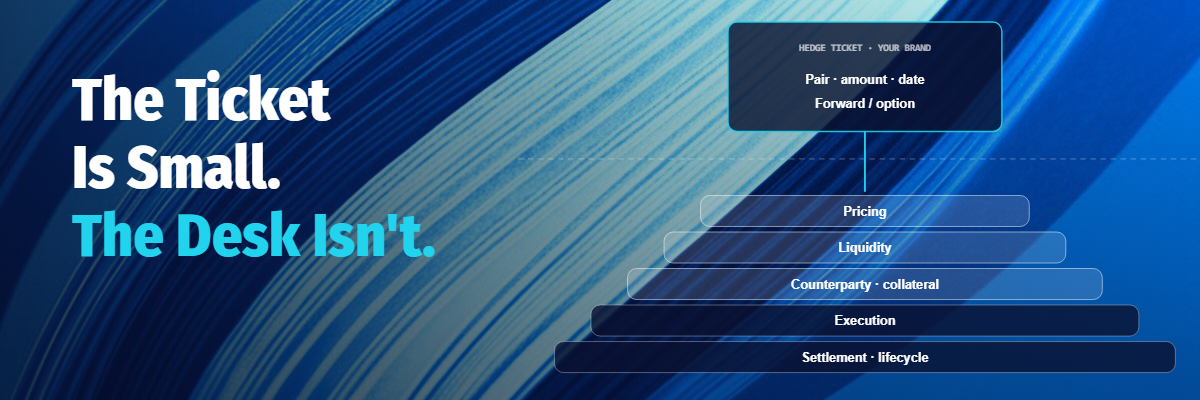
At a technical level, modern FX infrastructure performs five interconnected functions. Together, they transform currency risk from a manual headache into an automated system of control and optimization.
1. Detecting exposure
The system continuously scans financial data to identify where FX risk exists- across invoices, forecasted payments, account balances, and timing gaps between transactions and settlements. This provides a live, dynamic map of exposure.
2. Analyzing risk
Once exposure is mapped, FX infrastructure evaluates it against real-time market conditions, macroeconomic signals, and business-specific thresholds. It calculates potential impacts and highlights areas that need immediate or strategic action.
3. Building and executing hedging strategies
The system doesn’t just flag risk. It builds smart, rule-based hedging strategies, like forward contracts, options, or layered programs, and can execute them automatically when conditions align. The goal is to lock in value, not chase the market.
4. Accessing liquidity
FX infrastructure connects directly to global liquidity providers to ensure the best available rates. This avoids reliance on a single institution and enables fast, cost-effective execution across currencies and regions.
5. Handling compliance and reporting
Finally, the system tracks and logs every step. It automates reporting, audit trails, and documentation to meet regulatory standards like IFRS and Basel III, giving teams transparency without extra manual effort.
Infrastructure vs. Tools: what’s the difference?
It’s easy to confuse FX infrastructure with FX tools. Both aim to manage currency exposure. But the difference isn’t just in what they offer, it’s in how they work and where they live.
Traditional FX tools are external.
They sit outside your systems. You log in, upload data, run reports, and manually act on insights. These tools often feel disconnected, built for specialists, operating in silos, and requiring constant oversight.
FX infrastructure is internal by design.
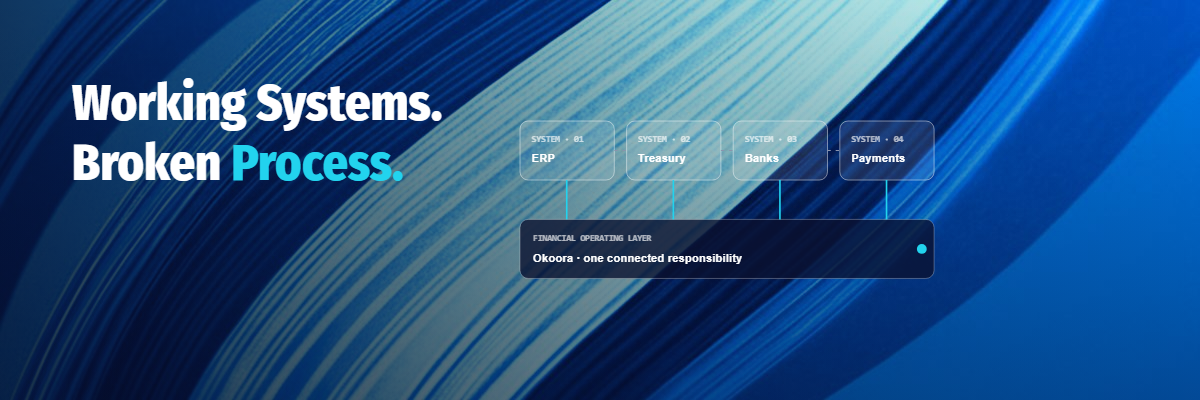
It integrates directly into the systems businesses already use, whether that’s an ERP, a payment platform, or a bank’s treasury stack. It works behind the scenes, automatically identifying exposure, analyzing market conditions, and executing protective strategies without manual input.
Here’s how they compare:
|
FX Tools |
FX Infrastructure |
|
Manual workflows |
Automated, real-time operation |
|
Standalone systems |
Embedded into financial platforms |
|
Used by FX or treasury specialists |
Invisible to end users, working system-wide |
|
Reactive – requires human decisions |
Proactive – executes based on rules and triggers |
|
Adds functionality |
Powers core financial logic |
|
Often surface-level |
Fully integrated and deeply operational |
A useful analogy: FX tools are like financial apps. FX infrastructure is more like cloud architecture. One helps you work around a problem. The other eliminates it altogether.
In the past, businesses accepted the cost and complexity of FX risk. Today, embedded infrastructure makes it possible to neutralize that risk automatically, within the systems they already rely on.
How FX infrastructure embeds into everyday systems
The power of FX infrastructure isn’t just in what it does. It’s in how quietly and effectively it fits into existing systems.
Unlike standalone tools, it doesn’t sit off to the side. It integrates directly into the platforms businesses already use, powering core financial flows from within, without changing user behavior.
Where it embeds
- ERP systems to monitor and manage exposure through invoicing and payments
- Banking platforms offering FX protection to business clients
- Payment and SaaS platforms enabling global transactions
It works in the background, enhancing functionality without adding complexity.
How it deploys
There are three common models:
API integration
For platforms that want flexibility and full control, FX logic is delivered through fast, modular APIs.
White-Label
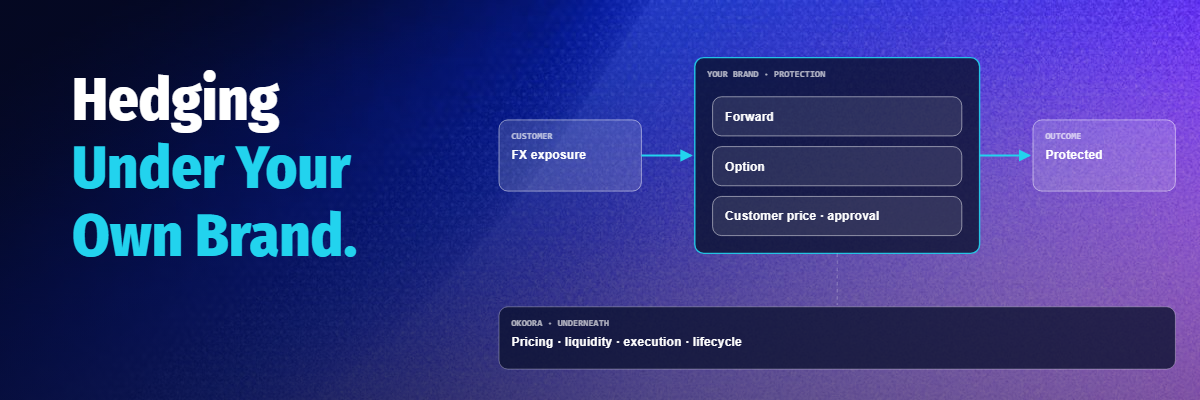
For institutions that want to offer FX services under their own brand, with okoora powering the backend.
Full-Platform access
For businesses needing a ready-to-use solution with wallets, hedging, payments, and reporting built in.
Why it matters
Embedding FX infrastructure means currency risk is handled automatically, within the systems teams already trust. It eliminates manual steps, accelerates decisions, and protects margins in real time, without anyone needing to think about it.
The layer that changes everything
When risk management becomes part of the infrastructure, it stops being a task. It becomes a default. Something you no longer have to remember, to calculate, or to act on manually.
This is not just a new toolset. It is a new mental model for how global business should work.
No more treating currency exposure as an afterthought
No more patching together spreadsheets, dashboards, or delayed trades
No more waiting for someone to notice a problem before solving it
With embedded FX infrastructure, resilience is built in. Every transaction is protected by design. Every decision is supported by intelligence. Every platform becomes smarter the moment this layer is in place.
And the most powerful part is that it works without needing to be seen.
Let’s build around it
If your business moves money across borders, this layer belongs inside your system. Let’s make it part of your foundation.
Request a live walkthrough of FX360 and explore flexible integration paths.