 OkooraEditorial Team
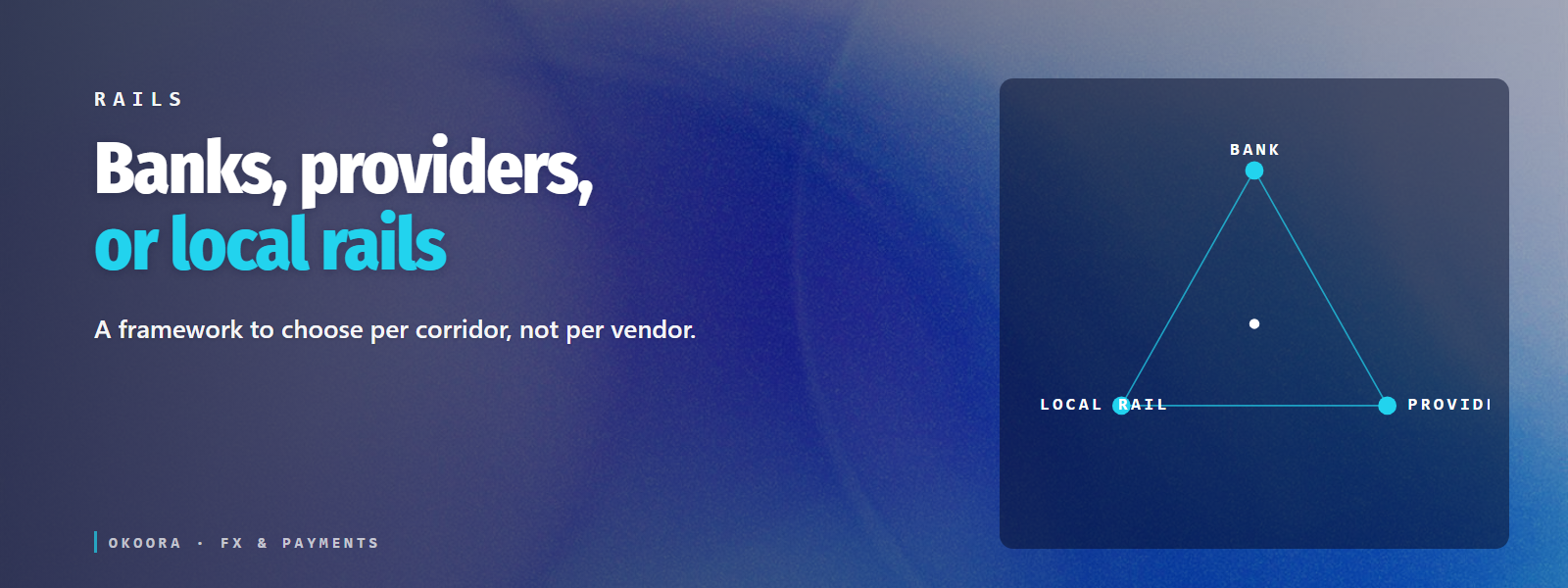
The payment method should follow the transaction, not the other way around
Cross-border payments are often discussed as if a business has to choose one model.
Use a bank.
Use a payment provider.
Use a local rail.
In practice, these are not mutually exclusive strategies.
They are different ways to move money, and each can be the right answer for a different transaction.
The more useful question is:
Which available route best fits this payment, in this currency, to this destination, under our policy?
That changes the decision from choosing one provider for everything to choosing the right path for each financial action.
When a bank route can make sense
Banks remain central to cross-border payments for good reasons.
They can provide broad currency reach, established correspondent relationships, credit, cash management, treasury services and operational familiarity.
For large-value payments, less common destinations, transactions linked to existing banking arrangements or payments that require a specific bank relationship, a bank route may be appropriate.
The trade-off is that a cross-border bank payment can sometimes pass through several institutions before reaching the beneficiary.
That can affect cost, delivery time and transparency.
The Financial Stability Board explicitly treats intermediary charges, delivery time and payment tracking as core dimensions of cross-border payment performance.
The point is not that bank routes are inefficient by definition.
It is that their economics should be understood before they become the default path for every payment.
When a payment provider can make sense
Payment providers can simplify access to multiple payment methods, currencies and destination markets behind one interface.
Depending on the provider, they may combine beneficiary management, payment initiation, FX conversion, local payout methods, status tracking and account capabilities.
That can reduce operational complexity for businesses that would otherwise manage several separate bank relationships or payment connections.
But the provider itself is still a route into underlying financial infrastructure.
The company should understand:
Which rails are being used?
Where does FX occur?
What fees can appear?
Which countries and currencies are supported?
How is the payment tracked?
What happens if the payment fails or is returned?
A simple interface is valuable, but it should not hide the economics of the route beneath it.
When a local rail can make sense
Many domestic payment systems are designed to move money efficiently inside one market.
Where cross-border infrastructure can reach the destination through a local rail, the final payment may be processed more like a domestic transfer than a traditional international wire.
That can shorten the transaction chain.
The Bank for International Settlements has identified payment-system interlinking and better interoperability as important ways to improve cross-border payment speed, cost and transparency.
For a business, local rails can be especially relevant for recurring payments into markets where the company regularly pays suppliers, contractors or other beneficiaries.
But local does not automatically mean better.
Availability, payment limits, cut-off times, beneficiary requirements, reversibility and settlement rules still need to fit the transaction.
The real comparison is route versus route
A useful comparison should put the available payment paths side by side.
For example:
Route A may be an international bank wire through correspondent banks.
Route B may be a specialist provider that settles locally in the destination market.
Route C may use a direct domestic rail through an existing payment infrastructure.
All three may reach the same supplier.
They may not produce the same cost, speed, FX outcome, tracking experience or amount received.
The route is therefore the unit that should be compared, not just the company name on the interface.
Start with destination and currency
Before comparing providers, define where the payment must land and in what currency.
Those two variables eliminate many irrelevant options immediately.
Ask:
Which country is receiving the payment?
What currency must the beneficiary receive?
Is a local payment method available?
Does the beneficiary require a bank wire?
Does the business already hold the destination currency?
Will FX be required?
A payment to a domestic EUR account inside a supported European payment scheme is a different routing problem from a USD payment to a market that relies on correspondent banking.
The routing decision starts with the actual payment, not with a preferred provider.
Then compare the full economic path
A payment route can create cost in several places.
The sender may pay a transfer fee.
An intermediary may deduct a charge.
The beneficiary bank may charge to receive.
Currency conversion may add spread or fees.
An unsuccessful route may create operational cost through repair, investigation or return.
The FSB's cross-border payment framework therefore measures total transaction cost, including sender and receiver fees, intermediary charges and FX conversion.
Businesses should do the same.
The relevant comparison is the total path from the company's funding account to the value the beneficiary actually receives.
Speed and predictability are different things
Businesses often ask which payment method is fastest.
A better question is whether the route meets the required delivery window predictably.
A local rail may settle quickly in one corridor.
A bank route may be entirely appropriate when delivery timing is known and acceptable.
A payment provider may offer a combination of local and cross-border methods behind the scenes.
The company should know:
Expected delivery time.
Cut-off times.
Whether weekends or local holidays matter.
Whether payment status can be tracked.
What happens if the payment is delayed.
The fastest theoretical route is less useful than a route whose timing can be understood and operated reliably.
FX can change the route economics
If the payment requires currency conversion, routing and FX should be evaluated together.
One route may convert currency before the payment is sent.
Another may let the business fund the payment in the beneficiary currency.
A provider may bundle FX into the payment price.
A bank may quote the conversion separately.
If the business compares only the payment fee, it can miss a larger difference in FX economics.
For cross-border payments, the right route is often the combination of:
Payment infrastructure.
Currency conversion.
Provider access.
Settlement.
That is why payment choice and market access should not be treated as separate operating problems.
Policy can rule routes in or out
The cheapest or fastest available route may still be the wrong route for the company.
Finance teams may need to follow rules around:
Approved providers.
Payment limits.
Countries and currencies.
Beneficiary approval.
Documentation.
Sanctions and compliance controls.
Approval thresholds.
Segregation of duties.
Settlement accounts.
Those rules should be applied before execution.
A strong routing model does not simply search for an attractive path.
It chooses among permitted paths under the company's policy.
You do not need one winner for every payment
This is the most important shift.
The question is not whether banks are better than payment providers.
It is not whether local rails are better than correspondent banking.
Each model has situations where it makes sense.
A company with international activity may use all three.
The bank may remain critical for strategic treasury relationships.
A specialist provider may simplify access to several markets.
A local rail may be efficient for a high-frequency corridor.
The operating advantage comes from being able to choose rather than being forced into the same route every time.
A practical decision framework
For each meaningful cross-border payment, compare the available routes across the same criteria:
Destination.
Beneficiary requirements.
Payment currency.
Funding currency.
Available rails.
Available providers.
Total expected cost.
FX conversion path.
Expected beneficiary amount.
Delivery time.
Tracking and transparency.
Failure and return handling.
Policy and approval requirements.
Settlement and reconciliation.
Then ask one final question:
Are we choosing this route because it is right for this payment, or simply because it is the route our current provider gave us by default?
Where Okoora fits
Okoora connects payment rails, clearing networks, financial providers and currency infrastructure into one operating layer.
That means a cross-border payment can be evaluated across available routes rather than being tied automatically to one provider or one path.
Okoora can connect the payment decision to the rest of the workflow: destination, currency, FX, approval, policy, execution, settlement and reconciliation.
The customer keeps control of the decision.
Existing banks can remain.
Existing providers can remain.
Okoora adds broader routing optionality around them.
The goal is not to declare one payment model the winner.
It is to choose the most appropriate available route for each financial action.
Next step: See how Okoora can connect multiple payment rails and providers so each cross-border payment can be routed according to currency, destination, economics and policy.