 OkooraEditorial Team
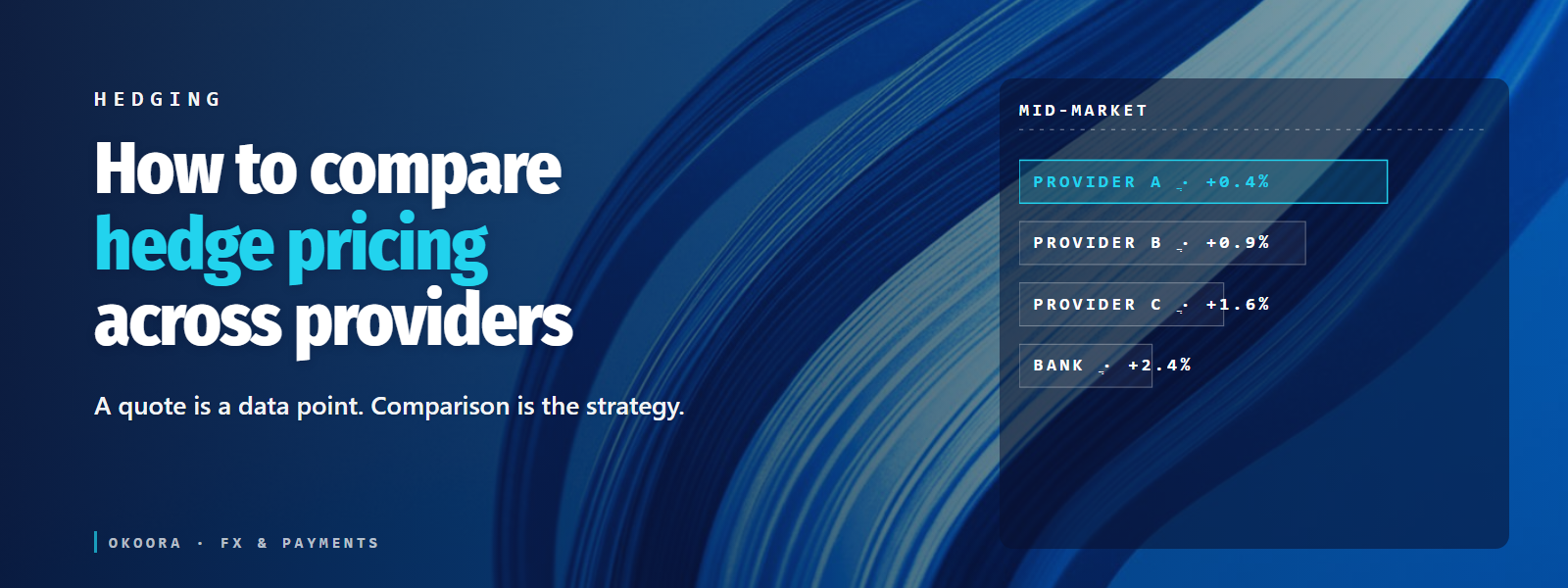
One hedge quote is not the market
A business identifies a currency exposure and asks its bank for a hedge quote.
The bank returns a price.
That price may be perfectly reasonable. But it is still one providerâs price for the transaction at that moment.
Foreign exchange is a decentralised, over-the-counter market. Hedging instruments such as forwards, swaps and options can be priced and executed through different dealers and liquidity providers, and those providers do not always face the same liquidity, inventory, balance-sheet constraints or client flow.
So the right question is not simply:
âWhat is the hedge price?â
It is:
âWhat are the executable alternatives for the same hedge requirement, on the same terms, right now?â
First define the hedge before comparing the price
A meaningful price comparison starts with an identical hedge requirement.
If two providers are quoting different structures, you are not comparing price. You are comparing different products.
Before requesting quotes, define the core terms:
The currency pair.
The exposure amount.
The hedge instrument.
The value date or maturity.
The settlement method.
The strike, where relevant.
Any optionality or participation feature.
Whether the hedge is deliverable or non-deliverable.
The required credit or collateral framework.
The same economic request should go to every provider being compared.
Only then does the pricing comparison become useful.
A forward price is more than todayâs spot rate
For a forward hedge, the quoted forward rate is linked to the spot rate and the forward points for the relevant maturity.
Those forward points are influenced by the interest-rate relationship between the two currencies and can also reflect market funding conditions and the cross-currency basis.
That means a forward quote should not be assessed as if it were simply a spot rate with a random adjustment.
The business should understand both components:
Where the spot market is.
What forward points are being applied for the required maturity.
A provider can be competitive on one component and less competitive on another.
The relevant number is the executable forward outcome for the actual hedge.
Longer tenors can produce different provider economics
A short-dated hedge and a long-dated hedge do not create the same balance-sheet requirement for the provider.
Longer maturities can involve different funding, credit and risk-management considerations.
The Bank for International Settlements has highlighted that FX swaps and forwards can be affected by dealer balance-sheet constraints, funding conditions and the cross-currency basis.
That helps explain why two banks can quote the same notional exposure differently, especially at longer maturities or around periods when funding conditions become more important.
The fact that both providers are looking at the same currencies does not mean their economics are identical.
Options require an even stricter like-for-like comparison
Option hedges add more dimensions.
A meaningful comparison may need to align:
Currency pair.
Notional.
Expiry.
Strike.
Option type.
Settlement.
Premium convention.
Any barrier or structured feature.
The marketâs implied volatility is a central input into option pricing, but the executable premium or structure can still differ across providers.
A slightly different strike, expiry or payoff can make a quote look better while changing the protection being purchased.
For options, the first question is always:
Are these providers actually pricing the same protection?
Credit and collateral can affect what a provider can quote
OTC hedges create counterparty exposure.
That means pricing can interact with the credit relationship between the customer and the provider.
One bank may already have an approved credit line.
Another may require margin or collateral.
A third may price differently because its available balance-sheet capacity for the customer or product is different.
This matters when comparing quotes.
A headline hedge price can be attractive but commercially less useful if the credit, collateral or settlement terms do not fit the company.
The comparison should include the full executable terms, not just the number on the pricing screen.
Liquidity differs across providers, instruments and moments
A provider that is highly competitive in spot FX may not be equally competitive in every forward, swap or option.
Different dealers can have different strengths across currencies, tenors and instruments.
Market conditions matter too.
During volatile periods, liquidity can become more selective. Dealers may change pricing, widen spreads or favour transactions that fit their current risk and client relationships.
That makes market access particularly important for material hedges.
The more significant the decision, the less comfortable a finance team should be treating one provider quote as a complete picture of the available market.
Use multiple providers without creating a pricing circus
Comparing hedge pricing does not mean asking every possible provider for every transaction.
That can create noise and unnecessary information leakage.
A stronger model uses a defined provider set.
The company can decide:
Which banks and liquidity providers are approved.
Which providers should see a particular currency, tenor or product.
How many executable alternatives are required.
Which hedge sizes require market testing.
How long quotes remain comparable.
Who can approve the execution.
When an exception should stop the process.
The objective is disciplined price discovery, not maximum quote volume.
Compare all quotes at the same time
FX markets move.
If one provider quotes at 10:00 and another quotes several minutes later, the underlying market may already have changed.
For a fair comparison, quotes should be requested close enough together that they reflect the same market environment.
This is one reason request-for-quote workflows and multi-dealer platforms are useful in institutional markets.
They allow the same transaction to be presented to multiple liquidity providers in a controlled window.
The closer the economic terms and timing, the more meaningful the comparison.
Price is not the only execution variable
The cheapest headline quote is not automatically the best hedge execution.
Finance teams should also consider:
Whether the quote is executable or indicative.
Quote validity.
Credit and collateral terms.
Settlement mechanics.
Ability to amend or roll the hedge later.
Liquidity in the product.
Operational confirmation.
Policy compliance.
Counterparty concentration.
How the execution will be reconciled.
For options or more complex structures, the company should also make sure it understands what protection it is buying and which economic outcomes it is giving up.
Good hedge pricing begins with a good hedge decision.
Keep your existing banks and add market access around the hedge
A company does not need to abandon its current banks to compare the market more effectively.
Existing relationships may provide valuable credit lines, limits and operating familiarity.
Those relationships can remain.
The company can add approved liquidity sources around them and compare the same hedge requirement across a broader provider set.
Sometimes the existing bank will still offer the strongest executable alternative.
Sometimes another provider will.
The value is in seeing the alternatives before the decision is made.
A practical hedge-pricing checklist
Before executing a material FX hedge, confirm:
Is the underlying exposure clearly defined?
Are all providers quoting the same instrument?
Is the notional identical?
Is the maturity identical?
Are settlement terms the same?
For forwards, are spot and forward points understood?
For options, are strike, expiry, premium and payoff identical?
Are credit and collateral assumptions comparable?
Were the quotes requested in the same market window?
Are the prices executable?
Are fees or markups clear?
What happens if the hedge needs to be rolled, resized or closed?
Does the execution comply with policy?
Have enough approved providers been tested to understand the available market?
If those questions are answered, the comparison becomes far more meaningful than simply asking which bank displayed the lowest number.
Where Okoora fits
Okoora can connect a defined hedge requirement to multiple banks and liquidity sources.
That means the company can compare relevant executable alternatives for the same transaction while keeping existing banks, limits and provider relationships in place.
The hedge decision remains under the customerâs policy and control.
Okoora connects the workflow around that decision: exposure, hedge requirement, market access, provider comparison, approval, execution and the updated financial state after the transaction.
The objective is not to force every hedge through a new provider.
It is to give the company a clearer view of the market around the hedge before it decides where to execute.
One hedge quote is one providerâs answer.
A stronger decision starts by understanding the alternatives.
Next step: See how Okoora can connect a defined hedge requirement to multiple banks and liquidity sources so you can compare executable alternatives under your policy and control.
Related reading: Why One Hedge Quote Does Not Represent the Market.