 OkooraEditorial Team
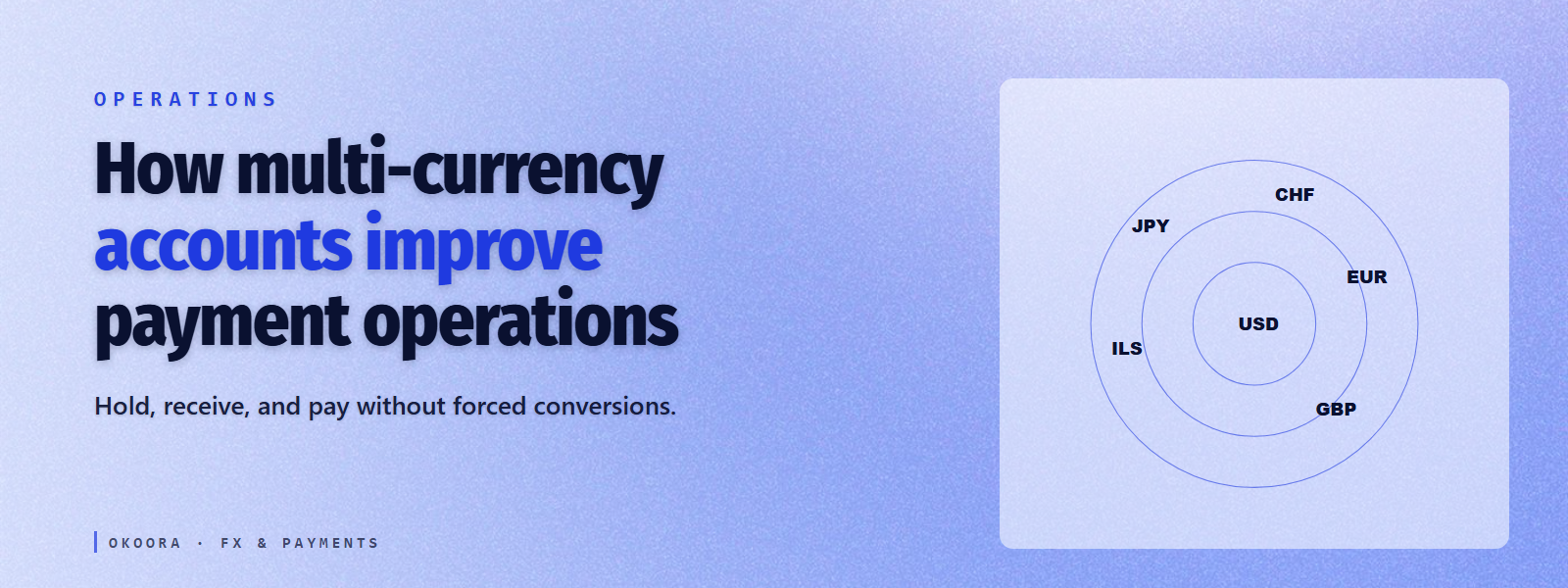
A multi-currency account changes the sequence of international payments
A business receives USD from customers, pays suppliers in EUR, covers operating costs in GBP and reports in another currency.
Without the right account structure, each payment can trigger an immediate conversion.
Receive money. Convert it.
Need to pay a supplier. Convert again.
Move funds between accounts. Convert again.
A multi-currency account changes that sequence.
Instead of forcing every inflow and outflow through the reporting currency, the business can receive, hold and use different currencies directly.
That creates a more flexible operating model for international payments.
The value is not simply âhaving more currency balances.â
The value is deciding when money should move, when it should convert and when it should stay in the currency the business already needs.
Receive money without converting it immediately
If a customer pays in a foreign currency, the business may not need to convert that payment as soon as it arrives.
A multi-currency account can allow the funds to remain in the original currency.
That gives the company several choices.
It can hold the balance.
Use it later for a supplier payment in the same currency.
Convert only part of it.
Wait until a planned conversion window.
Combine it with other currency flows before deciding what needs to be exchanged.
This separates the receiving event from the FX decision.
For businesses with recurring inflows and outflows in the same currencies, that separation can materially improve control over payment operations.
Pay suppliers directly from the currency you already hold
Consider a business that receives USD from customers and later needs to pay USD suppliers.
If every incoming dollar is automatically converted into another currency, the company may later need to buy USD again before making the supplier payment.
That creates two conversions around activity that was already naturally matched.
A multi-currency account can allow the company to retain some or all of the USD inflow and use it for the USD obligation.
The same principle can apply to EUR, GBP or other supported currencies.
The payment becomes simpler because the funding currency and payment currency are already aligned.
This is one of the clearest examples of why account structure, FX and payments should be considered together rather than as separate financial products.
Reduce unnecessary currency conversions
Every currency conversion is a financial action.
It can carry spread, fees, timing decisions and market risk.
That does not mean conversion should be avoided. It means conversion should happen because the business actually needs it.
A multi-currency structure can reduce conversions created only by account limitations.
Instead of:
Receive foreign currency â convert to base currency â later convert back â pay
the company may be able to operate:
Receive foreign currency â hold â pay directly
or:
Receive foreign currency â hold â convert when needed â pay
The simpler sequence can reduce unnecessary transaction steps and give the finance team more control over the economic timing of FX.
Local account details can improve how customers pay you
Multi-currency account structures can also improve the inbound side of payment operations.
Where local receiving details are available, customers may be able to pay into account details associated with the currency or market they already use.
That can change the payment experience.
The customer may avoid initiating a traditional international wire.
The business may receive the original currency directly.
The payment may be easier to identify and reconcile.
The route may involve fewer cross-border steps.
The exact mechanics depend on the currency, jurisdiction and provider, so local receiving details should never be treated as universal.
But where they are available, they can make the collection flow feel more local even when the commercial relationship is international.
Multi-currency accounts make payment routing more flexible
Account structure also affects which payment routes are available.
If the business holds the required payment currency, it can evaluate routes without first asking a provider to perform an immediate FX conversion.
That separates two choices:
Which currency balance should fund the payment?
Which available route should carry the payment?
This matters because cross-border payments can travel through correspondent banks, local rails or other payment providers.
The Bank for International Settlements continues to identify interoperability and access to payment systems as important factors in improving cross-border payment services.
For the business, broader account and route flexibility creates more combinations that can be evaluated before money moves.
The account should connect to the payment workflow
A collection of currency balances is not enough.
The real operating value appears when the account structure connects to the activity around it.
A payment may begin with:
An invoice.
A purchase commitment.
A customer receipt.
A payroll obligation.
An intercompany transfer.
From there, the finance team needs to know:
Which entity owns the obligation?
Which currency is required?
Which balance is available?
Whether FX is needed.
Which route is permitted.
Who must approve.
When the payment should settle.
How the final transaction will be reconciled.
Multi-currency accounts are most useful when they are part of that full workflow rather than another screen the team must manage manually.
Keep FX timing separate from payment timing
One of the biggest operational improvements is the ability to separate two decisions that often get bundled together.
When should we convert?
When should we pay?
Those events do not always need to happen at the same time.
A business may decide to acquire currency before a supplier payment becomes due.
It may receive the currency naturally from customers.
It may hold the currency because more obligations are expected.
It may convert only when the payment becomes certain.
The right answer depends on cash needs, market exposure, company policy and the economics of the underlying business.
A multi-currency account creates the operating space to make those decisions separately.
Improve visibility across international cash
As the number of currencies grows, finance teams can lose sight of where usable cash actually sits.
The issue is not simply seeing account balances.
The team needs to understand:
Which currency is available.
Which entity owns it.
Which payments are coming.
Which receipts are expected.
Which balances are already committed.
Where a currency shortage may develop.
Which conversion may be unnecessary because an incoming flow will offset it.
A multi-currency account can make currency balances easier to operate, but the highest value comes when those balances are connected to the wider financial state.
That is what turns a balance view into a decision tool.
Reconciliation should stay connected to the currency flow
International payments create accounting and operational work after the money moves.
A receipt may arrive in one currency.
A conversion may happen later.
A payment may be funded from that balance.
Fees may be applied.
The transaction then needs to be matched to the underlying invoice, customer, supplier or entity.
If account, FX and payment data sit in separate systems, reconciliation becomes another manual bridge.
A better operating model keeps the chain visible:
Receive.
Hold.
Convert if needed.
Pay.
Settle.
Reconcile.
The currency balance should not become a blind spot between the incoming and outgoing transactions.
A multi-currency account is not a strategy by itself
There is also an important limitation.
Opening many currency balances does not automatically improve financial operations.
If every currency is held without policy, the business can create fragmented cash, idle balances and more operational complexity.
The finance team still needs rules around:
Which currencies should be held.
How much liquidity should remain in each one.
When balances should be converted.
Which obligations can be funded directly.
Which entities can use which accounts.
Who can approve transfers.
How exposures created by balances should be managed.
The account creates optionality.
Policy turns that optionality into control.
A practical operating model
For each material currency, the business can ask:
Do we receive customer funds in this currency?
Do we have supplier or operating obligations in the same currency?
Can we receive the currency directly?
Can we hold it?
Can we pay from that balance?
Which payment routes are available?
When would conversion actually be required?
What policy determines how much currency we retain?
How are balances, conversions and payments reconciled?
If the answers are connected, the company can move from reactive conversion toward more deliberate international payment operations.
Where Okoora fits
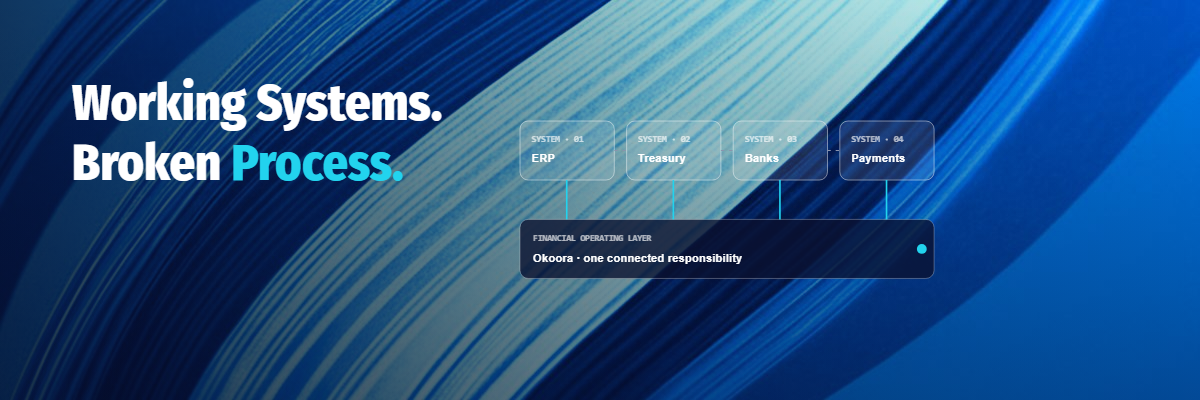
Okoora connects multi-currency accounts to payments, FX, market access, policy and reconciliation.
That means a currency balance is not treated as a standalone product.
Incoming funds can become part of the current financial state.
The business can hold the currency, use it for future obligations, convert it when appropriate or route it into a payment.
Okoora operates the broader chain across accounts, payments, currencies and financial decisions.
The customer keeps the control points.
The system keeps the state current.
The objective is simple:
Use the currency you already have when it makes sense.
Convert when there is a reason to convert.
Route the payment through the appropriate available path.
And keep the full financial workflow connected from receipt to reconciliation.
Next step: See how Okoora connects multi-currency accounts with payments, FX, policy and reconciliation so international money movement operates as one financial workflow.