 OkooraEditorial Team
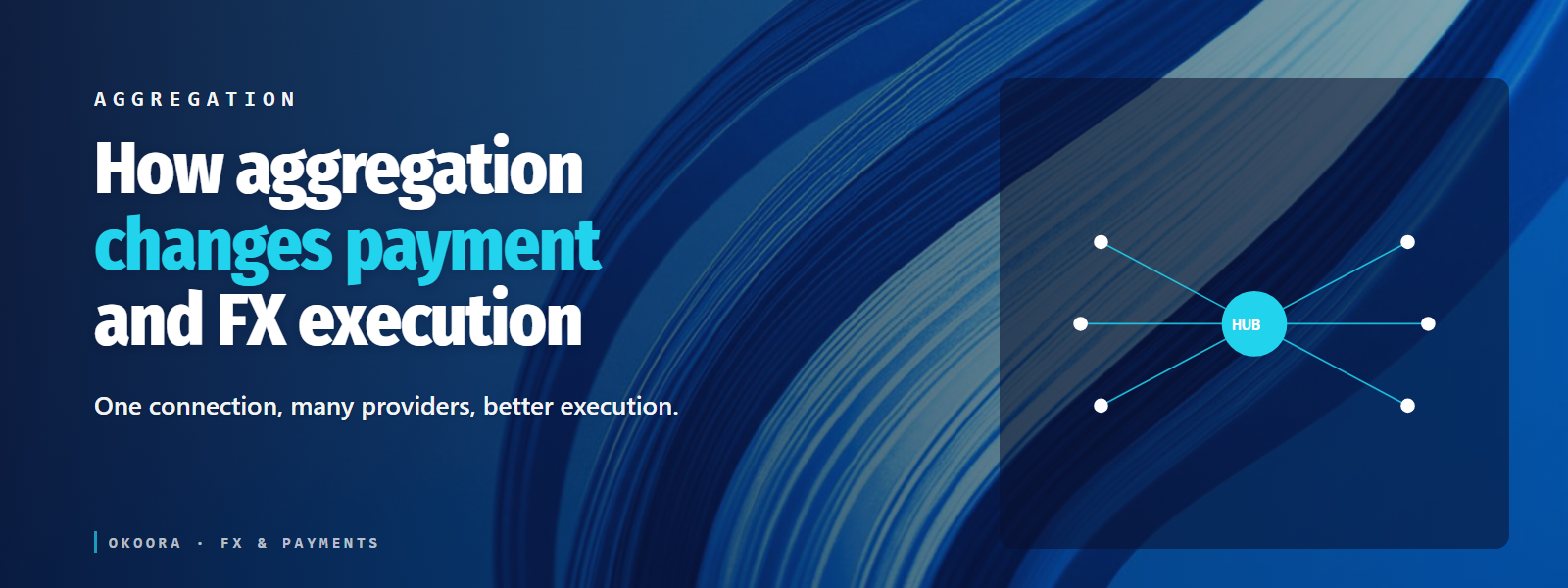
Aggregation changes the question from 'which provider?' to 'which route?'
Most businesses are used to choosing providers one relationship at a time.
One bank for FX.
Another provider for payments.
A local rail for a specific market.
A broker for a particular product.
That model can work, but it creates a structural limitation: the company often sees only the options available through the provider it has already chosen.
Provider aggregation changes the decision.
Instead of asking:
âWhich provider should we use?â
the business can ask:
âWhich available provider, route or liquidity source is most appropriate for this financial action?â
That is a different operating model.
The relationship remains important.
But the transaction is no longer forced to inherit the limits of one relationship by default.
In FX, aggregation creates broader price discovery
The FX market is decentralised and fragmented.
The Bank for International Settlements describes a market where customers can access multiple banks, non-bank liquidity providers, multi-dealer platforms and liquidity aggregators.
A liquidity aggregator consolidates access to several providers or venues.
That matters because different providers can show different executable prices for the same transaction.
One bank may have stronger liquidity in the currency pair.
Another may have inventory that makes the trade attractive.
A non-bank liquidity provider may be competitive for a particular ticket size.
Aggregation gives the customer a broader view of those alternatives before execution.
The immediate benefit is not that one source will always be cheaper.
It is that the business can see more of the executable market before it decides.
In payments, aggregation creates broader route choice
Cross-border payments are fragmented in a different way.
The payment may travel through correspondent banks.
It may settle through a local clearing system.
It may use a specialist payment provider.
It may involve one route for the money movement and another provider for the FX conversion.
The Financial Stability Board and Bank for International Settlements continue to focus on interoperability, access and more efficient connections between payment systems because cross-border payments still suffer from cost, speed and transparency frictions.
For a business, provider aggregation can create a practical response to that fragmentation.
Instead of tying every payment to one default path, the company can evaluate available payment rails and providers according to the transaction.
Destination.
Currency.
Cost.
Delivery time.
Beneficiary requirements.
Policy.
The result is routing optionality rather than provider dependence.
Aggregation does not mean using every provider
There is an important distinction.
Aggregation does not mean connecting indiscriminately to every bank, broker, rail or payment company.
More connectivity without control can create more complexity.
The value comes from maintaining an approved provider universe and making that universe available to the decision.
For example, the company may define:
Approved FX counterparties.
Approved payment providers.
Permitted payment rails.
Currency and country rules.
Transaction-size thresholds.
Credit and settlement limits.
Pricing tolerances.
Approval requirements.
Then aggregation works inside those boundaries.
It expands the choice set without removing governance.
The first value is information
Before aggregation changes execution, it changes visibility.
A business that sees only one price does not know whether the wider market is close to it or far away.
A business that sees only one payment route does not know whether another approved path offers better economics or settlement characteristics.
Aggregation turns hidden alternatives into visible alternatives.
That information can improve the decision even when the company ultimately executes with the provider it already knows.
This is especially important for existing banking relationships.
The bank can remain the chosen provider.
The difference is that the customer chooses it after seeing the available alternatives rather than simply because no alternatives were surfaced.
The second value is competition
When several providers can compete for the same transaction, pricing behaviour changes.
In FX, the same conversion request can be shown to several approved liquidity sources.
In hedging, several banks can price the same structure.
In payments, several available routes can be compared for the same destination and currency.
The point is not to create an auction around every transaction.
The point is to introduce real optionality where the transaction is material enough to justify it.
Competition is most useful when the underlying request is identical and the comparison happens under consistent terms.
The third value is routing
Aggregation becomes more powerful when the system can do more than display alternatives.
It can help route the financial action.
For a payment, routing may consider:
Destination.
Currency.
Available rail.
Provider availability.
Expected fees.
Expected delivery time.
Beneficiary requirements.
Company policy.
For FX, routing may consider:
Currency pair.
Transaction size.
Available liquidity.
Approved counterparties.
Executable pricing.
Settlement terms.
Policy.
That creates a common principle across payments and FX:
The financial action should move through the most appropriate available path, not automatically through the first provider connected to it.
Routing should optimize for the transaction, not for one universal metric
There is no universal 'best provider.'
A route can be cheaper but slower.
Another may offer stronger settlement certainty.
A bank may be valuable because of credit.
A specialist provider may have stronger local reach.
One liquidity source may be competitive for a major currency pair.
Another may be stronger for a specific hedge tenor.
The routing decision should therefore reflect the transaction's actual objective.
Cost.
Speed.
Liquidity.
Credit.
Settlement.
Policy.
Operational reliability.
This is why intelligent aggregation is more useful than simply exposing a long list of providers.
Aggregation can preserve existing financial relationships
One of the strongest benefits is that aggregation does not require an all-or-nothing provider change.
A company can keep its bank.
Keep its credit line.
Keep its approved payment providers.
Keep local relationships that already work.
Aggregation adds alternatives around those relationships.
That matters because financial relationships have strategic value that cannot be reduced to one transaction price.
The goal is not to replace every provider with a new provider.
It is to stop making every future transaction dependent on one provider's infrastructure by default.
Payment and FX aggregation become more valuable together
Many cross-border payments also involve currency conversion.
If payment routing and FX pricing are managed separately, the business can optimize one side while missing cost on the other.
For example:
A payment route may look inexpensive but use an unattractive FX conversion.
A competitive FX price may still feed into an inefficient payment route.
A company may already hold the destination currency and not need conversion at all.
When payment and FX provider access are considered together, the business can evaluate the full economic path.
Funding currency.
Conversion if needed.
Payment route.
Settlement.
Beneficiary amount.
That is a much stronger decision than choosing a payment fee and an FX rate independently.
Aggregation can reduce fragmentation for the user
The paradox is that aggregation connects more infrastructure while potentially exposing less complexity to the finance team.
Without aggregation, the team may log into several banks, request prices manually, compare spreadsheets, manage separate payment portals and reconcile activity afterward.
With a well-designed aggregation layer, the complexity remains underneath.
The user sees:
The financial requirement.
The permitted alternatives.
The relevant economics.
The decision.
The execution state.
This is one reason liquidity aggregators became important in fragmented FX markets: they consolidate access to multiple sources so customers do not need to navigate each venue independently.
The same principle applies to broader financial operations.
But aggregation creates a new responsibility: decision logic
Once a company has more alternatives, it needs a consistent way to choose among them.
Without decision logic, aggregation simply produces more options.
That is where policy and financial intelligence become important.
The system needs to understand:
What the business is trying to accomplish.
Which routes are allowed.
Which providers are approved.
Which economics matter.
Which transactions require human judgment.
Which actions can proceed automatically.
Aggregation creates the choice set.
Decision logic turns that choice set into an operating advantage.
A practical test for provider aggregation
A business considering an aggregation model should ask:
Can one financial request reach multiple approved providers?
Can the alternatives be compared on consistent terms?
Can the company keep existing providers?
Can payment and FX choices be evaluated together when relevant?
Can policy rule providers or routes in and out?
Can the system explain why one route was selected?
Can exceptions stop for human review?
Can execution happen through different providers without breaking the workflow?
Does the result return into the company's financial state after execution?
If the answer is yes, aggregation is no longer just connectivity.
It becomes financial orchestration.
Where Okoora fits
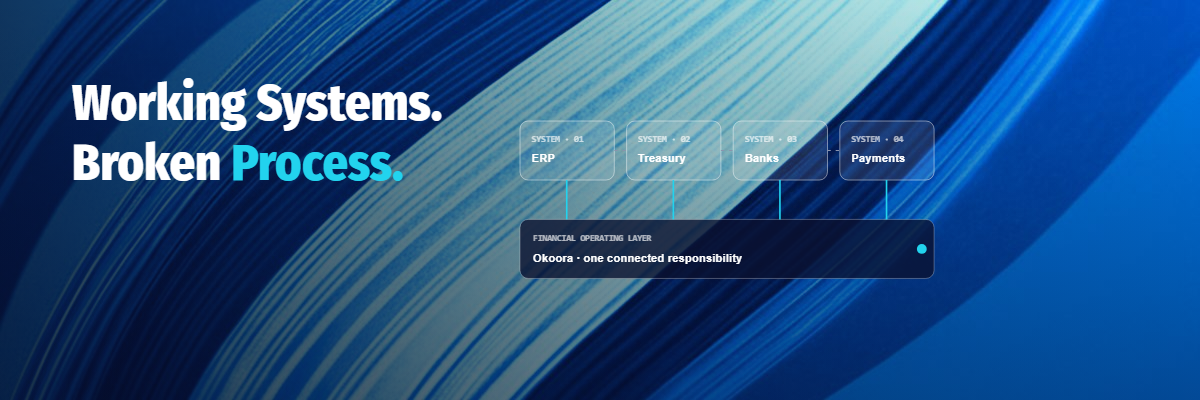
Okoora connects banks, brokers, liquidity providers, payment rails, clearing networks and financial execution infrastructure into one operating layer.
That means a financial action can begin with the business requirement rather than with the provider.
A supplier payment can be evaluated across available payment paths.
An FX conversion can be priced across multiple banks and liquidity providers through the FX Marketplace.
A hedge can be tested with approved market sources.
The customer can keep existing banks and providers while Okoora adds broader market access, provider aggregation, routing and policy around them.
The important distinction is this:
Okoora does not aggregate providers simply to show more logos or more options.
It connects financial intelligence, market connectivity, execution infrastructure and control so the available alternatives can be turned into a better decision and a controlled action.
Next step: See how Okoora connects banks, liquidity providers, payment rails and execution infrastructure so each financial action can be evaluated across available alternatives under policy and control.