What Businesses Should Look for in a Cross-Border Payment Provider
A payment provider should be judged by more than whether it can send money
Most cross-border payment providers can answer the first question:
Can you send this payment?
That is no longer enough.
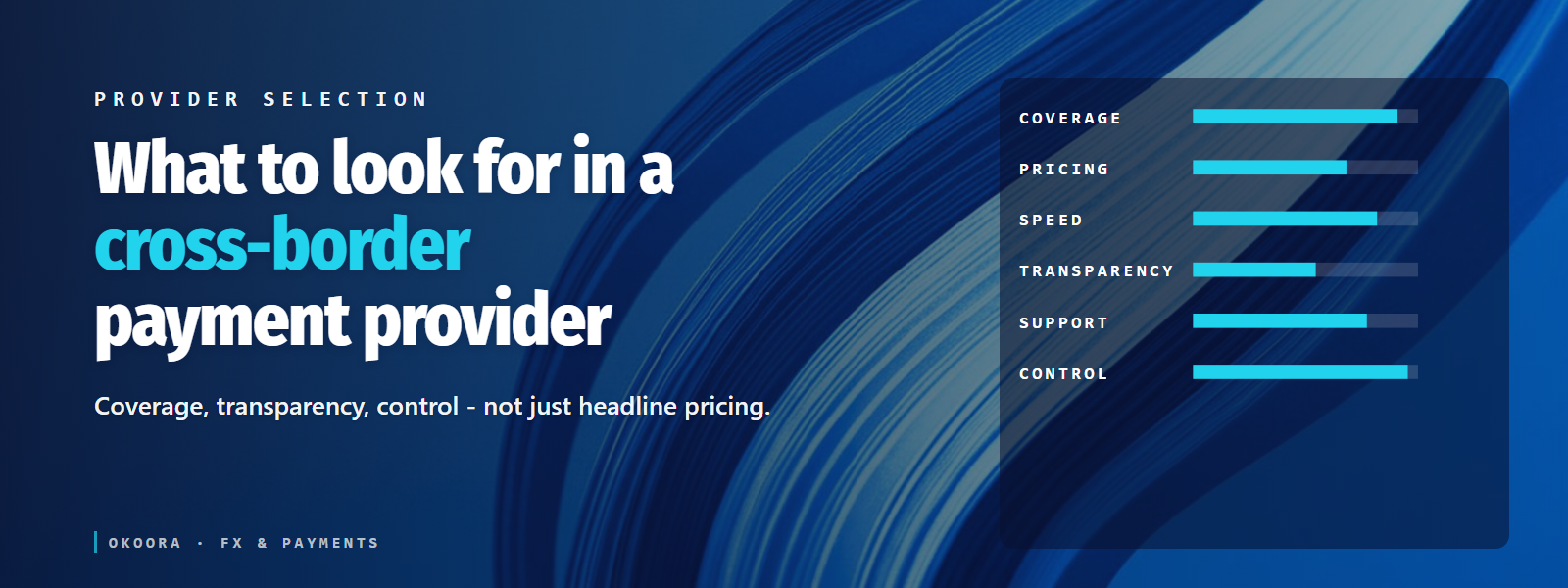
For a business operating across currencies, markets and suppliers, the real decision is whether the provider can move money in a way that is economically efficient, operationally reliable, transparent and controllable.
The provider should not be evaluated only as a transfer tool.
It should be evaluated as part of the financial infrastructure around the payment.
Start with the routes the provider can actually access
A cross-border payment provider is only as useful as the routes it can reach.
That can include correspondent banking, local clearing systems, domestic payout rails, partner banks and other payment infrastructures.
A provider with broader route access can potentially give the business more options for how a payment reaches the beneficiary.
That matters because different corridors can behave differently.
A route that works well for one country, currency or payment size may not be the right route for another.
The first practical questions are:
Which countries can the provider reach?
Which currencies can it send?
Which local rails are available?
When does the payment travel through correspondent banking?
Can the provider choose among several available routes, or is every payment forced through one path?
Look at total payment cost, not the headline fee
A low transfer fee can still produce an expensive payment.
Cross-border cost may include:
Sending fees.
Receiving fees.
Intermediary or correspondent charges.
Foreign exchange spread.
Currency-conversion charges.
Additional fees created by the payment method.
Operational cost when payments fail, are returned or require investigation.
The Financial Stability Board treats total transaction cost as the combination of the relevant charges across the payment journey, including FX.
Businesses should do the same.
The right comparison is not “what is your transfer fee?”
It is:
“What is the full economic cost of moving this amount, in this currency, to this beneficiary?”
Ask how the provider handles FX
For many international payments, FX is one of the largest economic variables in the transaction.
A provider may bundle conversion into the payment.
It may use a fixed markup.
It may provide access to live pricing.
It may allow the business to fund the payment in the destination currency and avoid conversion altogether.
Those are very different models.
The business should know:
Where does conversion happen?
Who prices it?
Is the rate indicative or executable?
What markup or spread applies?
Can the business compare alternatives?
Can the company hold the payment currency and convert separately?
A strong payment provider should make the FX economics visible, not hide them inside the transfer.
Delivery time should be predictable, not merely fast
Speed matters.
Predictability matters more.
The FSB's cross-border payment targets focus on delivery time and transparency around when funds will be available to the recipient.
For a business, that means a provider should be able to explain:
When the payment is expected to arrive.
What cut-off times apply.
Which local holidays or banking windows matter.
How delivery changes by route.
What happens if the payment cannot settle as expected.
A provider that promises speed but cannot explain the route or delivery window creates a different kind of operational risk.
Tracking should continue after the payment is sent
A cross-border payment does not become irrelevant when the instruction is released.
Finance teams still need to know whether the payment:
Passed approval.
Was converted.
Was executed.
Entered the payment network.
Reached the beneficiary bank.
Was credited.
Failed.
Was returned.
Needs intervention.
Tracking is therefore a core provider capability.
The strongest providers surface the payment state clearly enough that the finance team can manage exceptions without chasing multiple banks, emails or spreadsheets.
Reliability and exception handling matter at scale
A provider should also be judged by what happens when the normal flow breaks.
Cross-border payments can fail because of incorrect beneficiary data, regulatory screening, invalid account details, unsupported currencies, cut-off times, intermediary issues or local banking rules.
Businesses should ask:
How are payment details validated?
Can errors be identified before release?
How are failures communicated?
What happens to returned funds?
Can a failed route be repaired or rerouted?
Who owns the exception?
How quickly can the finance team understand what went wrong?
A provider that works only when everything goes perfectly is not enough for an operating business.
Compliance is part of the payment capability
Cross-border payment providers operate across multiple jurisdictions, regulatory frameworks and financial-crime controls.
The FSB has emphasised that bank and non-bank payment service providers need proportionate and consistent regulatory and supervisory frameworks, including controls around financial crime, operational risk and consumer protection.
For a business buyer, the practical implication is straightforward.
Understand who the regulated entities are.
Understand which jurisdictions they cover.
Understand how payments are screened.
Understand what information the provider requires.
Understand how compliance exceptions are handled.
Compliance should be designed into the payment flow, not added as a black box at the end.
The provider should fit your control model
A business does not want payment infrastructure that bypasses its own rules.
The provider should be able to support the operating controls that matter to the company.
That can include:
Approved beneficiaries.
Approved entities.
Payment limits.
Currencies.
Countries.
Approval thresholds.
Role-based permissions.
Segregation of duties.
Exception rules.
Required supporting information.
A strong payment setup allows routine activity to move efficiently while material or unusual transactions stop for the right review.
Integration matters when payments are recurring
A payment provider can look simple in a demo and become operationally expensive when every payment has to be rebuilt manually.
For recurring business activity, integration matters.
The company should consider whether the provider can connect to:
ERP data.
Treasury workflows.
Accounts.
Payment files.
AP processes.
APIs.
Scheduled exports.
Reconciliation data.
The objective is not integration for its own sake.
It is to reduce manual handoffs between the event that creates the payment obligation and the financial action that completes it.
Multi-currency capability can change the economics
Businesses that receive and pay in multiple currencies should also evaluate whether the provider supports multi-currency balances and accounts.
This can affect payment economics significantly.
If the company already holds the supplier's currency, it may not need to convert at the moment of payment.
If it receives customer revenue in the same currency it spends, the company may be able to reuse that balance.
That creates a broader decision:
Should the business convert now?
Hold the currency?
Pay directly?
Use the balance for another obligation?
A provider that connects accounts, payments and FX can give the business more control over that sequence.
One provider should not automatically mean one route
This is one of the most important evaluation questions.
Does the provider give you access to one payment route, or does it connect to several?
A business can have an excellent bank or provider and still benefit from additional route optionality.
The Bank for International Settlements has highlighted interoperability, expanded access to payment systems and connections between fast-payment systems as important building blocks for better cross-border payments.
For businesses, the principle is simple:
More infrastructure access can create more routing options.
The value comes when those options can be evaluated intelligently rather than exposed as operational complexity.
Ask whether the provider helps choose the route
A provider can offer many rails and still leave the difficult decision to the customer.
The next level is routing intelligence.
For a given payment, the system should be able to consider:
Destination.
Currency.
Amount.
Available providers.
Available rails.
FX requirements.
Expected cost.
Expected delivery time.
Policy.
Beneficiary requirements.
Then the company can choose the most appropriate available path for the transaction.
That is more valuable than simply having a long list of supported payment methods.
A practical provider evaluation checklist
Before choosing a cross-border payment provider, ask:
Which countries and currencies can you reach?
Which local rails and clearing systems can you access?
When do you use correspondent banking?
Can you route the same payment through more than one provider or infrastructure?
What is the total expected transaction cost?
How is FX priced?
Can we receive and hold multiple currencies?
What delivery time should we expect?
Can we track the payment end to end?
How are failures and returns handled?
Which regulated entities operate the service?
How are compliance checks handled?
Can the payment workflow follow our approval policy?
Can the service integrate with our existing systems?
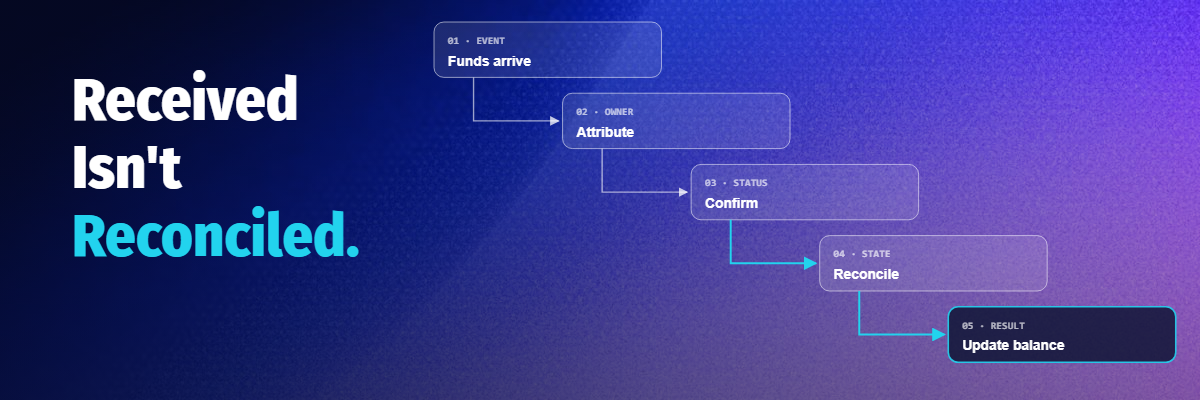
How will the payment reconcile after settlement?
And finally:
Are you simply a provider, or can you help us choose among the financial routes available to us?
Where Okoora fits
Okoora connects cross-border payments to a wider financial operating layer.
The customer can keep existing banks and providers while Okoora adds access to payment rails, clearing networks, accounts, FX market connectivity and policy-driven control around them.
That means the company is not limited to asking one provider how it would send the payment.
The payment can be understood as a routing decision across the available infrastructure.
Okoora connects the business obligation, currency, route, FX, approval, execution, settlement and reconciliation in one flow.
The objective is not to create more payment complexity.
It is to turn more financial connectivity into a better-controlled decision.
Next step: See how Okoora connects payment rails, providers, FX and policy so businesses can operate cross-border payments through the most appropriate available route.
See how Okoora can support customer-facing financial products and the institution's own treasury operations on the same underlying financial architecture.