A supplier payment can look simple on the surface: one company owes another company money, and the payment needs to arrive by a date.
Underneath, there may be several ways to get the money there.
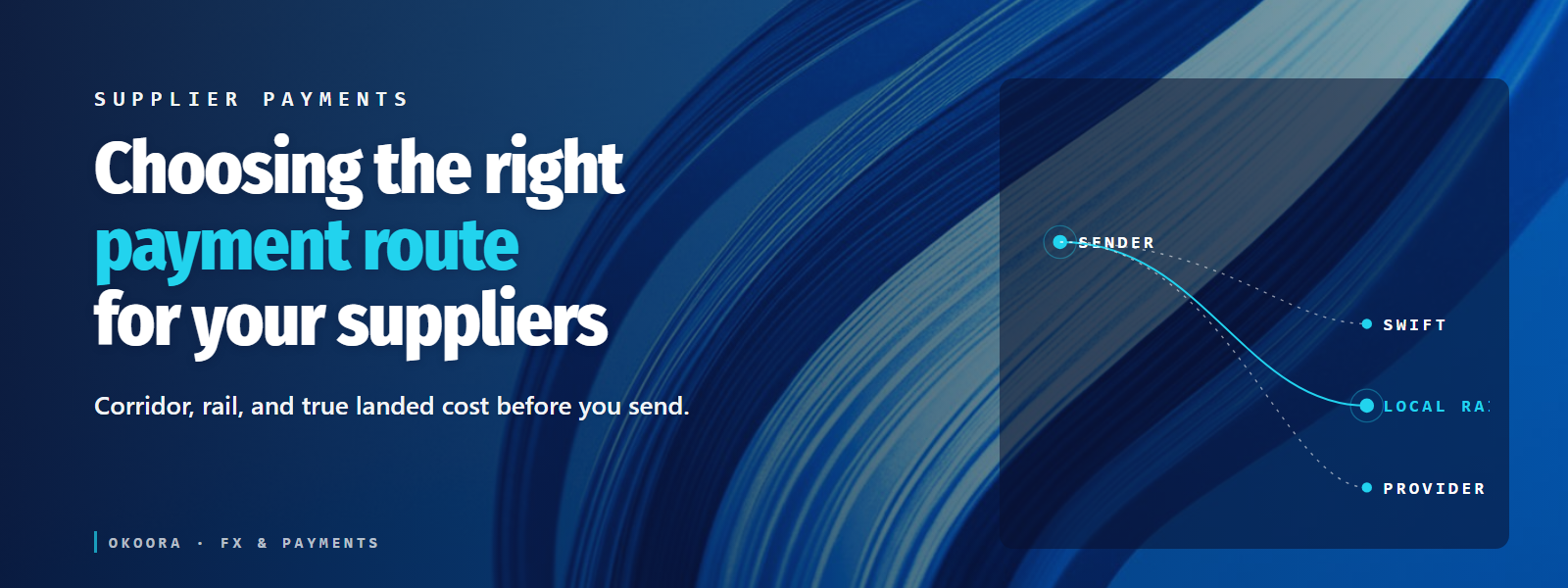
The route can involve different payment rails, correspondent banks, local clearing systems, payment providers, currencies and FX steps. Those choices can affect cost, speed, transparency, settlement certainty and the amount the supplier actually receives.
That is why a supplier payment should be treated as a routing decision, not only as a transfer instruction.
The right question is not simply: “Can this provider send the payment?”
It is: “Which available route best fits this payment?”
Start with the supplier and the destination
The destination determines much of what is possible.
A payment to a supplier in the same currency and domestic banking system is different from a cross-border payment that must move between currencies and jurisdictions.
Before selecting a route, confirm:
Which country is the supplier receiving in?
Which currency must the supplier receive?
Does the supplier require a local payment, a bank wire or a specific payment method?
Are there local clearing options available?
Does the beneficiary account support the intended currency and payment type?
What settlement date is required?
These questions sound operational, but they determine the feasible route set before cost or speed can even be compared.
Compare the full cost, not only the visible transfer fee
The cheapest-looking payment option is not always the lowest-cost route.
A cross-border supplier payment may include several economic components:
The sending fee.
Intermediary or correspondent charges.
Receiving-bank charges.
Foreign exchange spread or conversion charges.
Additional costs created by an unnecessary currency conversion.
Operational cost if the payment fails, is returned or requires investigation.
The Financial Stability Board’s cross-border payment framework explicitly treats total transaction cost as more than the sender’s fee. Its transparency target includes sending and receiving charges, intermediary fees, the FX rate and currency-conversion charges.
For a business payment, the useful comparison is therefore the total economic path from the funding account to the amount the supplier receives.
Speed is a route characteristic, not a universal promise
Different routes can settle at different speeds.
Domestic and local payment systems may provide faster settlement in some corridors. Other payments may travel through correspondent-bank chains, multiple time zones and different cut-off times.
The Bank for International Settlements has repeatedly highlighted that cross-border payments tend to be slower, more expensive and less transparent than domestic payments. It also notes that interlinking payment systems can shorten transaction chains and improve speed, cost efficiency and transparency.
For the buyer, that means speed should be evaluated transaction by transaction.
A payment that can arrive through a local rail may have a different operating profile from one that needs a longer cross-border chain.
The right route is the one that meets the required delivery window without creating unnecessary cost or operational risk.
Check whether the payment needs FX, and where that conversion occurs
Currency conversion can materially change the economics of a supplier payment.
If the business holds the supplier’s currency already, the payment may not need conversion at all.
If conversion is required, the route can determine where the FX happens, which provider prices it and whether the payment is converted once or more than once before it reaches the beneficiary.
This is where payment routing and market access begin to overlap.
A supplier payment is not only a money-movement decision when currency changes along the way. It is also an FX execution decision.
The company should know the payment amount, the required settlement currency, where conversion occurs, what executable FX alternatives are available and how the FX cost interacts with the payment route.
Transparency matters while the payment is in motion
A good payment route should also make the payment easier to operate after it is sent.
Finance teams need to know:
Has the payment been instructed?
Was it approved?
Was it converted?
Was it executed?
Is it in transit?
Has the supplier received it?
Was the expected amount received?
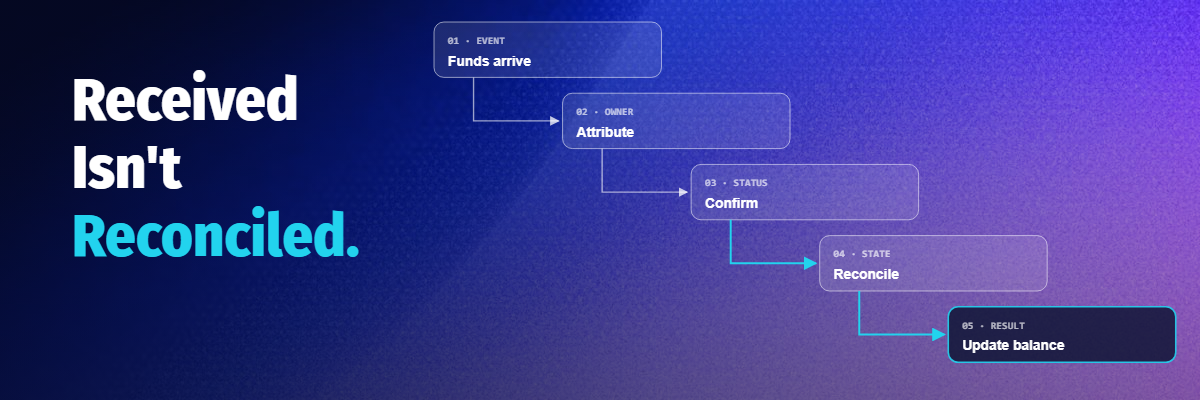
Has the transaction been reconciled?
These are not cosmetic status updates. They determine whether the team can manage exceptions quickly and close the financial record cleanly.
The FSB’s transparency targets for cross-border payments include expected delivery time and tracking of payment status alongside cost information. That is a useful operating standard for businesses as well.
Policy can change which route is appropriate
The economically attractive route is not automatically the permitted route.
A company may have rules around approved providers, payment thresholds, entities, currencies, beneficiaries, jurisdictions, approval levels or settlement timing.
Those rules should be part of the routing decision before the payment leaves.
For example, a lower-cost route may not be appropriate for a high-value payment if the company requires a different approval path or provider class. A routine supplier payment inside policy may be able to proceed automatically. An unusual payment may need to stop for review.
The route should therefore satisfy both the economics of the payment and the company’s operating policy.
One provider does not always represent the full route set
A business often sees the payment routes available through the institution it asks.
That view can be perfectly valid, but it is still one provider’s available path set.
A broader payment infrastructure can expose additional rails, providers or clearing options for the same underlying obligation.
This does not mean more routes are automatically better.
Optionality is valuable because it creates a choice.
For each payment, the company can compare the available paths and choose based on the relevant combination of destination, currency, cost, speed, settlement, transparency and policy.
The objective is not maximum complexity.
It is better routing from a broader set of executable alternatives.
A practical supplier-payment routing checklist
Before a supplier payment is released, ask:
What currency must the supplier receive?
Which country and banking system will receive it?
What is the required arrival date?
Which rails or providers are available for this corridor?
What is the full expected transaction cost, including FX and intermediary charges where relevant?
Where will currency conversion happen?
What amount is the beneficiary expected to receive?
Can the payment status be tracked through settlement?
What happens if the payment is rejected, returned or delayed?
Which policy, approval and provider rules apply?
How will the payment be reconciled after arrival?
Is there another available route that should be compared before execution?
If these questions are answered, the payment is no longer just an instruction. It is a controlled financial decision.
Where Okoora fits
Okoora operates supplier and business payments as part of a broader money-movement workflow.
The payment can begin with the obligation, move through currency, approval, routing and execution, and continue through settlement, record and reconciliation.
Okoora connects payment infrastructure with financial intelligence, market connectivity, provider optionality and policy. That means the route can be evaluated as part of the financial action rather than treated as a fixed path from a single provider.
The customer retains the control points. The payment operates inside the customer’s policy, and exceptions can stop for review.
This is the deeper difference between simply being able to send a supplier payment and operating the payment route as a financial decision.
Next step: See how Okoora operates supplier payments across currency, approval, routing, execution and settlement, under your policy.
See how Okoora can support customer-facing financial products and the institution's own treasury operations on the same underlying financial architecture.