 OkooraEditorial Team
More approval does not automatically mean more control
Many expense processes are built around a simple assumption: if a transaction matters, a person should approve it. That sounds safe, but it often produces the opposite result. When every routine expense enters the same approval queue, managers spend time confirming transactions that already comply with policy, employees wait for decisions that add little value, and genuinely unusual activity competes for attention with everything else.
Control is not the number of approvals in a workflow. Control is the ability to apply the right rule to the right transaction, preserve authority where it matters and make exceptions visible when something actually requires judgment. In that model, approval becomes one possible outcome of policy rather than a mandatory step in every expense.
Start with policy, not with the approver
The better question is not who approves this transaction. It is what should happen to this transaction under company policy. A routine expense may already satisfy the relevant amount, merchant, category, location, currency, validity and evidence requirements. If the transaction is fully inside policy and no additional authority is required, routing it through a manual approval simply recreates logic that the system already knows.
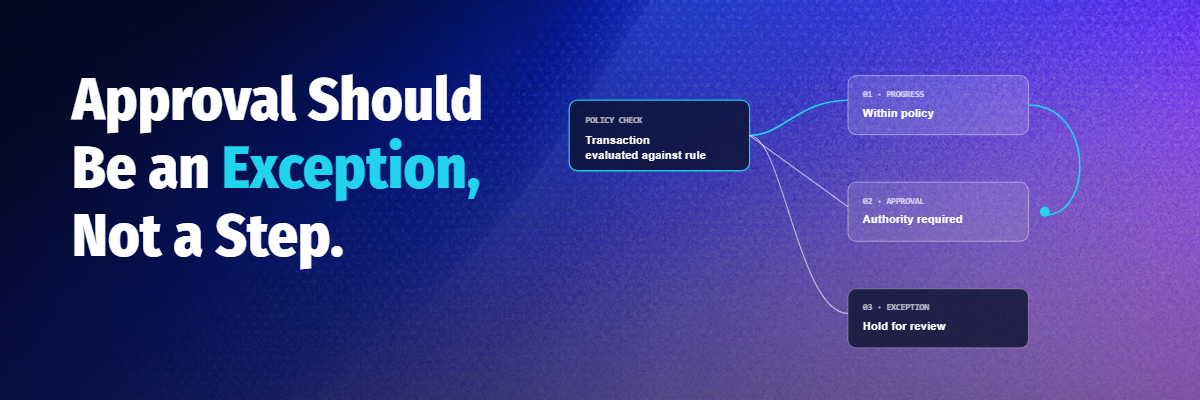
A stronger workflow starts by evaluating the transaction against the rules that define permitted activity. Only after that check does the system decide whether the item can progress, requires approval or should stop as an exception. The approver is therefore part of the control model, but no longer the control model itself.
Three paths are usually more useful than one
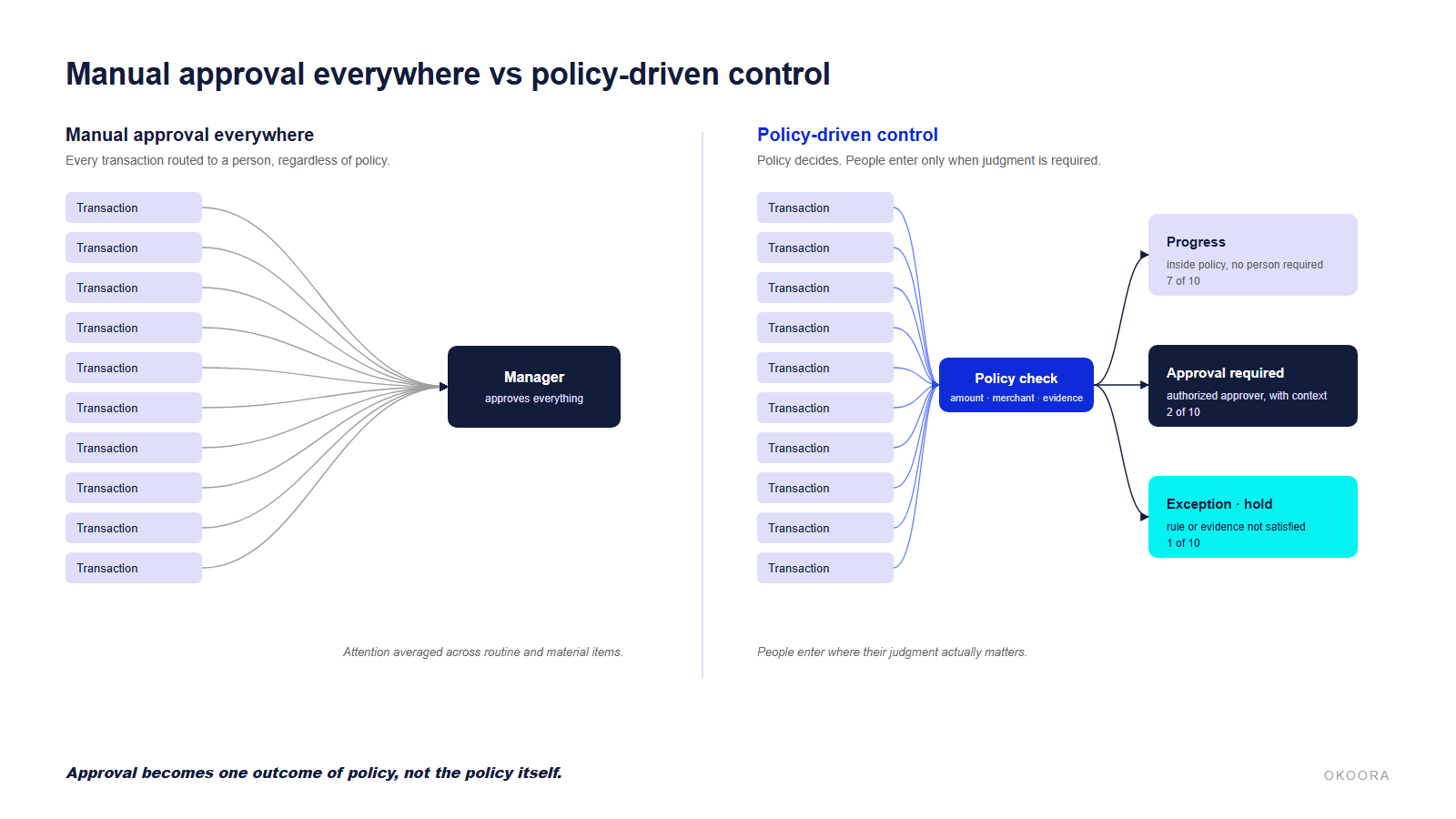
A practical policy-driven workflow often produces three distinct outcomes. The first is routine work that is inside policy and can continue. The second is activity that is permitted only after an authorized person approves it. The third is an exception that should be held because a rule, data requirement or operating condition has not been satisfied.
These paths create a more precise operating model. Routine activity keeps moving. Authority is preserved where policy requires it. Exceptions receive explicit attention. Instead of treating every transaction as equally uncertain, the system distinguishes between work that can proceed and work that genuinely needs a person.
This changes what managers spend time on
In a manual approval environment, managers can become a human routing layer. They receive large numbers of expense items, scan them quickly and often approve the majority because the transactions are ordinary and expected. That creates activity, but it does not necessarily create better judgment.
When policy handles routine decisions, managerial attention can move toward transactions with real economic or control significance. An unusual merchant, a material amount, activity outside the approved geography, missing evidence or a policy breach can surface with its context already attached. The manager is then making a decision rather than performing clerical confirmation.
Policy should be specific to the operating context
A single company-wide threshold is rarely enough. Expense policy can depend on the business context around the transaction. A procurement Program can have different rules from employee travel. An emergency use case can allow rapid activation under a predefined policy. A specific location or role can have different permissions. Different evidence may be required for different categories of spend.
This is why policy works best when it is connected to the Program, user, purpose and financial context of the transaction. The rule becomes part of how the work operates rather than a static document that people are expected to remember after the fact.
Evidence can be part of the same decision
A transaction can be financially valid and still be incomplete. A receipt may be missing. A required business purpose may not be recorded. The accounting context may not yet be clear. These are not necessarily reasons to send the transaction through a generic manager approval. They are reasons to keep the item open until the missing requirement is satisfied.
Policy-driven workflows can separate missing information from authority. The system can request evidence when evidence is missing, route approval only when approval is required and hold exceptions when a rule is breached. That creates a much cleaner distinction between data completion, financial authority and exception handling.
Automation should not remove judgment
The purpose of policy-driven automation is not to eliminate people from finance. It is to stop using people for decisions that have already been made through policy. Human judgment remains essential when the facts are ambiguous, the economics are material, an exception is unusual or authority must be exercised.
A well-designed system therefore makes human involvement more intentional. Routine work progresses under the rules the company has already approved. People enter when the policy says they should, with enough context to understand why the item reached them and what decision is required.
The audit trail becomes clearer
When every expense goes through the same manual approval, an approval record does not necessarily explain much. It can show that someone clicked approve, but not why the transaction was allowed, what policy applied or whether the approval was actually necessary.
A policy-driven model can preserve a richer operating record. It can show which rule applied, whether the item passed automatically, which authority was invoked when approval was required, what exception caused a hold and what evidence completed the item. That is a stronger form of control because the logic behind the outcome is visible.
Where Okoora fits
Okoora can operate spend policy as live financial logic rather than as a static checklist around the transaction. Routine eligible work can progress under the approved rules. Transactions that require authority can be routed to the right approver. Exceptions can be held with the reason surfaced and the relevant evidence preserved.
The customer retains authority. Okoora carries the recurring operating work around policy, workflow, exception handling and evidence. The objective is not fewer controls. It is more precise control, with people involved where their judgment actually matters.
Next step: See how Okoora can turn financial policy into live operating logic across spend, approvals, exceptions and evidence.