 OkooraEditorial Team
Business responsibility and bank-account structure are different problems
Companies often create separate accounts because they need to separate business responsibility. A location needs its own budget. A project needs controlled spend. An emergency Program needs dedicated limits. A procurement team needs visibility. The instinct is understandable: if the business context is different, create another account.
But the operating purpose of the money and the legal or financial account that holds the money are not the same thing. A company can need distinct policy, permissions, limits and reporting without needing a separate real bank account for every use case. Separating these layers can make financial operations simpler while preserving control.
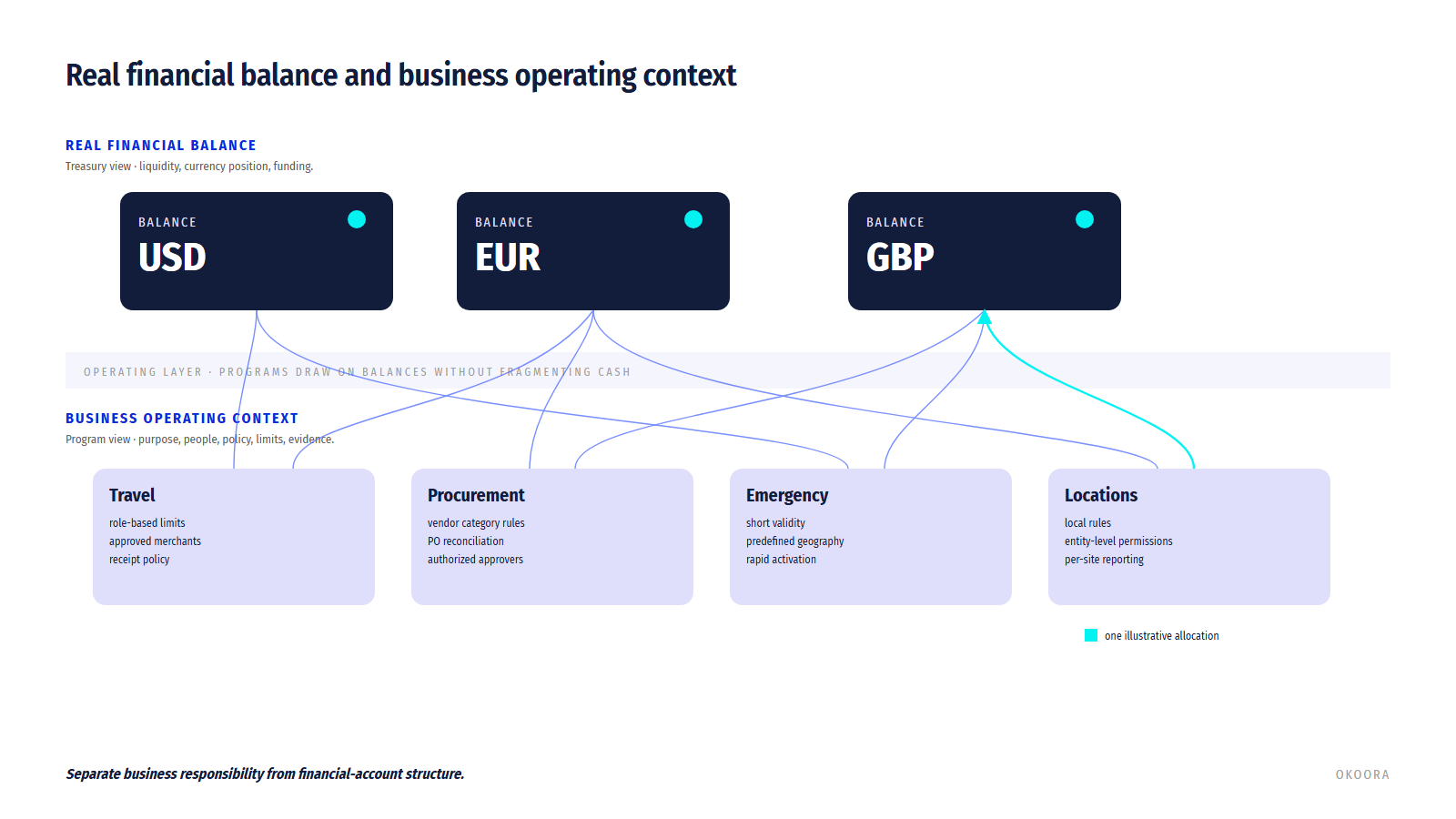
A real balance answers a financial question
A currency account represents actual financial value. It tells the company where funds sit, in which currency and under which account or provider structure. Treasury cares about that real balance because it affects liquidity, funding, cash availability and currency position.
That is different from the question of who may use the funds and for what purpose. A business Program can organize that operating responsibility without pretending that every Program is a legally segregated account. Once the distinction is clear, the company can keep financial balances at the level that makes sense for Treasury while organizing usage at the level that makes sense for the business.
Programs can organize purpose without fragmenting cash
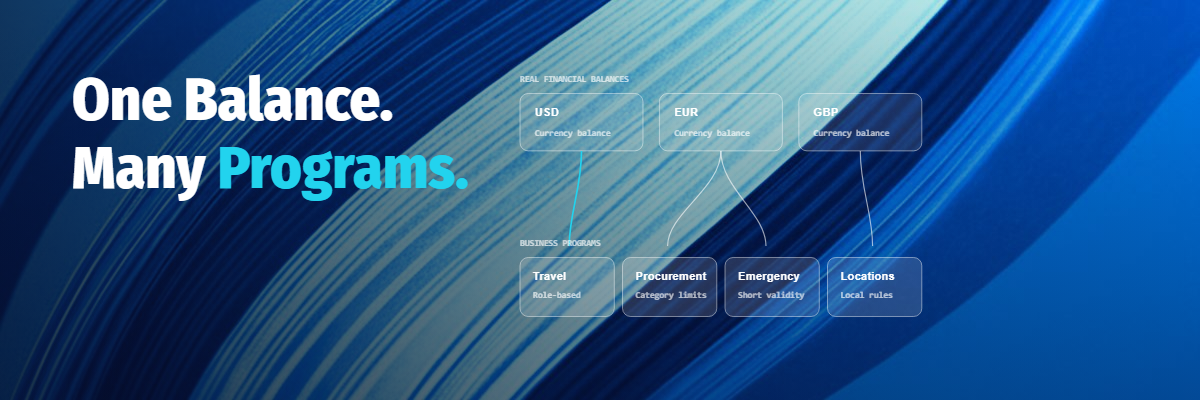
Consider a company with several recurring spend contexts: employee travel, procurement, overseas locations, emergency activity and testing. Each use case may require its own limits, participants, validity rules, merchant controls and evidence. If every one of those contexts requires a separate real account, cash can become fragmented across structures that exist primarily for administrative reasons.
A Program layer can instead hold the business logic. It can define the use case, the eligible people, the permitted spend and the required controls while drawing on an appropriate underlying currency balance. The finance team gains operational separation without necessarily breaking the cash into dozens of separate financial containers.
This can improve Treasury visibility
When operating contexts and real balances are mixed together, Treasury can struggle to understand the actual currency position. Several operational accounts may all represent pieces of the same EUR or USD liquidity, while the business thinks in terms of projects, departments or use cases.
Keeping the real balance at the currency level can create a clearer Treasury view. Programs can still show how that balance is allocated or expected to be used, but the company can see the aggregate currency position before deciding whether it needs funding or conversion. That matters because financial decisions should be based on the real economic position, not only the organizational structure around it.
It also creates cleaner policy
A Program can become the natural home for operating policy. A procurement Program can allow specific merchant categories and larger limits. An emergency Program can have short validity and predefined geographic restrictions. Employee travel can follow role-based thresholds. A location Program can apply local rules while still drawing on the relevant financial balance.
The policy therefore follows the business responsibility rather than being duplicated across multiple accounts. This can make the model easier to understand and maintain, especially as use cases expand.
The distinction matters for cards
Cards make the difference between balance and Program particularly visible. Several cardholders can operate under the same Program, each with their own limits and permissions. Several Programs can draw on the same underlying currency balance. The company can organize who may spend and why without requiring a separate real account behind each card or use case.
The issuer and card program still determine which funding and card models are actually available. The operating principle is simply that business context should not be confused with legal account structure unless the use case genuinely requires segregation.
The distinction matters beyond cards too
The same logic applies to other financial workflows. A project can have a payment policy without owning a separate bank account. A business unit can have an operating allocation without representing a legally segregated balance. A customer program can have controls and evidence requirements while the underlying funds remain within an approved financial structure.
This separation lets Finance organize responsibility around the work while Treasury manages liquidity around the real financial position.
Where separate accounts still make sense
There are many situations where real account separation is necessary or desirable. Legal segregation, safeguarding, regulatory requirements, entity ownership, contractual restrictions, tax structure or risk management can all justify distinct accounts. The point is not that separate accounts are unnecessary.
The point is that operational separation should not automatically be implemented as financial-account fragmentation. The company should decide deliberately whether a use case requires a separate real balance or only a separate operating context.
Where Okoora fits
Okoora can separate real financial balances from business Programs while keeping them connected in one operating model. Currency balances represent the real financial foundation. Programs can organize who may use those balances, for which business purpose, under which policy and with which controls.
This lets Finance organize responsibility without losing Treasury visibility. It also allows card, spend and other financial activity to remain connected to the real currency position underneath.
Next step: See how Okoora can separate real financial balances from business operating Programs while keeping policy, spend and accountability connected.