 OkooraEditorial Team
An operational event can create a financial need immediately
A flight disruption, field incident, urgent procurement request, customer entitlement, temporary project or emergency can create a financial requirement before Finance has time to build a new process around it. Someone needs controlled access to money, a card, a payment capability or another financial resource, and the business needs that access to exist quickly without abandoning governance.
The event should be the trigger, not an email chain
In many organizations, exceptional financial access begins with messages, spreadsheets and manual lists. Operations identifies the need, Finance checks who is eligible, someone decides the limit, another person requests the financial instrument, and the evidence is assembled later. The financial product may work, but the process around it is improvised each time.
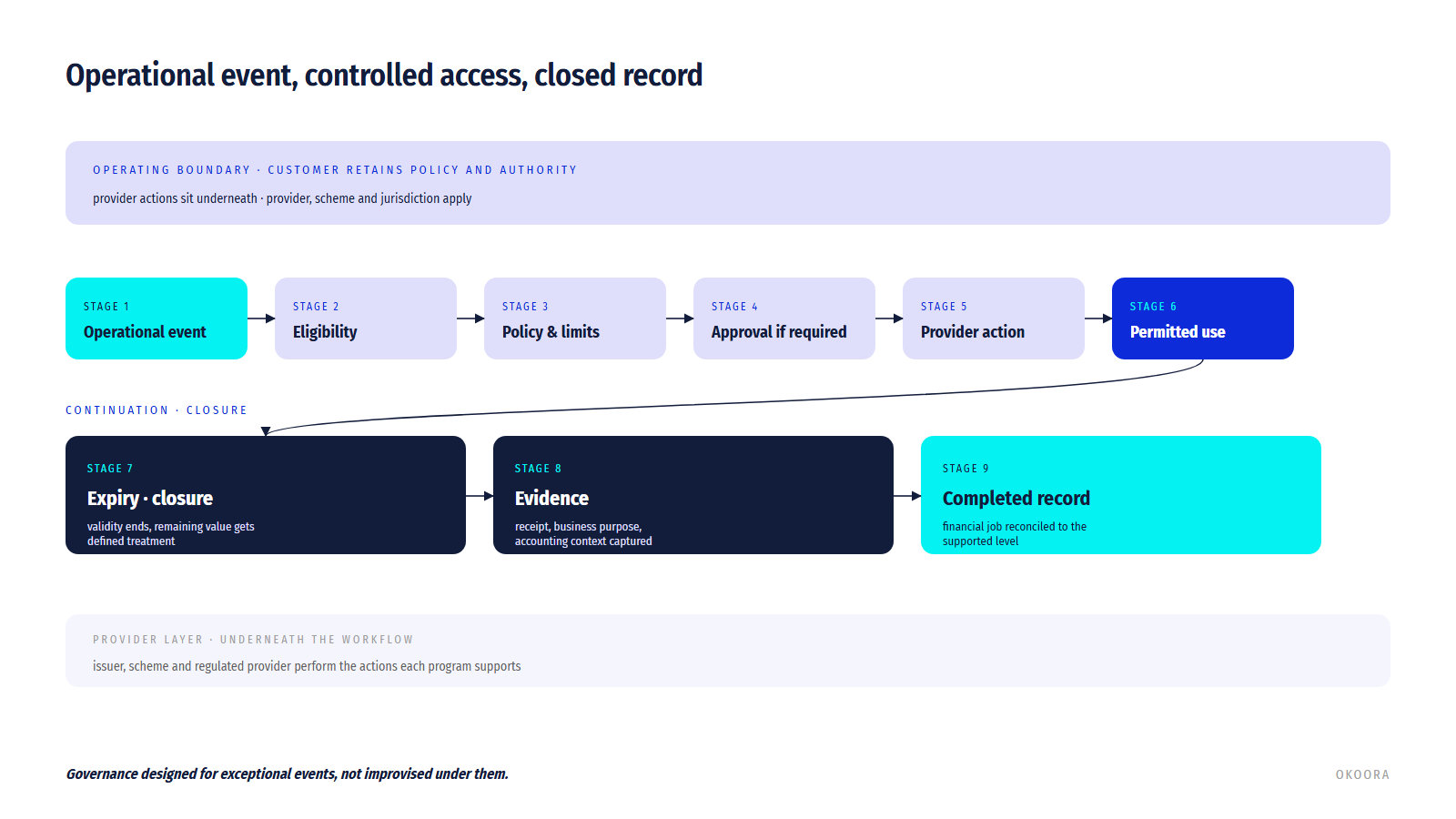
A stronger model starts from the operational event itself. When an approved event occurs, the system can begin the financial workflow with the relevant business context already attached.
Eligibility should be determined before access is created
The event alone should not be enough. The company still needs to know who is eligible, which role or population may receive access, what identification or onboarding is required and which financial provider can support the use case. These rules should be defined in advance wherever the event is predictable enough to prepare for.
That turns a time-sensitive request into a governed workflow rather than a discretionary exception.
Policy should define the financial boundary
Controlled financial access needs clear limits. The company may define amount, geography, currency, merchant category, validity, transaction type, permitted user group or another operating boundary. The exact controls available can depend on the selected issuer, provider, scheme and jurisdiction, but the business policy should remain explicit.
The goal is speed inside a predefined boundary, not speed instead of a boundary.
Provider actions can remain underneath the workflow
The operating layer and the financial provider do different jobs. The company defines the business event and policy. The operating layer coordinates context, eligibility, workflow and evidence. The selected issuer or financial provider performs the provider-controlled action that its program supports.
That separation lets the business keep one governed process even when the underlying provider or financial instrument varies by geography or use case.
The experience should stay simple for the person receiving access
A sophisticated control model should not create a complicated employee or customer experience. The recipient may simply need to receive access, understand the permitted amount or validity, use it and provide supporting information where required.
The complexity belongs underneath. Policy, permissions, provider coordination, accounting context and evidence should be carried by the system so the user sees only the steps that require action.
Expiry and completion are part of the job
Temporary financial access should not remain open indefinitely. The workflow needs a clear completion state. Access may expire, unused value may need defined treatment, the underlying transaction may need evidence, and the final financial record may need to be reconciled.
This matters because the financial job is not complete when access is created. It is complete when the event has been served, the permitted financial activity has ended and the resulting record is closed to the supported level.
Prepared rules make exceptional events easier to operate
The highest-value work often happens before the emergency. The company can define eligible roles, financial limits, approval authority, validity and evidence requirements in advance. Then, when the event occurs, the system applies an approved rule set instead of asking people to invent one under pressure.
This creates a useful principle for finance operations: exceptional events do not require exceptional governance. They require governance designed for exceptional events.
Where Okoora fits
Okoora can connect an operational event to the financial workflow it creates. The event can trigger eligibility checks, policy, approval where required, provider coordination, controlled financial access, expiry, evidence and completion while the customer retains authority over the rules.
The selected issuer or provider remains responsible for the actions it controls. Okoora operates the context, policy and workflow around the financial job.
Next step: See how Okoora can connect operational events to policy, eligibility, financial access, provider actions and evidence in one governed flow.
Related reading: Why Approval Should Be an Exception, Not a Step in Every Expense.