 Okoora TeamOkoora
For payment service providers processing transactions across multiple currencies, FX reconciliation is one of the most operationally demanding functions in the business. Done manually, it consumes significant team time, introduces error risk at every step, and slows down the financial close. Automated FX reconciliation solves all three problems by matching transactions, validating rates, and flagging discrepancies in real time, without the spreadsheet overhead.
What Is FX Reconciliation and Why Does It Break at Scale?
FX reconciliation is the process of verifying that foreign currency transactions, such as payments sent, payments received, conversions executed, and fees charged, match across a PSP’s internal records, bank statements, and settlement reports. For every transaction that crosses a currency boundary, the reconciliation process must confirm that the correct exchange rate was applied, the right amount settled, and that any FX margin or fee was captured accurately.
At low transaction volumes, this is manageable with manual processes. At scale, it is not. A PSP processing thousands of cross-border transactions daily across EUR, GBP, USD, JPY, and emerging-market currencies generates a reconciliation workload that compounds quickly. Every transaction requires a rate lookup, matching across multiple data sources, and investigation of any unmatched items. Each discrepancy then needs manual correction before the books can close.
The failure modes are predictable:
- Delayed closes
- Undetected rate errors that erode margin
- Finance teams are spending time on data matching rather than analysis
Foreign exchange reconciliation software exists precisely to remove these failure points.
How Automated FX Reconciliation Works for PSPs
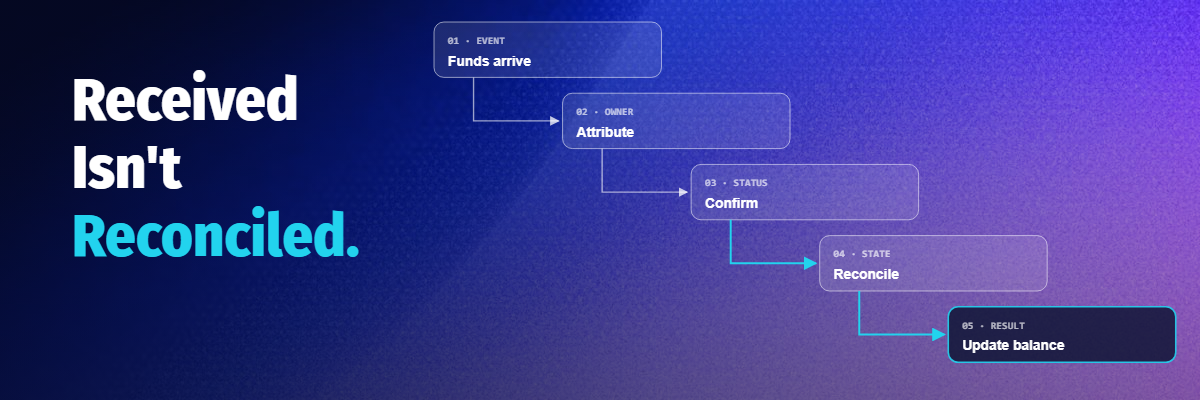
Automated FX reconciliation replaces the manual matching process with a system that ingests transaction data from multiple sources, including payment processors, banking partners, internal ledgers, and FX execution engines, and automatically applies a set of matching rules to verify each transaction.
The Core Workflow Covers Four Steps:
Data ingestion. The system pulls transaction records from all relevant sources in real time or near-real time. For a PSP, this typically means settlement files from card networks, FX execution confirmations, bank statements, and internal accounting entries.
Rate validation. Each FX transaction is checked against the agreed or prevailing rate at the time of execution. Deviations beyond a defined tolerance are flagged automatically for review. This is where margin leakage is caught. Rate discrepancies that would be invisible in a manual process surface immediately.
Transaction matching. The system matches payments across sources using configurable rules based on:
- Reference number
- Amount
- Currency pair
- Counterparty
- Settlement date
Matched items are cleared automatically. Unmatched items are queued for investigation with enough context to resolve them quickly.
Exception management. Rather than reviewing every transaction, finance teams work only on the unmatched or out-of-tolerance items that the system could not clear automatically. In a well-configured FX reconciliation automation setup, auto-match rates of 95% or higher are achievable, dramatically reducing manual workload.
The Business Case for PSPs: Where Automated Reconciliation Pays for Itself
The operational efficiency argument for payment reconciliation automation is straightforward. With fewer hours spent on matching, you’ll close faster. But the margin protection argument is equally important and often underappreciated.
For a PSP that earns revenue on FX spread, the accuracy of rate application across thousands of daily transactions directly determines profitability. A systematic rate error of even 0.05% on high-volume currency pairs compounds into material revenue leakage over the course of a month. Manual reconciliation processes are unlikely to consistently catch these errors; however, automated rate validation catches them on every transaction, every day.
There are also compliance and audit benefits. Regulators in most jurisdictions require PSPs to maintain accurate records of all FX transactions, including the rates applied and the basis for those rates. A system that produces a clean, timestamped audit trail for every transaction is significantly easier to audit than a collection of spreadsheets and manual reconciliation files.
Get Started with FX Reconciliation Automation
Implementing automated FX reconciliation starts with understanding your current data flows: where transaction records originate, how many sources need to be reconciled, and where the current process breaks down most frequently. The answer to that last question usually points directly to where automation will deliver the fastest return.
Okoora’s FX Execution Engine provides real-time FX execution with full transaction-level data, giving reconciliation systems a clean, structured source of record for every conversion. The FX Risk Engine monitors exposure and rate application across your entire transaction portfolio, flagging discrepancies before they reach the close.
If your team is managing FX reconciliation manually at scale, speak with Okoora about what an automated infrastructure layer looks like for your payment operation.