 Okoora TeamOkoora
Exchange rate fluctuations, multi-leg settlement timelines, and counterparty discrepancies can turn a straightforward payment into a reconciliation puzzle. For finance teams managing cross-border operations, three-way reconciliation is the foundation of accurate, audit-ready FX reporting.
What Is Three-Way Reconciliation?
Three-way reconciliation is the process of matching three independent data sources to confirm that a transaction is complete, accurate, and consistent across all records. In traditional accounts payable, this means aligning a purchase order, a goods receipt, and a supplier invoice. When applied to foreign exchange, the same principle holds, but the data sources shift to reflect the realities of currency transactions.
For FX transaction reconciliation, the three layers typically involve:
- The trade confirmation — the record of the FX deal as agreed between counterparties, including the currency pair, rate, notional amount, and value date.
- The bank or settlement statement — the actual movement of funds reflected in account statements from the sending and receiving banks.
- The internal ledger or ERP entry — how the transaction was recorded in the company’s own accounting system, including any realized gains or losses from rate differences.
When all three match, the transaction is clean. When they don’t, the discrepancy must be identified and resolved before the financial statements can be trusted.
Why FX Transactions Demand a Three-Way Approach
A standard two-way reconciliation compares an internal ledger against a bank statement. It works well enough for domestic payments. FX transactions break that model for several reasons.
Rate Divergence Between Booking and Settlement
The rate at which an FX trade is booked is rarely identical to the rate at which it settles, particularly for forward contracts or transactions with multi-day settlement windows. A two-way match won’t surface this gap. Three-way match reconciliation closes it by cross-referencing the agreed rate in the trade confirmation against both the bank statement and the ledger entry.
Multi-Currency Settlement Chains
Cross-border payments often pass through correspondent banks or intermediaries, each of which may apply fees or convert amounts at slightly different rates. Without a three-way framework, these micro-discrepancies accumulate silently and only surface during an audit or when a payment fails to reconcile at period end.
Realized vs. Unrealized FX Gains and Losses
Finance teams must distinguish between unrealized FX positions (open trades valued at current market rates) and realized gains or losses (closed trades with actual settlement amounts). FX three-way reconciliation makes this distinction traceable, ensuring each closed transaction flows cleanly from trade confirmation to settlement to the correct ledger account.
The Three-Way Match Reconciliation Process for FX
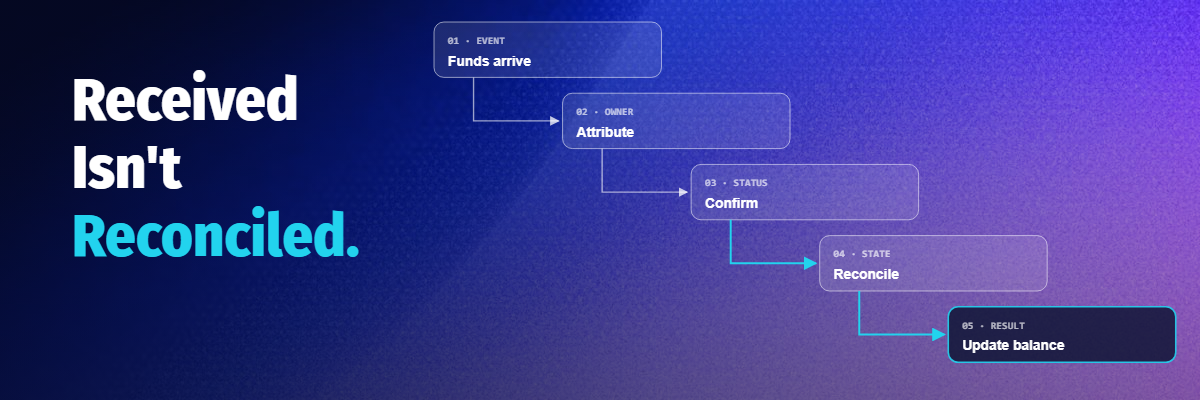
Executing three-way reconciliation for FX transactions follows a structured workflow:
Step 1: Capture All Trade Confirmations
Centralize trade confirmations from all FX counterparties, including banks, brokers, or platform providers. Each confirmation should include the currency pair, agreed rate, settlement date, and notional amounts in both currencies.
Step 2: Obtain Settlement and Bank Data
Pull MT940 statements, SWIFT messages, or bank feed data for the relevant settlement accounts. Match each inbound and outbound cash movement to a corresponding trade confirmation, checking that settlement amounts align within an acceptable tolerance.
Step 3: Reconcile Against the Internal Ledger
Compare the matched bank/trade data to ledger entries in your ERP or accounting system. Verify that the FX rate used for ledger booking reflects the agreed trade rate, and that any rate differences have been properly recorded as FX gains or losses in the appropriate accounts.
Step 4: Investigate and Clear Breaks
Flag any unmatched or out-of-tolerance items as reconciliation breaks. Common causes include timing differences (transactions settled after the reporting period), bank charges deducted mid-payment, or manual entry errors. Each break should be documented, investigated, and resolved before sign-off.
Step 5: Produce a Reconciliation Report
Generate a documented output that shows matched items, cleared breaks, open items, and the final reconciled balance. This report serves as the audit trail and the basis for any period-end FX adjustment entries.
Common Pitfalls in FX Three-Way Reconciliation
Even well-resourced finance teams run into recurring issues:
- Tolerance Thresholds Set Too Wide — A tolerance that’s too generous masks genuine errors. FX reconciliation tolerances should account for rounding differences but flag meaningful rate discrepancies.
- Inconsistent Rate Sources — Using different FX rate sources for trade booking versus period-end revaluation creates phantom discrepancies that are time-consuming to unwind.
- Manual Processes at Scale — Spreadsheet-based three-way reconciliation works for low transaction volumes. As FX activity grows across multiple currencies and entities, manual matching becomes a liability — slow, error-prone, and difficult to audit.
Automating Three-Way Reconciliation for FX at Scale
Modern treasury and FX management platforms can automate much of the three-way match reconciliation process. By connecting trade confirmation feeds, bank data, and ERP ledger entries in a single environment, finance teams can reduce manual matching effort, accelerate close cycles, and catch discrepancies in near real-time rather than at period end.
For businesses managing FX across multiple entities or geographies, automation is a requirement for maintaining accuracy without proportional growth in headcount.
Okoora’s platform is built around exactly this challenge: giving finance teams the tools to manage, settle, and reconcile FX transactions with full visibility across all three data layers — so every trade is traceable from confirmation to close.