 Benjamin AvrahamCEO
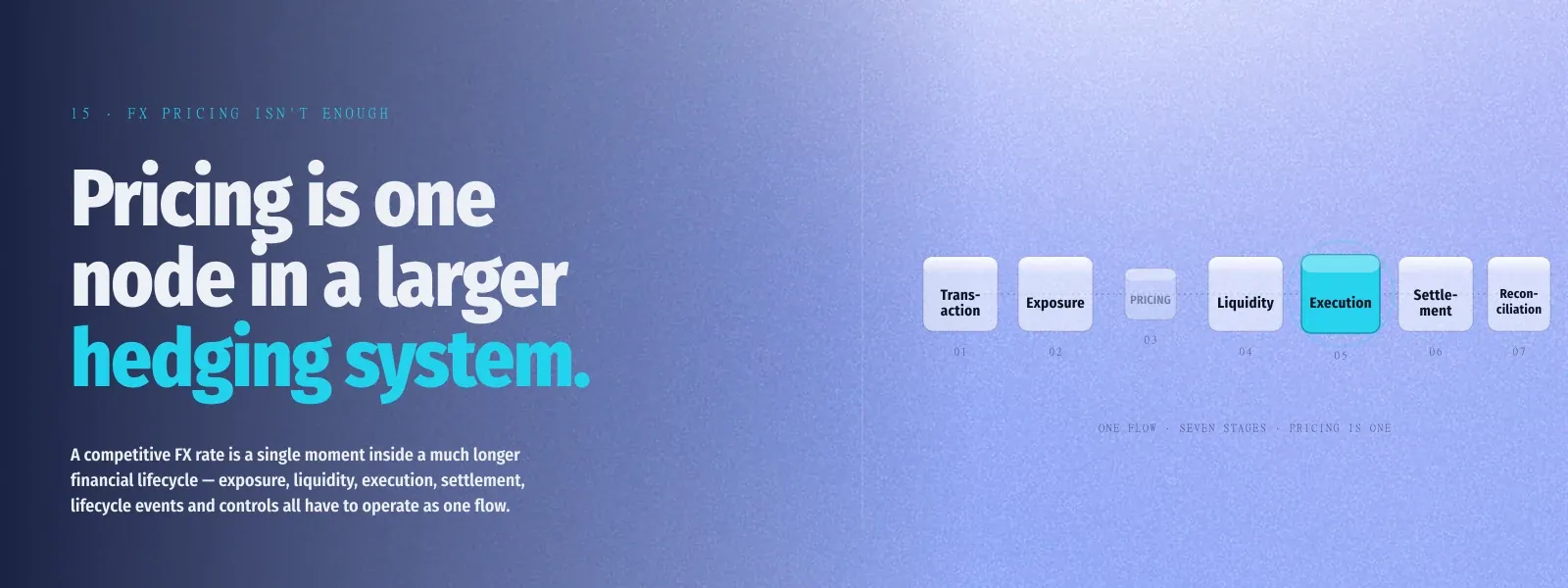
A competitive FX rate is only one moment in the product
Embedded hedging can look deceptively simple from the outside. A customer creates a transaction today that will settle later, the platform offers protection against currency movement, and an FX rate or premium sits somewhere behind the experience.
That can make pricing appear to be the main infrastructure question: who can provide the best rate?
Pricing matters. But an embedded hedging product does not succeed or fail at the quote alone. The quote is one moment inside a much longer financial lifecycle. Before and after it, the system still has to understand the transaction, create or aggregate exposure, choose the correct instrument, execute at the right time, handle settlement, react to changes and keep the financial state consistent.
If those pieces do not operate together, a strong price can still sit inside a weak product.
The underlying transaction creates the real requirement
The starting point is not the FX trade. It is the customer activity that creates a future financial consequence.
Consider a travel booking, marketplace purchase, installment plan or other transaction in which a commercial price is fixed today but the economic settlement occurs later. The platform may want to protect the expected value of that transaction from currency movement.
To do that reliably, the infrastructure needs more than a currency pair and an amount. It may need to know the transaction date, expected settlement date, source and destination currencies, cancellation rules, refund behavior, whether the exposure should be hedged individually or aggregated, and what should happen if the underlying transaction changes.
The financial product begins with the business event. The hedge is the financial action that follows from it.
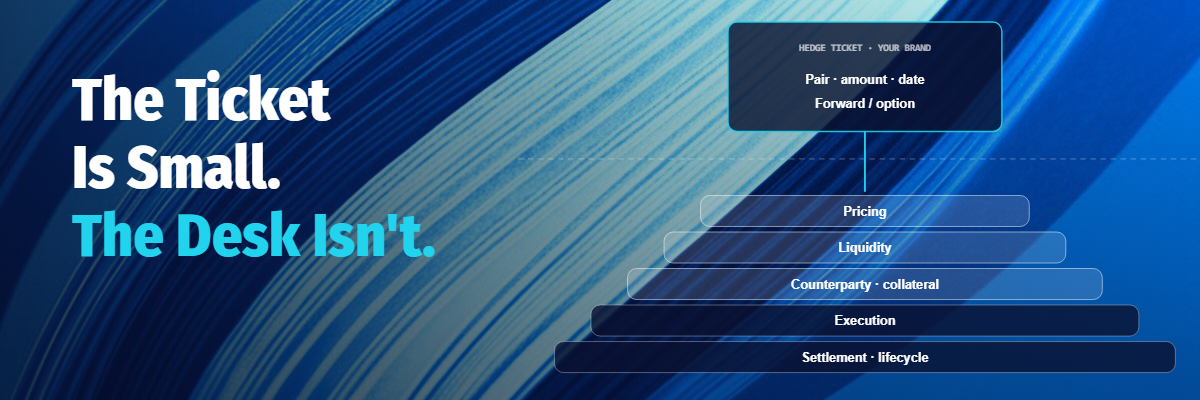
Pricing, liquidity and execution are different problems
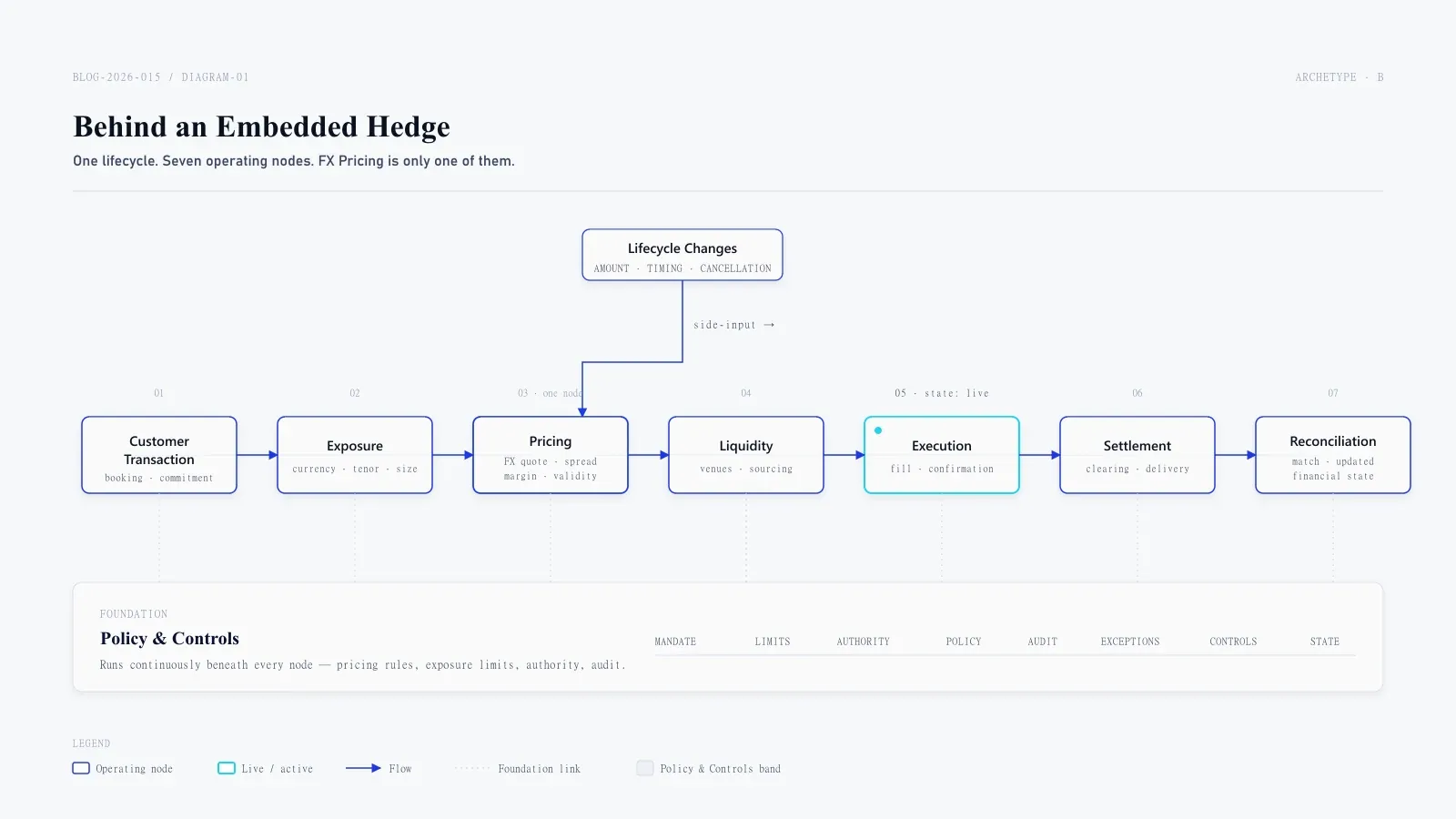
A price is an indication of what a transaction could cost. Liquidity determines whether the required market exposure can actually be taken at the required size, currency and tenor. Execution determines how that exposure is placed and confirmed.
For a simple liquid currency pair, those distinctions may feel small. They become much more important as the product expands into additional currencies, emerging-market corridors, longer tenors or a high volume of smaller transactions.
A platform therefore needs to evaluate questions such as:
Can pricing be delivered in the format the product requires, such as API quotes, RFQ or streaming prices?
Can the provider support the currencies and tenors the product actually sells?
Which instruments are available, including spot, forwards, swaps or NDFs where relevant?
Can execution happen programmatically and at the frequency the product requires?
Are there practical limits, credit requirements or prefunding conditions that change how the product can operate?
What happens when a market or corridor is available for pricing but not for the required execution or settlement path?
A high-volume product changes the operating model
Embedded hedging often turns a financial activity that was historically handled as a relatively small number of treasury trades into a product that may create many customer-level exposures.
That changes the infrastructure problem.
The system may need to decide whether to hedge transaction by transaction, aggregate exposures before execution, or use a combination of both. It must maintain the relationship between the customer transaction and the resulting market position even when many customer transactions are compressed into fewer hedge trades.
This is not only an efficiency question. It affects reconciliation, lifecycle management, risk visibility and the ability to explain what the financial position represents at any moment.
Cancellations and amendments are part of the product, not edge cases
A customer transaction does not always remain exactly as it was when the quote was created.
A booking can be cancelled. An installment can be repaid early. A settlement date can move. A transaction amount can change. A refund can create a new cash flow in the opposite direction.
When the underlying activity changes, the financial position may also need to change. A hedge that was appropriate for the original transaction can become too large, too small or incorrectly timed.
That means embedded hedging infrastructure needs a lifecycle model. It must know what the hedge is protecting, detect when the underlying event changes, determine the financial consequence and support the appropriate adjustment.
A pricing API alone cannot do that.
Settlement is where a quoted product becomes real money movement
Execution does not complete the operating cycle. The financial obligations created by the trade still have to settle.
That introduces practical questions around settlement currencies, value dates, prefunding, account structures, payment corridors, confirmations, reconciliation and exception handling. The exact requirements vary by product and market, but the principle is constant: the platform needs a reliable path from customer promise to financial completion.
The stronger the embedded experience becomes, the less visible this complexity should be to the end customer. That does not make the complexity disappear. It makes the quality of the underlying infrastructure more important.
The product needs one financial state across customer activity and market execution
The hardest operational problems often appear when customer activity and market execution live as separate realities.
The product knows what customers bought. The liquidity provider knows what was traded. Another system knows what settled. A spreadsheet or operations team is left to reconstruct how those pieces relate.
A stronger model maintains one persistent financial state that connects the relevant customer transaction, exposure, hedge, execution and settlement status.
When something changes, the system can update the relationship rather than rebuilding it from scratch. That is what allows the product to answer questions such as: what is still exposed, what is already protected, what has changed, what is due to settle and what requires action?
Controls have to be embedded as deeply as execution
A financial product cannot scale safely if control is added only after execution.
Policy, permissions, limits, approvals, counterparty rules and exception handling need to be part of the operating flow. The system should know what can proceed routinely, what requires review and what must stop.
This becomes increasingly important when a platform is serving its own customers. The platform is not simply executing an internal treasury decision. It is making a financial capability part of a customer-facing product and must preserve a consistent operating model across many transactions.
What to evaluate when choosing embedded hedging infrastructure
When a platform evaluates providers, the useful question is not simply, “Who gives us the best FX price?”
A better evaluation looks across the entire operating chain:
Customer transaction: what event creates the exposure and what can change later?
Pricing: how is the quote delivered and how long is it valid?
Liquidity: which currencies, sizes, tenors and markets can be supported?
Execution: how are trades placed, confirmed and linked back to customer activity?
Hedging model: transaction level, aggregated or hybrid?
Lifecycle: how are cancellations, refunds, amendments and timing changes handled?
Settlement: what accounts, currencies, corridors, cycles, prefunding or credit are required?
Reconciliation: can customer activity, hedge activity and settlement be tied together reliably?
Controls: what policy, limits, permissions and exceptions govern the flow?
Operations: what happens when pricing, execution or settlement fails?
The best infrastructure can expand without forcing a product rebuild
Platforms rarely launch every currency, corridor and product variation on day one. A good infrastructure model should therefore support a narrow initial scope while preserving a path to expansion.
That may mean starting with selected currencies, a defined transaction type and a specific execution model. As the product proves demand, the platform can add currencies, settlement paths, instruments or additional financial capabilities without redesigning the customer experience around a new provider every time.
The objective is not maximum infrastructure on day one. It is enough depth to operate the first real product reliably, with an architecture that can grow as the financial product grows.
Where Okoora fits
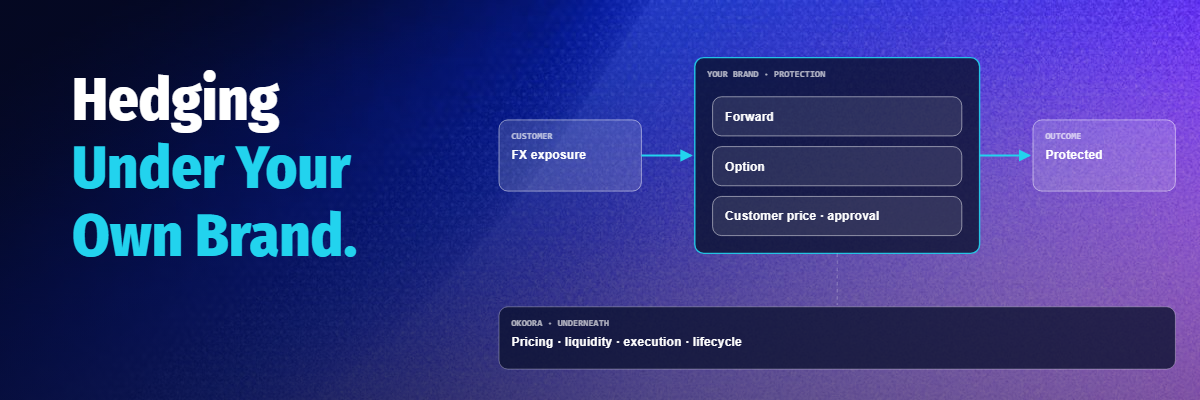
Okoora provides the financial infrastructure that can sit behind embedded financial products, connecting pricing, liquidity, FX execution, settlement, money movement, data connectivity and control.
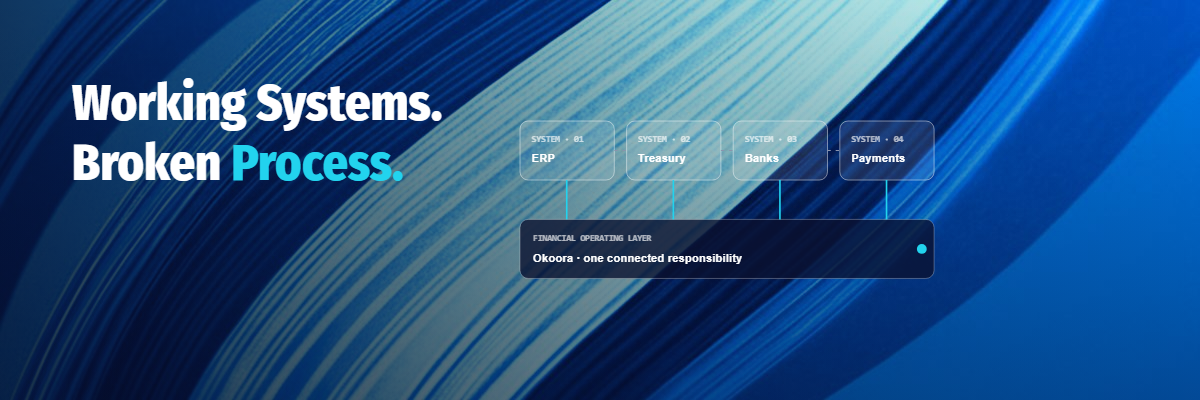
The value is not a rate in isolation. It is the ability to operate the financial lifecycle behind the customer experience as one connected system.
For platforms building embedded hedging, that means the commercial product can stay focused on the customer problem while the underlying financial activity is priced, executed, settled, controlled and kept connected to the transaction that created it.
Next step: Explore how Okoora can provide the financial infrastructure behind an embedded hedging product.
Explore how Okoora can provide the financial infrastructure behind an embedded hedging product.
Related reading: What Embedded Hedging Actually Requires Behind the API.