 OkooraEditorial Team
One product integration can solve a problem. Ten product integrations can create another one.
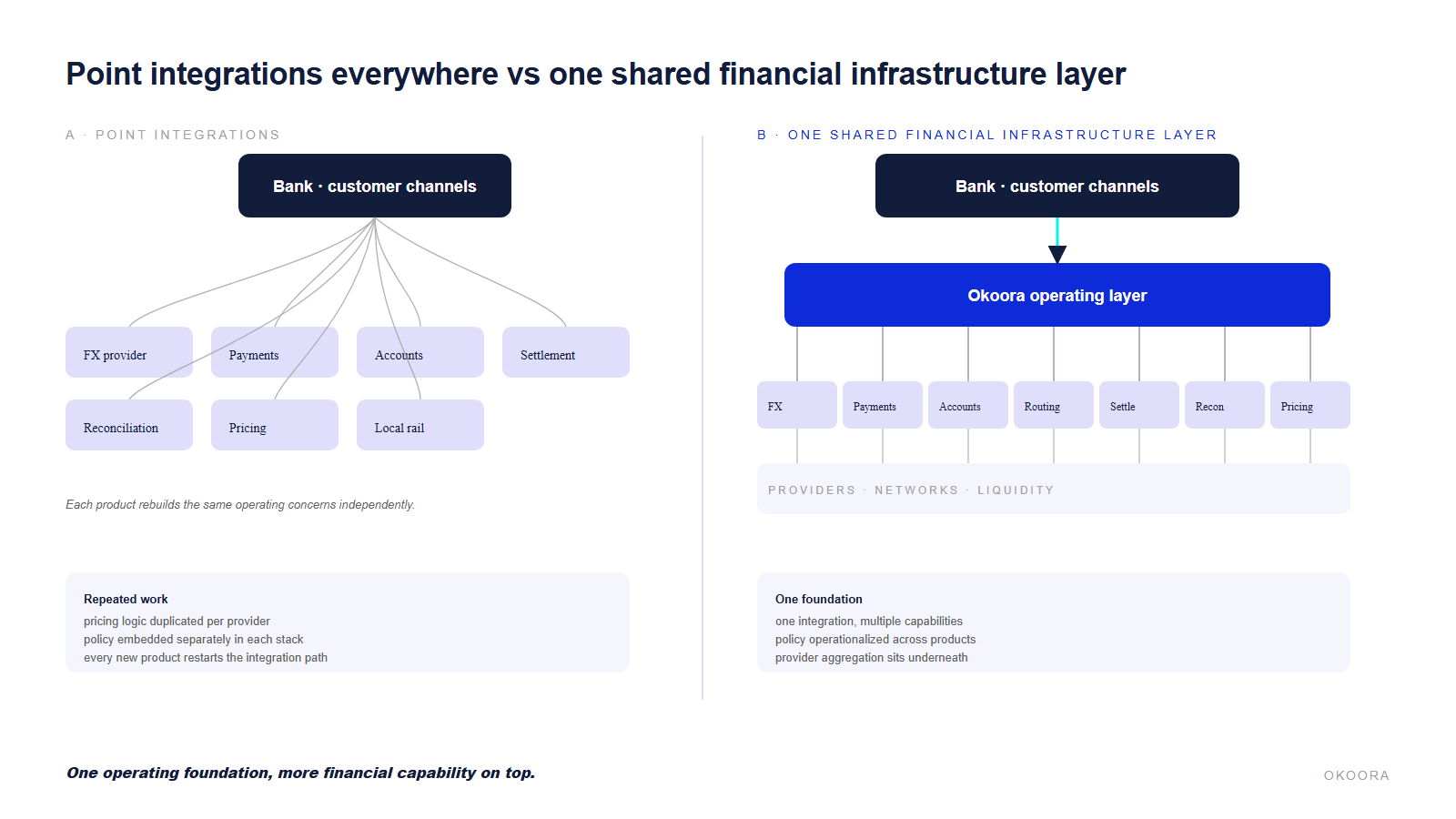
A bank wants to add better FX pricing, so it integrates an FX provider. It wants local payments, so it adds a payment connection. It needs virtual accounts, so it integrates another provider. Settlement and reconciliation create additional work. A new country introduces another local rail and another provider relationship.
Each decision can be reasonable on its own. Over time, the bank can end up with a product stack built as a collection of point integrations rather than one financial operating architecture.
The immediate capability works. The larger system becomes harder to extend.
Financial products share more infrastructure than they appear to
FX, payments and accounts are often bought as separate products, but the underlying financial work overlaps. A payment may require currency conversion. An account structure determines where funds sit. Settlement affects when value becomes usable. Reconciliation connects execution back to the customer and ledger state. Pricing determines the economics of the customer relationship. Policy and controls apply across all of them.
When each capability is integrated independently, the bank can end up rebuilding the same operating concerns repeatedly around different vendors.
The customer relationship should sit above the infrastructure
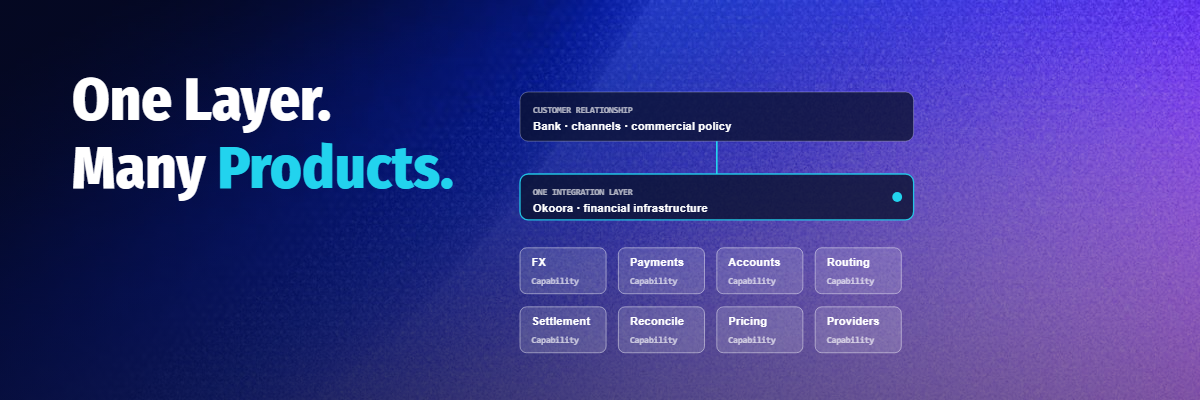
The bank already owns the customer relationship, brand, channels and commercial policy. Those are strategic assets. The financial infrastructure underneath should support them rather than forcing the bank to redesign the customer experience around each new provider.
A shared infrastructure layer creates a cleaner separation. The bank keeps the customer-facing proposition. The infrastructure layer provides the connectivity, pricing, routing, execution, settlement and reconciliation required behind it.
One integration can expose multiple financial capabilities
A stronger architecture connects the bank once to an operating layer that can support multiple financial domains. FX pricing and execution, local and cross-border payments, accounts, settlement, reconciliation, liquidity and additional financial products can then operate through the same integration foundation.
This does not mean every capability becomes automatically available in every market. Provider, regulatory, customer-type and jurisdiction requirements still matter. The architectural advantage is that the bank does not need to start from zero each time a new capability is added.
The shared layer can also preserve policy
Commercial and operating policy should remain consistent even when the underlying provider changes. The bank may define customer pricing, routing rules, approved providers, transaction limits, exception logic and product eligibility.
A shared infrastructure layer can operationalize those rules across several financial capabilities. That is more durable than embedding the policy separately inside each point integration.
Provider aggregation belongs underneath the customer experience
Banks should not need to expose the complexity of the provider ecosystem to customers. Several banks, liquidity providers, payment rails, clearing networks or regulated providers may sit underneath a financial product. The customer should experience one coherent bank proposition.
The infrastructure layer can absorb that complexity. It can coordinate the eligible provider network while the bank preserves one customer relationship and one product experience.
This also improves expansion
The value becomes more obvious when the bank expands. A new market may require a different local payment rail, account structure or regulated provider. A new segment may need a different pricing model. A deeper SME proposition may add hedging or liquidity capabilities.
If the bank has a shared financial infrastructure layer, those changes can be activated underneath the existing customer architecture. If every capability is a separate point integration, expansion repeatedly becomes an integration project.
Architecture affects economics too
A shared layer can do more than reduce technical duplication. It can connect execution economics with customer economics. The bank can see the underlying executable price, apply its own commercial policy and price customers according to segment, volume, product or transaction context.
That creates a direct connection between infrastructure design and monetization. The architecture determines not only how the transaction works, but how much financial value the bank can retain from the relationship.
The question is what the bank wants to build on for years
A procurement process may begin with a narrow requirement such as FX, payments or accounts. The larger decision is whether the chosen architecture can support the next product, market and customer segment without forcing another rebuild.
Banks should therefore evaluate both the immediate capability and the expansion path. The best point solution today may still create structural friction tomorrow if it cannot become part of a wider financial operating model.
Where Okoora fits
Okoora provides an embedded financial infrastructure and intelligence layer across FX, payments, accounts, routing, settlement, reconciliation, pricing and provider connectivity. The bank can keep the customer relationship, channels, product experience and commercial policy while Okoora operates the financial infrastructure underneath.
The goal is not one vendor for the sake of consolidation. It is one operating foundation that can support more financial capability without rebuilding the stack one integration at a time.
Next step: See how Okoora can provide one embedded financial infrastructure layer across FX, payments, accounts, routing, settlement, reconciliation and financial intelligence.
Related reading: How Banks Can Expand Into New Markets Without Rebuilding the Financial Stack, How to Launch a New Financial Product Without Rebuilding the Financial Stack.