 OkooraEditorial Team
Market data answers an important question. It does not answer the whole financial question.
Treasury teams have access to more market information than ever. FX rates update continuously. Interest-rate curves move throughout the day. Commodity prices, volatility, liquidity and provider quotes can all be observed in near real time.
That visibility is valuable. But the financially important question is rarely only what moved in the market.
The question is what that movement changed for the business.
The same market move can create very different business consequences
A currency can strengthen by the same amount for two companies and create opposite outcomes. One company may benefit because its revenue is denominated in that currency. Another may face a higher cost because its major supplier obligation is denominated there. A third may already have protection in place that changes the result again.
The market fact is shared. The economic meaning is company-specific.
That distinction is where modern Treasury needs to move beyond market visibility and toward decision-ready financial context.
Economic meaning begins with the business activity underneath the market move
A financial system cannot understand the consequence of a market movement without understanding the activity that gives the movement meaning.
Orders, purchase commitments, contracts, forecasts, customer pricing, production changes, balances, debt and expected cash flows can all create or change financial responsibility.
The earlier that activity is connected to financial interpretation, the earlier Treasury can understand whether a market move is material while there is still time to decide.
Existing financial state changes the meaning again
The business may already have hedges, balances, debt, prior execution, protection, limits or approvals in place. A market movement should therefore be interpreted against the state that already exists, not against a blank position.
A useful Treasury view should be able to answer not only what the market did, but what the company is already carrying, what is already protected, what remains open and what has changed since the last accepted state.
Without that context, even accurate market data can lead to an incomplete financial picture.
Policy turns economic meaning into a decision boundary
Knowing that an economic state changed does not automatically mean the company should act.
Treasury policy, thresholds, limits, approval rules and authority determine whether a change is material, whether action is permitted, whether escalation is required or whether the correct decision is to do nothing.
This is why policy is part of financial intelligence, not only part of governance after the analysis is complete.
The useful output is not another chart. It is a decision-ready state.
Modern Treasury does not need more information for its own sake. It needs a reliable answer to a practical sequence of questions: what changed, why did it change, what does it mean for us, does it matter now and what should happen next?
A decision-ready state connects the minimum information required to answer those questions. Depending on the company and decision, that may include business activity, market context, existing financial positions, customer-specific economic logic and policy.
The system should simplify the decision, not display every available input.
Live financial intelligence means the meaning changes when reality changes
A real-time market screen is live because the prices move. A live financial operating system is live because the financial meaning updates when the underlying reality changes.
If a forecast changes, the expected exposure may change. If a supplier commitment moves in timing, the relevant protection window may change. If a hedge is executed externally, the current position should change. If policy changes, the action boundary may change.
The useful financial state remains current across those changes so the next decision starts from the latest accepted reality.
Explainability becomes more important as the context becomes richer
A finance team should be able to understand why the system says the economic state changed.
That means showing the relevant inputs, the material change, the relationship that produced the result, the existing financial state, the policy applied and the reason an action is or is not required.
The objective is not a black-box recommendation. It is explainable financial judgment that a capable finance team can evaluate and control.
A simple example
Consider a manufacturer that has a forecast purchase in USD, sells finished goods in EUR and already holds partial protection against the expected USD requirement.
The USD rate moves. That fact matters, but it does not tell Treasury what to do. The useful decision also depends on whether the purchase volume changed, whether the expected payment date moved, how much protection is already in place, whether the selling economics changed and what the company policy allows.
A useful system would turn those realities into a current financial interpretation rather than leaving the team to reconcile separate facts manually.
The goal is not to predict the market
Market forecasts, scenarios and sensitivities can be useful inputs when they are relevant and supported. They are not the core proposition.
The more durable value is knowing what current and scenario-based market conditions mean for the company's own financial economics and decision.
The company may continue to use its existing market-data providers, banks, analysts and internal forecasts. The operating layer connects those inputs to business reality, policy and action.
What modern Treasury should expect from financial intelligence
A useful system should help Treasury answer a concise set of operating questions:
What business activity creates the financial consequence?
Which market variables materially affect that activity?
What is the current financial state, including existing protection and positions?
What changed since the last accepted state?
What does that change mean economically for this company?
Is the change material under the customer's policy?
Does action need to happen now?
What action is permitted, and who has authority?
Can the reasoning be explained clearly?
Did the financial state update after the action so the next decision starts from current reality?
Where Okoora fits
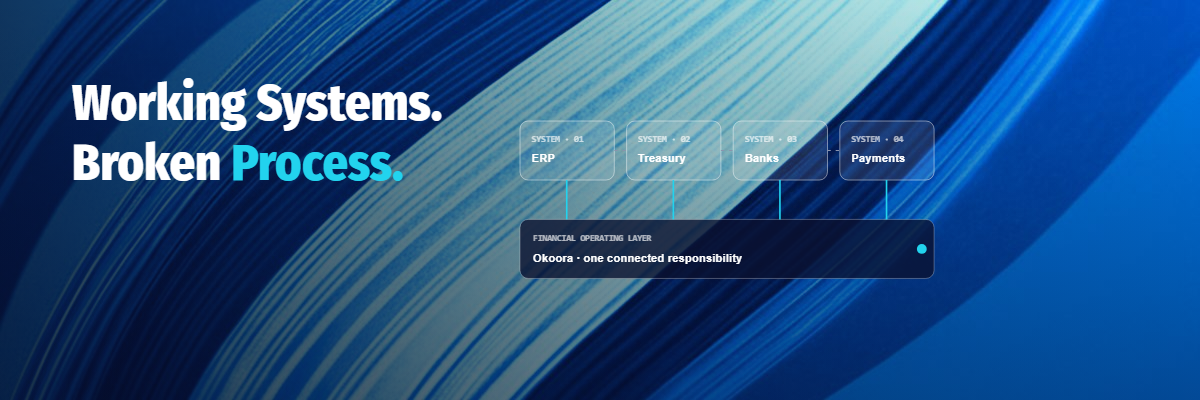
Okoora is designed to connect financial activity with business context, market context, existing financial state, customer policy and controlled action.
For Treasury, that means market movement can be interpreted in the context of the company's own economic reality rather than remaining a separate stream of market information.
The purpose is not to replace the systems, data providers, banks or finance expertise the company already uses. It is to connect the relevant truths so the financial decision becomes current, explainable and actionable.
Next step: See how Okoora connects market context with business reality, financial state and policy to support better financial decisions.