 OkooraEditorial Team
A market move is shared. Financial meaning is local.
Markets move for everyone at the same time. A currency strengthens. An interest-rate curve shifts. A commodity price changes. The market event is common, but the financial consequence is not.
Two companies can observe the same movement and face different decisions because their business models, obligations, revenue mix, existing protection, timing and policies are different.
This is why the useful financial question is rarely only, âWhat did the market do?â The more important question is, âWhat did that movement change for us?â
Start with the economic object the company actually manages
A CFO or Treasurer ultimately manages economic outcomes such as margin, cash flow, cost, funding, protection and policy compliance. FX, rates, commodities and other market variables matter because they influence those outcomes.
The financial system therefore needs to understand the economic object behind the instrument. A currency movement may affect supplier cost. A commodity move may change project economics. An interest-rate move may alter funding cost. The same company may experience several of those effects at once.
The decision becomes clearer when the system starts from the business economics and then identifies which market variables materially change them.
The same FX move can create opposite consequences
Consider two companies exposed to the same currency pair. One earns revenue in the strengthening currency. The other has a large supplier obligation in that currency. The market movement is identical, but the economic effect can move in opposite directions.
Now add a third company that has already placed protection against part of the exposure. Its gross market exposure may resemble the second company, while its remaining financial responsibility is different again.
The currency move is one fact. The decision depends on how that fact interacts with the companyâs own financial reality.
Existing financial state changes the decision again
Business exposure is rarely the only state that matters. The company may already hold hedges, balances, debt, cash, prior execution or other protection. Those positions change the meaning of a new market movement.
A company with a large forecast exposure and substantial existing protection may need a different response from a company with the same forecast exposure and little protection. Timing differences can change the picture further.
The system should therefore interpret the market movement against the current accepted financial state rather than treating each movement as a fresh event without history.
Business reality can change while the market is moving
Market conditions are only one source of change. The underlying business can change at the same time.
A purchase quantity may increase. A delivery date may move. A forecast may be revised. A contract may be signed. Customer pricing may change. Production may shift. Any of these events can change the financial meaning of the same market price.
This is why financially useful intelligence needs both sides of the picture: what changed in the market and what changed in the business.
Policy determines whether the new meaning requires action
Even when the economic consequence changes, the correct decision may still be to wait.
Company policy, thresholds, limits, authority and approval rules determine whether a change is material enough to act on, whether an action is permitted, who must approve it and when an exception should be escalated.
This is an important part of financial judgment. A strong system should be able to distinguish between a market movement that deserves attention and one that does not change the required action under the companyâs policy.
One market move can therefore produce several valid decisions
For one company, the right response may be to increase protection. For another, the existing position may already be sufficient. A third may need to change timing. A fourth may need no action because the movement remains inside policy.
None of those decisions can be inferred from the market move alone.
The decision emerges from the relationship between business reality, market context, existing financial state, customer-specific economics and policy.
A useful financial system should explain why the decision changed
Company-specific financial meaning must remain explainable.
The finance team should be able to see which inputs mattered, what changed, which relationship changed the economic outcome, what existing state was considered, which policy applied and why an action is or is not required.
Explainability matters because the objective is controlled financial judgment, not an opaque signal. The team retains the authority to evaluate the reasoning and make or approve the material decision.
The system should update the meaning, not only the data
A live market feed updates prices. A live financial operating system should update the company-specific financial meaning when the relevant business or market reality changes.
If the exposure changes, the economic state should change. If protection changes, the remaining position should change. If timing changes, the decision window may change. If policy changes, the action boundary may change.
The next financial decision should begin from that updated state rather than from a new manual reconstruction of the situation.
What finance leaders should ask of financial intelligence
A useful system should help answer a small set of practical questions:
What business activity creates the financial consequence?
Which market variables materially change that consequence?
What existing protection, positions, balances or obligations already affect the state?
What changed since the last accepted financial state?
What does the combined change mean for this company?
Is the change material under company policy?
Does action need to happen now?
What action is permitted and who has authority?
Can the reasoning be explained clearly?
Did the state update after the action or external execution?
Where Okoora fits
Okoora is designed to connect financial activity with business reality, market context, existing financial state, customer economic logic, policy and controlled action.
That means the same market movement can be interpreted through the economics of the specific company rather than treated as a universal signal. The system can help show what changed, why it matters, whether policy changes the required response and what decision should follow.
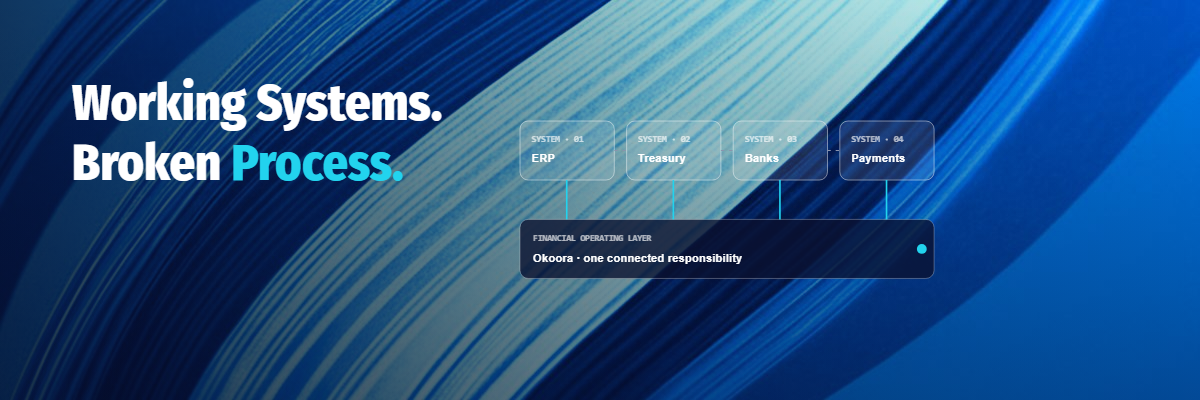
The company can continue to use its existing banks, market-data providers, ERP, Treasury systems and internal expertise. Okoora operates across the relevant financial context so those separate truths can become one current, explainable and decision-ready financial state.
Next step: See how Okoora connects business reality, market context, existing financial state and policy into decision-ready financial meaning.
Related reading: Your FX Exposure May Not Be an FX Problem, Financial Intelligence Should Understand Your Margin, Not Just Your Exposure, From Market Data to Economic Meaning: What Modern Treasury Actually Needs.