 OkooraEditorial Team
You should not have to move execution to get deep value from financial software
Many enterprises already have banks they trust, credit lines they rely on, hedge facilities already in place and operating processes built around those relationships.
That is not a weakness. It is the existing financial environment.
The deeper question is whether financial software can become strategically important without requiring the company to move every payment, conversion or hedge to a new execution provider.
It can.
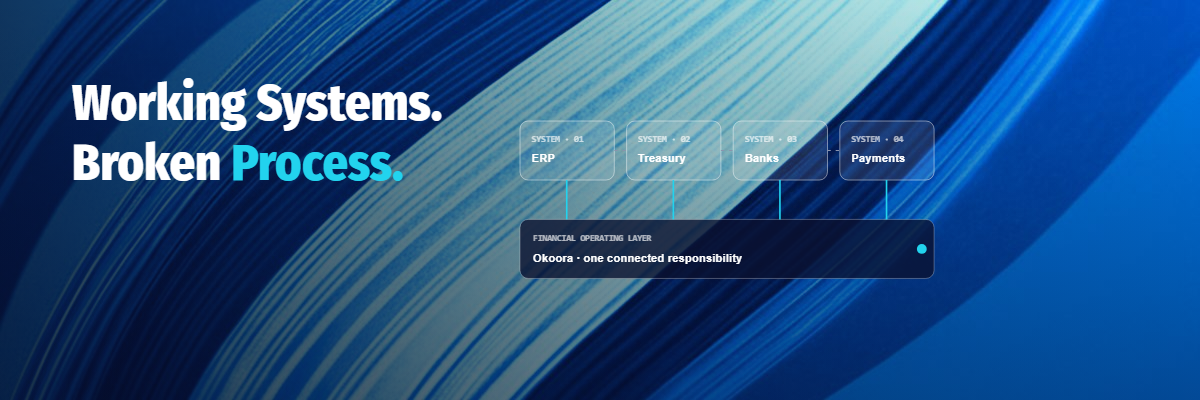
Financial software can create deep value by operating the recurring financial work that happens before, around and after execution: maintaining the current financial state, understanding what changed, applying policy, preparing decisions, routing approvals, recording outcomes and keeping the next cycle current.
Execution can remain with the bank. The operating value does not have to disappear with it.
The operating relationship begins before the transaction
A transaction is usually the end of a longer financial story.
A supplier commitment creates an obligation. A forecast changes expected exposure. A balance moves. A contract changes timing. A policy threshold is crossed. Existing protection no longer matches the underlying activity.
By the time a Treasury team asks a bank for a quote, much of the important financial work has already happened.
The software can create value by operating that upstream reality continuously.
It can connect the origin event to the financial meaning, maintain the resulting state, identify what requires attention and prepare the decision before the transaction reaches an execution venue.
Persistent financial state creates value independently of execution
The strongest dependency should not come from forcing money to move through one provider.
It should come from the system becoming the place that knows what is financially true now.
That means maintaining the relevant relationships among obligations, receivables, balances, exposures, existing protection, timing, policy, approvals, prior decisions, execution results and open exceptions.
When those relationships remain current, the team does not need to reconstruct the financial picture every time a new decision appears.
That continuity can create operating value even when the final trade, payment or hedge remains outside the software.
Policy and authority can remain inside the operating loop
Execution venue and financial governance are different questions.
A company can continue using its existing bank while the software still applies internal policy before the action takes place.
The system can determine whether a proposed action is inside policy, who has authority, whether an approval is required, what exception must be escalated and what evidence should remain.
This matters because the economically correct action is not automatically the operationally permitted action.
A strong financial operating layer keeps judgment, policy and authority connected before execution, regardless of where the transaction finally occurs.
External execution should not break the workflow
If the customer executes with its bank, the operating loop should continue.
The execution result should return to the financial state. The system should know what actually happened, update the position, preserve the record and carry the updated reality into the next decision.
A simple example might look like this:
Supplier commitment â exposure forms â existing protection is assessed â policy is applied â hedge action is prepared â customer approves â hedge executes at the customerâs bank â result returns to the system â exposure and protection state update.
The transaction did not need to execute through the software for the software to remain responsible for the financial work around it.
This is different from advisory software
Execution independence does not mean the system stops at analysis or recommendation.
A shallow model would produce an insight and leave the customer to reconstruct the rest of the process manually.
A deeper model continues through the operating lifecycle: decision preparation, approval, action preparation, external execution, verification, updated state and recurrence.
That difference matters.
The value is not that the software had an opinion. The value is that the recurring financial responsibility continues to operate as one connected process.
This is also different from forced execution
Some financial software becomes valuable only after the customer moves enough transaction flow onto the provider.
That can create friction in large enterprises.
Banks may provide credit lines, collateral arrangements, guarantees, documentary credit, hedge capacity, relationship economics and internal operational familiarity that the customer has good reasons to preserve.
A stronger enterprise model can respect those relationships.
The customer can keep existing banks and providers while gaining a financial operating layer above them.
Where a new execution route creates additional value, the customer can choose it. Where the existing bank remains preferable, the operating model still holds.
Execution should become optional upside, not the foundation
Execution can still create major additional value.
A broader provider set can create better price discovery. Different payment rails can change routing economics. Liquidity access can improve execution optionality. Hedging and derivatives infrastructure can connect a decision directly to a supported protection action.
But these should deepen an already valuable operating relationship.
The healthier sequence is:
Operating value first.
Execution choice second.
Execution upside when the economics or operating outcome justify it.
This preserves customer control and makes the software useful even before transaction flow moves.
The zero-execution test
A useful way to evaluate enterprise financial software is to ask one uncomfortable question:
If none of our payments, conversions or hedges moved through this provider, would the software still be materially valuable?
A strong answer should include recurring financial responsibility.
Would the system still know the current financial state?
Would it still detect change?
Would it still apply policy?
Would it still prepare decisions and actions?
Would it still route approvals?
Would it still record external execution?
Would it still update the state and operate the next cycle?
If the answer is yes, the operating relationship is deeper than transaction flow.
The dependency test
A second question is even more revealing:
What would the organization lose if the software disappeared tomorrow?
If the answer is only a dashboard or a quote source, the operating depth is limited.
If the answer is a current financial state, recurring decision process, policy application, exception handling, action preparation, execution record, verification and continuity across cycles, the software has become part of how the financial work actually operates.
That is a stronger form of enterprise dependency because it is based on operating responsibility rather than custody or forced routing.
Where Okoora fits
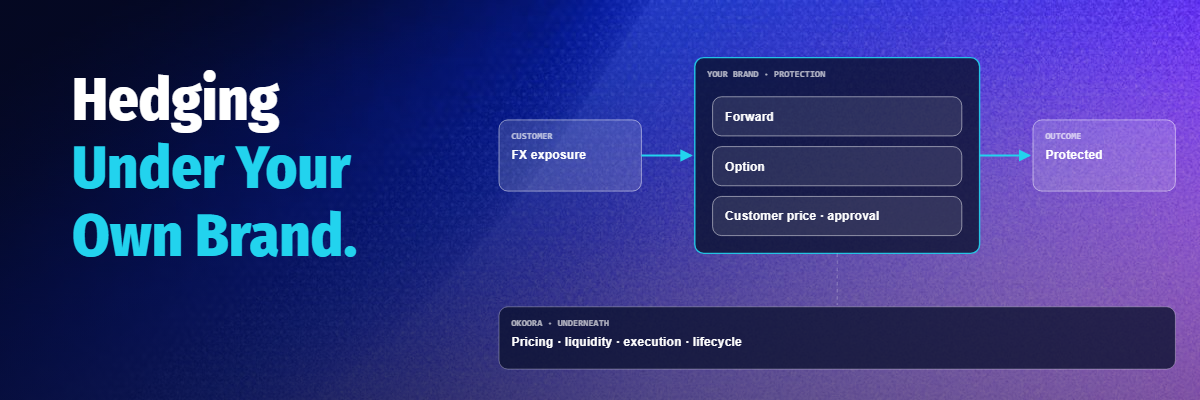
For Enterprise Self-Use, Okoora can operate financial activity in a Technology Only, Okoora Execution or Hybrid model, depending on the customer and the use case.
In a Technology Only model, Okoora can maintain financial state, connect relevant business and market context, apply policy, prepare decisions and actions, preserve control, record externally executed outcomes and keep the next cycle current while the customer continues to execute through existing banks and providers.
Where Okoora execution offers a compelling alternative, the customer can choose to use it. That may add market access, provider aggregation, routing, liquidity, payment or hedging advantages.
The customer does not need to choose between keeping trusted banking relationships and operating finance more intelligently.
The stronger model lets both coexist.
Next step: See how Okoora can operate the financial work above your existing banks and providers, while keeping execution choice in your hands.