 OkooraEditorial Team
A hedge quote is an answer from one provider
A company identifies a currency exposure.
It decides that a hedge may be needed.
It asks one bank for a price.
The bank returns a quote.
At that point, it is easy to think: this is the market price.
It is not.
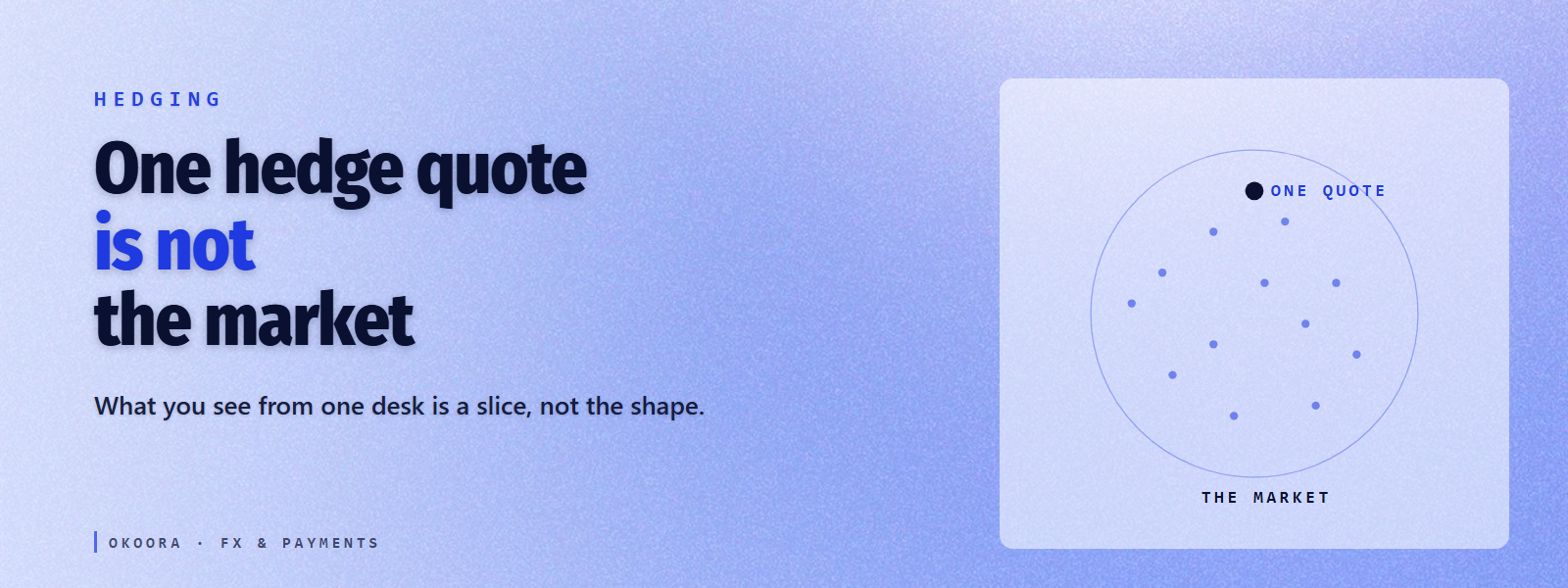
It is one provider's executable answer to the transaction at that moment.
The foreign exchange market is decentralised. Different banks and liquidity providers can price the same hedge differently because they do not all have the same liquidity, client flow, inventory, balance-sheet capacity or risk appetite.
One quote can be valid.
It is still only one view of the market.
The FX market is fragmented by design
Unlike a centralised exchange where all orders meet in one order book, much of the FX market operates over the counter.
Customers can trade directly with individual dealers, through single-dealer platforms, through multi-dealer venues, or through infrastructure that aggregates liquidity from several providers.
That creates a fragmented market.
The Bank for International Settlements describes a market in which customers can access numerous multi-dealer platforms and multiple bank and non-bank liquidity providers.
The practical implication for a corporate hedge is simple:
There may be several executable prices for the same economic requirement at the same moment.
Different providers can want the same hedge differently
A hedge is not priced in a vacuum.
A bank may already have customer flow moving in the opposite direction.
Another may have more appetite for the currency pair.
A third may be managing balance-sheet or funding constraints.
A liquidity provider may be particularly competitive in a certain tenor or product.
The same hedge can therefore fit differently into each provider's book.
That difference can appear in the price.
It can also appear in credit terms, collateral requirements, quote validity or willingness to execute a particular structure.
The difference becomes more important as the hedge becomes more material
For a small routine transaction, the economic difference between providers may not justify a complex process.
For a large exposure, a longer-dated forward, an option or a more structured hedge, provider differences can matter much more.
The transaction itself can become harder to price.
Liquidity can be thinner.
Credit and balance-sheet usage can become more important.
The structure may be more bespoke.
That is exactly when treating one provider's quote as the market becomes most dangerous.
The more material the hedge, the more important it is to understand the available alternatives before execution.
The structure has to be right before the price can be judged
There is another reason one quote can mislead.
A hedge price only makes sense in the context of the hedge being priced.
A forward with one maturity is not the same as a forward with another.
An option with one strike is not the same as an option with another strike.
A deliverable hedge is not the same as an NDF.
A structure with optionality is not the same as a simple forward.
So before deciding whether a quote is competitive, the company must first decide whether the hedge itself is appropriate.
The sequence matters:
Define the exposure.
Define the protection needed.
Then test the pricing of that same requirement across the relevant market.
A strong banking relationship does not change this logic
A company may have an excellent bank.
That bank may provide credit lines, financing, cash management, limits and years of operational history.
None of that needs to change.
But the strength of the relationship and the breadth of the market are different questions.
The company can preserve the banking relationship while still testing a material hedge with additional approved providers.
Sometimes the existing bank will still be the strongest choice.
Sometimes it will not.
The benefit is knowing the difference before the trade is executed.
More market access creates information before it creates execution
The first benefit of accessing several providers is not necessarily that the company trades elsewhere.
It is that the company learns what the executable market looks like.
That information can improve the decision even if the trade eventually stays with the existing bank.
The company can see whether prices are tightly grouped or widely dispersed.
It can see whether one provider is particularly competitive.
It can identify whether a certain product or maturity has thinner liquidity.
It can understand whether the existing relationship is producing strong pricing.
This is decision advantage before execution advantage.
But more quotes are not automatically better
There is a limit.
Sending a sensitive or large hedge request to too many providers can create noise and expose information about the company's trading interest.
The FX Global Code places importance on transparency, order handling and appropriate conduct in request-for-quote workflows.
So the goal is not to broadcast every hedge to the widest possible audience.
The goal is controlled market access.
Use an approved provider set.
Send the same economic requirement.
Compare within a consistent time window.
Apply policy.
Then choose the execution path.
What the company should know before accepting a hedge quote
Before a material hedge is executed, the finance team should be able to answer a few basic questions:
What exactly are we protecting?
Why is this the chosen hedge structure?
Is this quote executable?
What amount and maturity does it cover?
What settlement terms apply?
What credit or collateral assumptions are included?
Have we seen any comparable alternatives?
Do those alternatives represent the same hedge?
Is the selected provider approved under policy?
What happens if the hedge needs to be resized, rolled or closed later?
The objective is not to turn the treasury team into a trading desk.
It is to make sure a material financial decision is not based on one isolated number.
The better question is not 'is this a good quote?'
A single quote encourages the wrong question:
âIs this a good price?â
Without context, that is difficult to answer.
A better question is:
âHow does this executable quote compare with the other alternatives available for the same hedge, under the same conditions?â
That is a much more useful standard.
It turns pricing from an opinion into a comparison.
And it keeps the final decision where it belongs: with the customer, under the customer's policy and control.
Where Okoora fits
Okoora connects a defined hedge requirement to multiple banks and liquidity sources.
That allows the customer to understand a broader set of executable alternatives before deciding where to trade.
Existing bank relationships can remain in place.
Existing limits can remain in place.
The customer keeps control of the decision.
Okoora adds the market around the hedge, connecting exposure, hedge requirement, provider access, pricing, policy, approval and execution in one operating flow.
One hedge quote is one answer.
The stronger decision comes from understanding the market around it.
Next step: See how Okoora connects hedge requirements to multiple banks and liquidity sources so you can understand the executable market before choosing where to trade.
Related reading: How to Compare Hedge Pricing Across Banks and Liquidity Providers, How to Get Better FX Pricing Without Replacing Your Bank.