 OkooraEditorial Team
You do not have to replace your bank to improve FX price discovery
For many businesses, the bank relationship is valuable for reasons that go far beyond foreign exchange.
Credit lines matter. Limits matter. Cash management matters. Financing matters. Operational history matters.
So when a company decides it wants better FX pricing, the answer does not have to be: replace the bank.
There is another option.
Keep the banking relationships that work, and add broader market access around the FX transaction.
That separates two decisions that are often treated as one:
Which banking relationships should the company maintain?
Where should this specific FX transaction be priced and executed?
One bank can be important without being the only price source
A bank can be strategically important and still represent only one view of the FX market.
Foreign exchange is decentralised and fragmented. Customers can trade directly with dealers or access multiple providers through multi-dealer platforms and liquidity aggregators.
That matters because a single provider naturally quotes from its own liquidity, inventory, client flow and risk position.
A second provider may see the same transaction differently.
A third may have stronger liquidity in the currency pair.
The value of broader access is therefore not that the existing bank is somehow wrong.
It is that the business can see more of the executable market before it decides.
Market testing and relationship banking can coexist
Corporate finance teams sometimes assume that requesting competing prices will weaken an important bank relationship.
In practice, the two can coexist.
The business can continue to use its bank for lending, cash management, limits, deposits, credit support or selected FX flow.
At the same time, it can market-test significant conversions or hedges across additional approved providers.
This is already normal in institutional FX markets. Multi-dealer platforms allow market participants to request quotes from several liquidity providers while still maintaining direct bank relationships.
The goal is not to dismantle the relationship.
It is to make each execution decision with better information.
Decide which transactions should be market-tested
Not every FX transaction requires the same process.
A small routine conversion may not justify a broad request-for-quote process.
A large conversion, an unusual currency pair or a material hedge may deserve more market testing.
A sensible policy can define when broader access is required.
For example:
Routine transactions below a threshold can follow a pre-approved path.
Larger trades can be tested across multiple providers.
Less liquid currency pairs can trigger additional price discovery.
Material hedges can require multiple executable alternatives before approval.
Exceptions can stop for human review.
That turns market access into a controlled process rather than an ad hoc negotiation on every trade.
Compare like with like
Broader access only helps if the quotes are comparable.
When testing the market, every provider should be looking at the same economic transaction.
That means aligning:
Currency pair.
Transaction amount.
Spot, forward, swap or other instrument.
Value date or maturity.
Settlement terms.
Quote timing.
Credit and collateral assumptions where relevant.
Only then can the business compare the executable alternatives meaningfully.
A rate quoted for a different amount, time or settlement condition is not the same price comparison.
Use the bank where the bank is strongest
There are good reasons why an existing bank may still win a transaction.
It may have the strongest liquidity in that currency.
It may price aggressively because it values the wider relationship.
It may provide credit capacity that another provider cannot.
It may offer better terms for a particular instrument or maturity.
Broader market access does not imply that a different provider should always win.
It makes the bank compete against real alternatives rather than against no comparison at all.
Sometimes the existing bank will still be the right execution venue.
The difference is that the company knows why.
Use other providers where they are stronger
The reverse is also true.
Another bank, broker or liquidity provider may offer a more attractive executable alternative for a specific transaction.
The reason could be liquidity, inventory, appetite, currency specialisation, market conditions or execution model.
A business that relies on one source may never see that alternative.
A business with multi-provider access can.
That optionality becomes more valuable when FX activity spans multiple currencies, entities, transaction sizes and instruments.
Keep the decision inside policy
More provider choice should not create less control.
The business still needs rules around:
Approved counterparties.
Credit limits.
Currencies and products.
Maximum transaction size.
Pricing tolerances.
Approval thresholds.
Settlement instructions.
Exception handling.
The strongest model combines provider competition with governance.
The company can access more of the market while still deciding who may execute, under what conditions and when human approval is required.
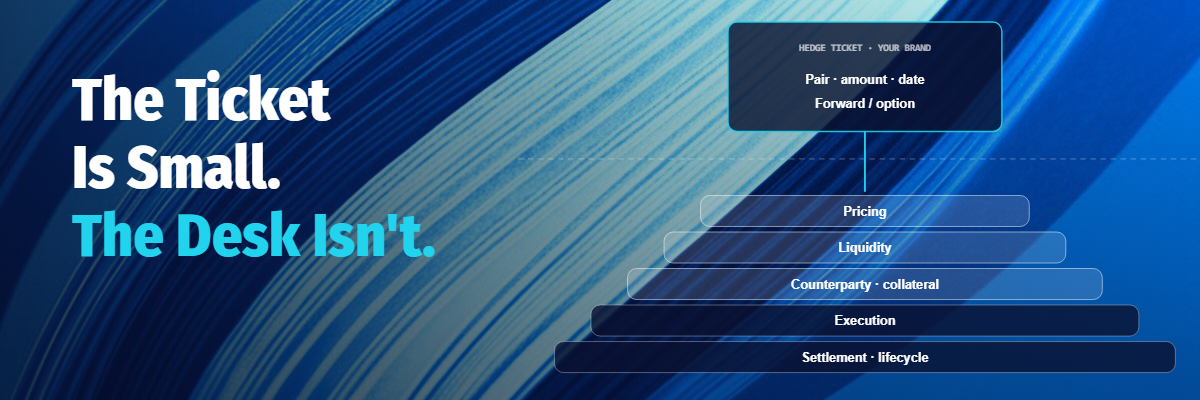
Price is only one part of execution quality
A lower visible quote is not automatically the better trade.
Execution quality can also depend on:
Whether the price is firm or indicative.
How long the quote is valid.
Whether the trade can be rejected.
Market impact on a larger order.
Credit requirements.
Operational workflow.
Confirmation and reconciliation.
For that reason, the objective is not simply to collect more rates.
It is to compare executable alternatives on the terms that matter to the transaction.
Build optionality before you need it
Market access is most valuable when it already exists before a large or urgent trade appears.
Opening new counterparties, agreeing legal terms, setting limits and creating operational connectivity can take time.
A company that waits until a volatile market event or urgent payment to search for alternatives may have fewer practical choices.
A stronger model establishes approved provider optionality in advance.
Then, when a material transaction arises, the company can compare and act within an existing operating framework.
A practical model for keeping your bank and expanding the market around it
A company does not need a complex execution desk to apply this approach.
The model can be simple:
Keep existing strategic banks.
Add additional approved FX liquidity sources.
Define which transactions should be market-tested.
Send the same transaction to the relevant provider set.
Compare executable alternatives.
Apply company policy.
Choose the execution path.
Settle and reconcile the transaction.
Review the result over time.
The operating idea is straightforward:
Keep the relationships that already create value.
Add market access where more choice can improve the decision.
Where Okoora fits
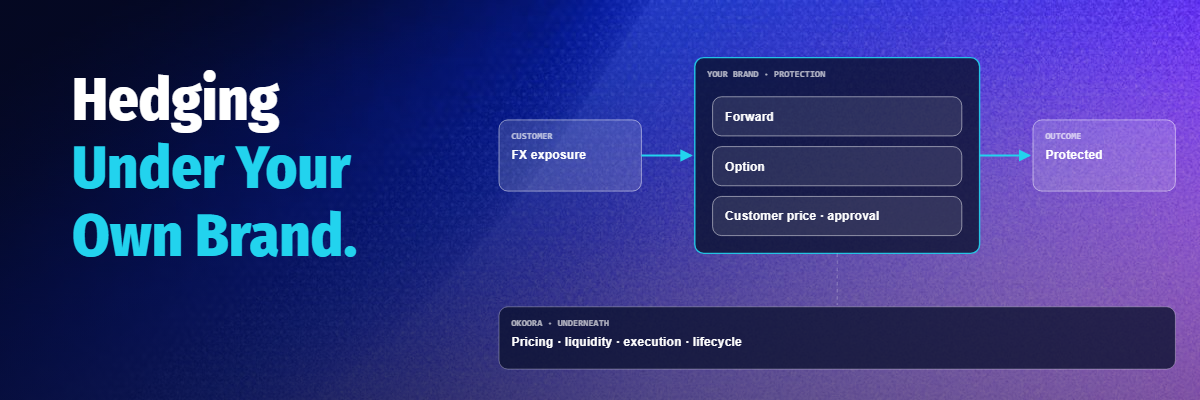
Okoora connects businesses directly to multiple banks and brokers through one FX marketplace.
That means a company can keep the banks, limits and relationships that already work while adding broader liquidity and pricing access around each FX conversion or hedge.
On Okoora, multiple sources can compete on the same transaction. The customer can compare the available executable prices, apply policy and choose the execution path that fits the transaction.
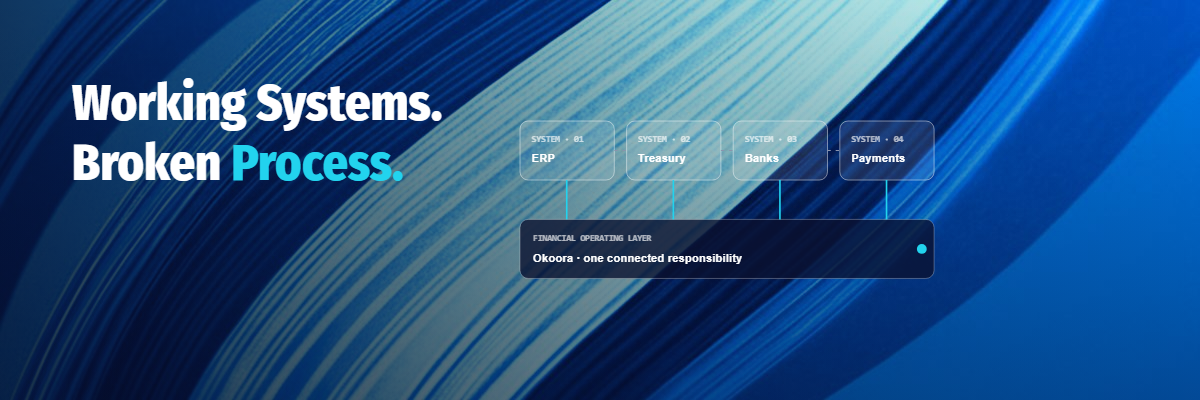
The broader Okoora layer then connects that decision to conversion, hedging, accounts, payments, settlement and reconciliation.
The point is not to replace your bank.
It is to stop treating one banking relationship as the only market available to every FX decision.
Keep your bank. Add the market around it.
Next step: See how Okoora lets businesses keep existing bank relationships while adding broader FX market access, provider competition and policy-driven execution.