 OkooraEditorial Team
A currency can be one part of a much larger financial equation
A company may describe a problem as FX exposure because a currency appears somewhere in the transaction. That description can be correct and still be incomplete.
Imagine a manufacturer that buys a key input in one currency, sells its finished product in another, prices customer orders before settlement, and already has some protection in place. The currency rate matters. So do the purchase price, selling price, timing, existing hedge position, expected volumes and the policy that determines when action is allowed.
The financial question is therefore larger than âwhat is the FX exposure?â The more useful question is: what do all of these variables mean together for the economic outcome the company actually cares about?
The business experiences one outcome, even when several markets sit underneath it
A CFO does not experience an FX rate, a commodity price or an interest rate as separate business outcomes. The company experiences margin, cash flow, cost, profitability, liquidity and risk.
That is why a market-by-market view can become misleading when the decision depends on the relationship between variables. A currency move may increase the local cost of an input while another market movement offsets part of that effect. A hedge may protect one component while the underlying business volume changes. A selling price may move in the same direction as a cost input, changing the net consequence again.
The decision belongs to the combined economics, not to the label of the individual instrument.
Multi-factor decisioning is not about adding more data
The answer is not to place more charts on the screen. Three live charts remain three separate facts unless the system understands how they interact.
The useful model uses only the variables that genuinely change the financial decision. Depending on the business, that may include business activity, market prices, existing financial positions, customer-specific formulas, policy thresholds and authority rules.
A simpler model is better when it fully explains the economics. Complexity is justified only when the interaction itself is financially material.
Start with the economic object the company actually manages
The first design question should be: what financial outcome is management trying to understand or protect?
That object might be gross margin on a product line, landed cost on an imported order, cash-flow consequence on a project, hedge-adjusted economics on a commitment, effective protection across a portfolio, or another financially meaningful outcome.
Once that object is clear, the relevant variables can be connected around it. This reverses the usual tendency to start with the available data and ask what can be displayed. Instead, the system starts with the decision and asks what truth is required to make it well.
The same market move can mean something different to every company
Market prices are shared. Business economics are not.
Two companies can see the same currency move and require different decisions because their revenues, costs, hedge positions, timing, operating volumes and policies differ. Even two subsidiaries inside the same group may experience the same market move differently.
This is why generic market intelligence has a natural limit. It can explain what happened in the market. Decision-ready financial intelligence must also understand what that movement changed inside the company.
Customer-specific financial logic is part of the context
Companies already use their own economic logic to run the business. It may exist in pricing formulas, procurement models, policy documents, operating spreadsheets, internal benchmarks, hedge relationships or management rules.
A useful financial system should be able to work with that logic where it is verified and appropriate. It should not invent a customer formula, target margin, threshold or policy simply because the data is available.
The discipline matters. Customer economics are a source of truth, not an invitation to manufacture a more sophisticated model than the business actually uses.
Live market data is valuable when it changes the financial meaning
A live price feed answers a market question: what is the price now?
A live financial operating system must answer a different question: what did the change in that price alter for this business, given everything else that is true now?
That requires the system to keep the relevant business state and financial state current. When an order changes, a forecast moves, an exposure is reduced, a hedge is added, a policy threshold is crossed or a market variable changes materially, the economic interpretation may need to change as well.
The value is not speed for its own sake. It is keeping the decision current while the decision still matters.
The output should be explainable, not a black box
The more variables a financial decision contains, the more important explainability becomes.
A finance team should be able to understand which inputs were used, what changed, which variable contributed materially, how customer logic and policy affected the result, and why the recommended action changed or did not change.
Sophisticated financial intelligence is useful when it makes judgment clearer. A model that produces an answer without making the financial reasoning legible creates a new control problem instead of solving one.
A better decision can create value before execution moves
This way of thinking also separates decision advantage from execution advantage.
A company can create meaningful operating value by understanding the current economic state, recognizing material change, applying policy and reaching a better decision, even when the final hedge, conversion or payment still executes through its existing bank or provider.
Execution can create additional value through pricing, routing, liquidity, settlement or market access. But the first question remains what should happen. The second is where and how to execute it.
That distinction matters because strong financial software should remain useful across the financial environment the customer already trusts.
A simple example
Consider a company that buys a raw material in USD and sells finished goods in EUR. A customer order is priced today and will settle later. The company also has an existing hedge against part of its expected USD purchase.
Looking only at EUR/USD does not answer the business question. The decision may depend on the raw-material price, expected purchase volume, selling price, timing, the current hedge, the companyâs margin logic and its policy thresholds.
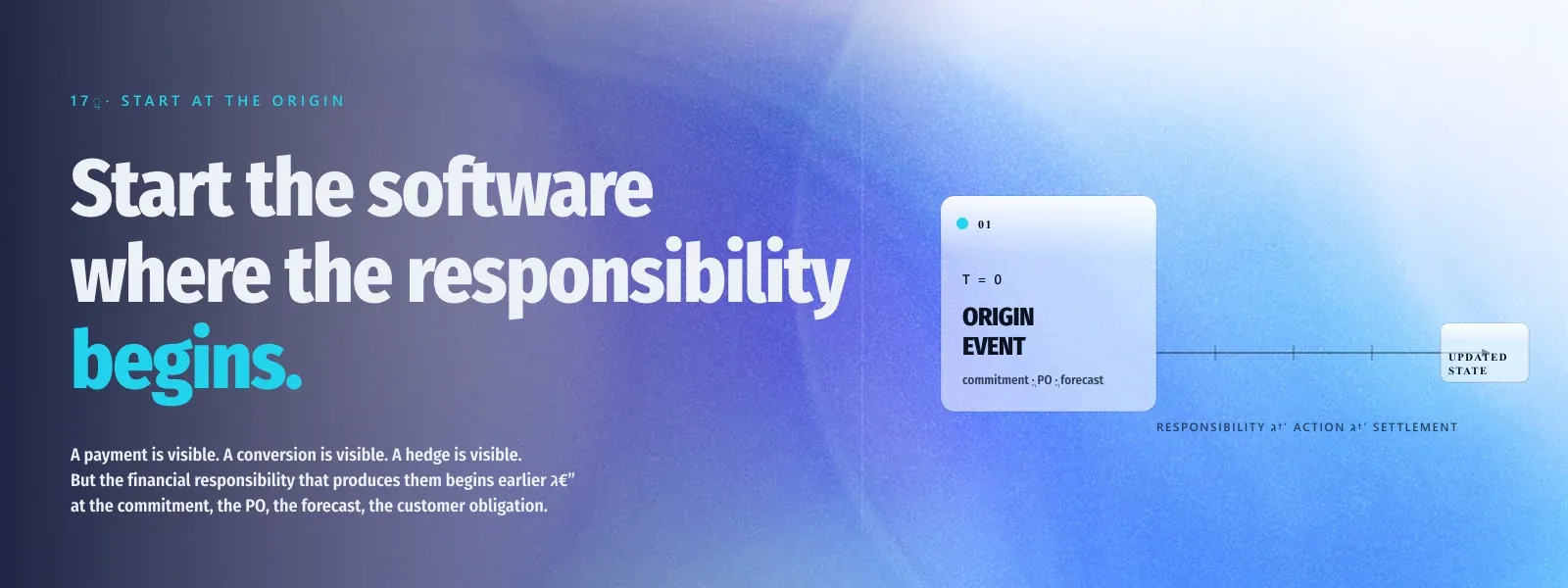
The useful operating sequence is:
Business reality changes: an order, forecast, purchase quantity or selling price moves.
Market reality changes: FX, commodity, rates or another relevant market variable moves.
The system recalculates the combined economic state using verified customer logic.
Existing protection and current financial positions are included in the state.
Policy and authority determine whether the change is material and whether action is permitted.
The finance team sees what changed, why it matters and what decision is required now.
Execution can remain with the existing provider or move through another approved path.
The resulting state is updated for the next decision.
The point is not that every company needs this exact model. The point is that the financial decision should be built around the economics the company actually manages, not around the first instrument that happens to be visible.
What a decision-ready financial system should be able to answer
Where several variables genuinely determine one financial outcome, the system should be able to answer a small set of practical questions:
What economic outcome are we actually managing?
Which business and market variables materially change that outcome?
What is financially true now?
What changed since the last accepted state?
Which variable caused the meaningful change?
How do existing protection and financial positions affect the result?
Which customer-specific logic and policy apply?
Is action required, and if so, what action is permitted?
Can the reasoning be explained to the people responsible for the decision?
What must update after the action so the next cycle starts from current reality?
Where Okoora fits
Okoora is designed to connect financial activity with business context, market context, existing financial state, customer policy and controlled action.
Where a decision genuinely depends on several variables, Okoora can help connect those inputs into current financial meaning and keep the decision tied to the companyâs own economics rather than to an isolated market screen.
The objective is not to make financial work more complicated. It is to understand the minimum set of realities required to make the decision truthfully, explainably and while it still matters.
Next step: See how Okoora connects financial activity, market context and policy into decision-ready financial meaning.
Okoora Master Strategic Anchor, Version 2.0, current approved version.
Okoora Blog Growth Anchor v1.2 FINAL, current approved version.
Okoora Marketing Operating Depth Anchor v1.0, supporting strategic depth source.
Okoora Financial Value Creation & Measurement Anchor v1.0, supporting strategic value source.
Okoora Real-World Financial Operating & Economic Advantage Anchor v1.0, supporting strategic depth source.
Okoora Multi-Factor Financial Decisioning & Economic Meaning Anchor v1.0, supporting strategic depth source.
Okoora Content Strategy Transfer Anchor: Multi-Factor Financial Decisioning as a Content Territory v1.0, internal content-strategy source. Customer-specific details excluded from public copy.
Agnico Eagle Mines Limited, 2025 SEC filing, Capital and Financial Risk Management. Example of a company managing foreign exchange, commodity and interest-rate market risks within an overall policy framework.
Bartram, Dufey and Frenkel, âA primer on the exposure of non-financial corporations to foreign exchange rate risk,â Journal of Multinational Financial Management, 2005.
Related reading: Financial Intelligence Should Understand Your Margin, Not Just Your Exposure, One Decision, Multiple Markets: The Financial Problem Most Systems Were Not Built to Solve.