 OkooraEditorial Team
Exposure is important. Margin is the economic outcome.
Finance teams need to understand exposure. Currency positions, commodity sensitivity, interest-rate risk and existing protection all matter. But the instrument-level position is not always the final object the business is trying to manage.
A CFO ultimately cares about the economic consequence: margin, cash flow, cost, profitability, liquidity, project economics or another financially significant outcome. Exposure is one input into that consequence.
This creates a deeper question for financial intelligence. It should not stop at identifying what the company is exposed to. It should help explain what that exposure means for the economics the company is actually managing.
A correct exposure view can still be economically incomplete
Consider a company with a material foreign-currency purchase obligation. The currency exposure can be measured correctly, yet the business consequence may still depend on several other variables.
The selling price may be linked to another currency. Raw-material costs may move independently. Existing protection may offset part of the exposure. Delivery timing may change when the cost is realized. Customer pricing may adjust with a delay.
Looking at the currency position alone can therefore describe one financial fact without fully describing the margin consequence.
Start from the economic object the company already uses
The strongest financial model begins with the economic object the customer actually manages.
For one company, that may be gross margin. For another, landed cost. For another, project economics, funding cost, unit economics or cash-flow consequence.
The system should then identify the smallest set of business, market and financial variables that materially change that object. The goal is not to add complexity. It is to preserve the relationships that create the financial meaning.
Margin can depend on several markets at the same time
A manufacturing business may sell in one currency, buy inputs in another and have raw-material costs linked to a commodity market. An energy-intensive business may also have energy or carbon-related cost drivers. A global project may combine contract revenue, supplier costs, financing and currency effects.
In each case, the company experiences one economic result even though several market variables sit underneath it.
This is why a financial system that understands each instrument separately can still miss the relationship the CFO actually needs to operate.
Existing protection changes the margin consequence
The current financial state matters as much as the gross business exposure.
Two companies can have the same underlying commercial exposure and very different remaining economics because one has already placed protection and the other has not. Even inside one company, the answer can change as hedges mature, forecasts move, balances change or protection is adjusted.
Useful financial intelligence should therefore interpret the business exposure together with the protection, positions, balances and prior actions that already exist.
Business reality can change the equation before the market moves again
The economic meaning is not driven by markets alone.
A customer order can change. A supplier quantity can increase. A delivery date can move. Production can be revised. A pricing formula can change. A forecast can be accepted or replaced. Each of those events can change the financial consequence even if the market price has not moved.
A live financial system should therefore update the economic meaning when either side of the equation changes: the market or the business.
Customer-specific economics cannot be invented
Company economics are specific. The formula that matters may contain internal benchmarks, conversion factors, pricing rules, hedge relationships, thresholds or policy conditions that do not exist in a generic market model.
Those relationships must come from verified customer truth, such as accepted operating models, policy, formulas, business data or validated discovery. Financial intelligence becomes useful when it operates the economics the company actually uses, not when it manufactures a sophisticated-looking approximation.
This is also why explainability matters. Finance should be able to understand which inputs were used, what changed and why the economic meaning changed.
Policy turns economic meaning into a decision
A change in margin or exposure does not automatically require action.
Policy, thresholds, limits, approvals and authority determine whether the change is material, whether action is permitted, who should decide and whether the correct response is to do nothing.
The useful chain is therefore not simply Market Move â Alert. It is Business Reality + Market Reality + Existing Financial State + Customer Economic Logic + Policy â Current Economic Meaning â Decision â Action.
The right action may begin before execution
Once the economic meaning is clear, the company can decide what should happen next. That decision may involve adjusting protection, changing timing, reviewing pricing, comparing execution alternatives, escalating an exception or intentionally taking no action.
Execution is important, but the decision advantage can exist before the transaction moves. The customer can continue to execute through existing banks or providers while the financial operating layer maintains the state, policy, decision record and resulting update.
Where Okoora execution creates a stronger alternative, the customer can evaluate it as an additional execution option rather than as a prerequisite for receiving operating value.
What finance leaders should ask of financial intelligence
A useful system should help answer a practical set of questions:
What economic outcome are we actually trying to manage?
Which business variables materially change that outcome?
Which market variables materially change it?
What existing protection, balances, positions or prior actions already affect the result?
What changed since the last accepted financial state?
What does the combined change mean for margin, cash flow, cost or another relevant outcome?
Is the change material under our policy?
Does action need to happen now?
Can the reasoning be explained clearly?
Did the financial state update after the decision and execution outcome?
Where Okoora fits
Okoora is designed to connect financial activity with business reality, market context, existing financial state, customer economic logic, policy and controlled action.
That allows the financial system to interpret exposure through the economics the company actually manages rather than treating each instrument as an isolated signal. The relevant economic object may be margin, cost, cash flow, protection or another financially significant outcome.
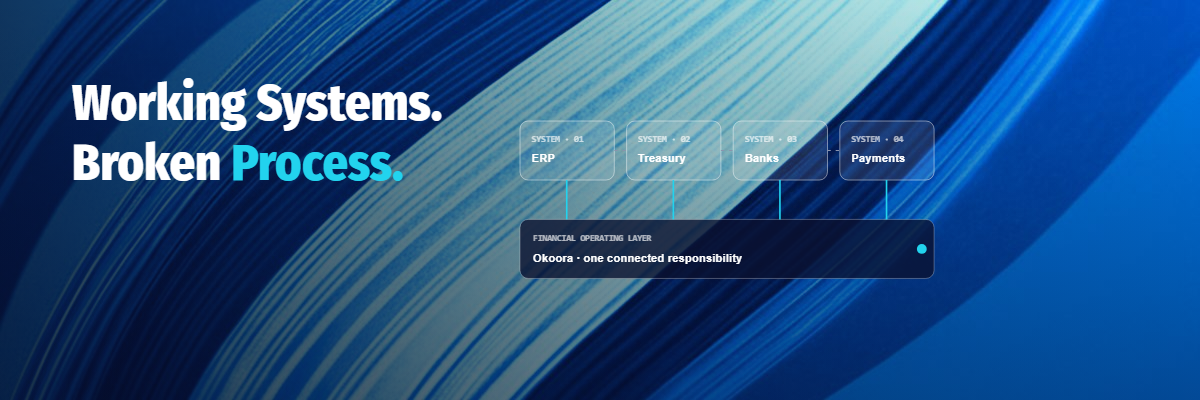
The company can continue to use its existing ERP, Treasury systems, banks, market-data providers and internal expertise. Okoora operates across the relevant financial context so the current economic meaning can remain connected to decision, action, verification and the next operating cycle.
Next step: See how Okoora connects business reality, market context, existing financial state and customer economic logic into decision-ready financial meaning.
Related reading: The Same Market Move Can Mean a Different Financial Decision for Every Company, Your FX Exposure May Not Be an FX Problem.