 Benjamin AvrahamCEO
Future exposure often exists before the ERP entry
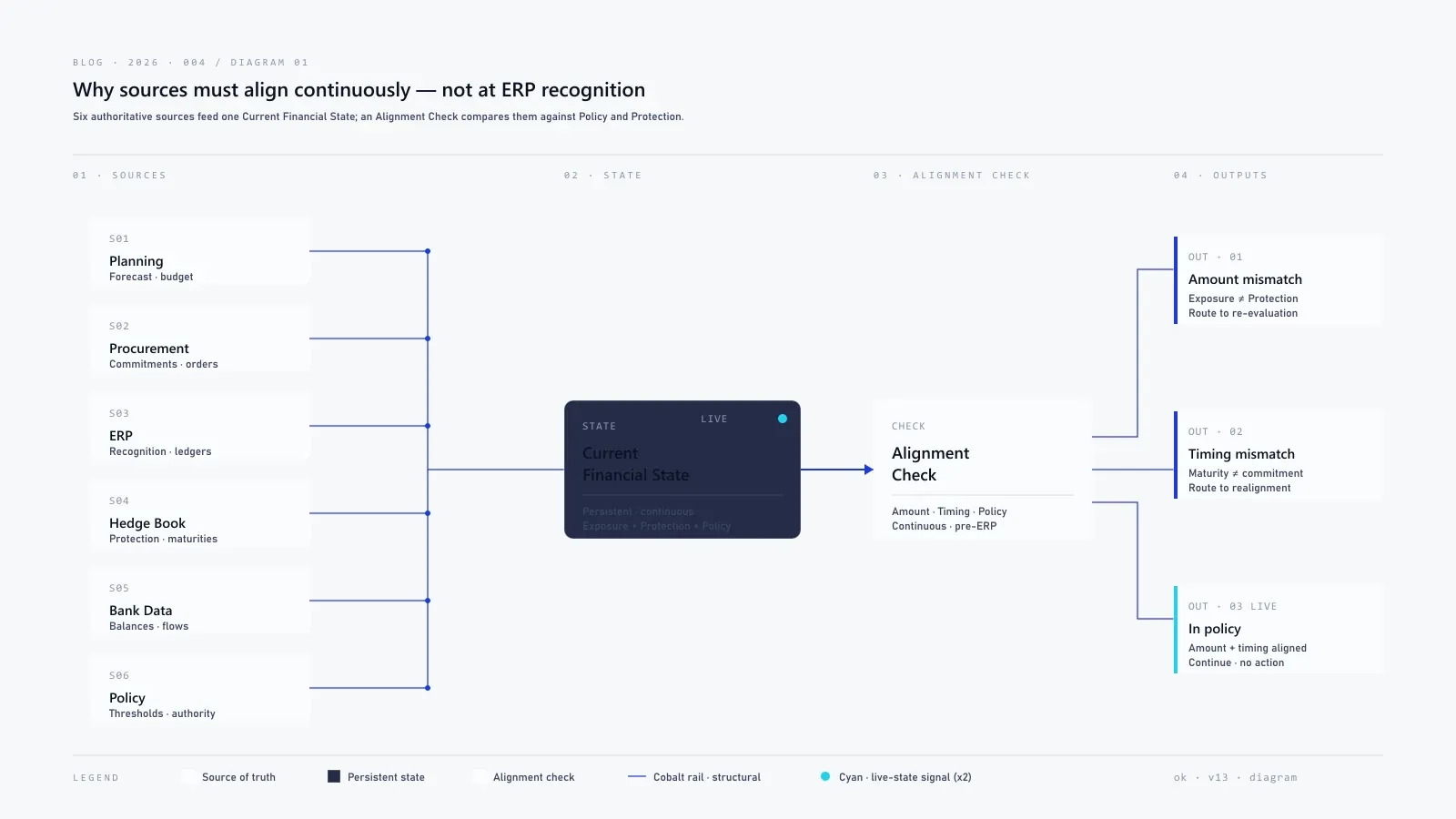
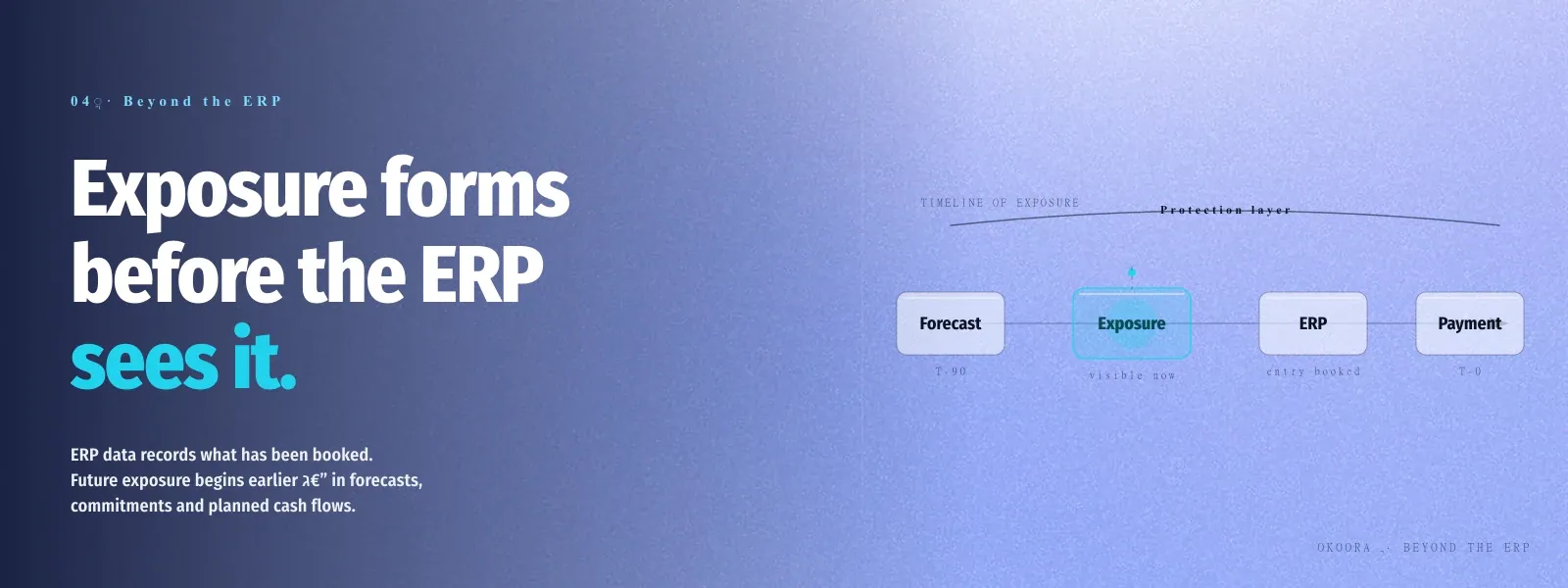
ERP systems are essential financial systems of record. They tell the business what has been booked, invoiced, received, paid, shipped or otherwise recognized inside the operating process.
But future financial exposure often begins earlier.
A sales forecast can create an expected foreign-currency inflow before an invoice exists. A procurement plan can create a future currency need before a supplier invoice is booked. A purchase commitment can change the economics of a future payment before the payable appears in the ledger. A planned shipment, subscription, intercompany flow or recurring payment can create a financial consequence while the ERP still has little or nothing to record.
That does not make the ERP incomplete. It means the ERP is one part of a broader financial reality.
The future lives across several sources of truth
Finance teams usually already know this. That is why future exposure is often assembled from several places: planning systems, procurement forecasts, sales forecasts, purchase orders, open orders, treasury files, bank balances, hedge portfolios and ERP data.
The problem is not that these sources exist. The problem is that the financial meaning has to be rebuilt every time they change.
One source may tell you the expected purchase amount. Another tells you when it is likely to settle. The ERP shows what has become an actual payable. The treasury file shows what is already protected. The bank shows what cash is available. Policy determines how much should be protected and who can approve an adjustment.
To manage future exposure well, those facts have to become one current financial state rather than a set of separate reports.
Amount is only half the position. Timing matters too.
A company can look correctly hedged in aggregate and still be wrong in time.
Imagine an illustrative case. A company expects a foreign-currency purchase in November and has protection maturing in November. The purchase is then delayed to February. The annual forecast may be unchanged. The total hedge amount may also be unchanged. Yet the financial position has changed materially because the cash flow and the protection no longer meet in the same period.
The same problem appears when forecast volumes fall, orders are cancelled, shipments move, customer collections shift, or planned purchases are brought forward. The question is no longer only, “How much exposure do we have?” It is also, “When does it exist, what is already protecting it, and does that protection still match the business reality?”
IFRS 9 itself recognizes that highly probable forecast transactions can be hedged items in cash flow hedging, and IFRS Interpretations Committee materials explicitly discuss uncertainty in both timing and magnitude. The accounting standard is not the operating model, but it reinforces the underlying financial truth: future transactions have financial relevance before they become settled accounting entries.
Existing protection does not update itself when the business changes
The most important operational gap often appears after a hedge is already in place.
The business forecast changes. The hedge remains exactly where it was.
If the forecast falls, the company may become overprotected. If the forecast rises, it may become underprotected. If timing shifts, the amount may still look right while the maturity becomes wrong. If natural offsets change, the net exposure changes even when the gross forecast does not.
This is why exposure management is not a one-time calculation. It is a continuous alignment problem between business reality, current financial state, existing protection and policy.
The goal is not more data. It is minimum durable truth.
A better operating model does not begin by connecting every system in the enterprise.
It begins with one real financial process and asks what information must remain current for that process to be operated reliably.
The minimum might include a forecast source, the ERP facts that confirm actual obligations, current hedge positions, relevant bank balances and the policy that governs action. For another process, the minimum will be different.
The important distinction is durability. A spreadsheet can be useful to validate the first picture. It should not become the permanent production architecture if the same file has to be rebuilt manually every cycle. The recurring sources need a reliable path into the financial state so that tomorrow's change is reflected without starting again.
From reporting to an operating financial state
Once the relevant sources are connected, the system should do more than display them side by side.
It should understand the relationships among the underlying financial objects: the business event, the obligation, the currency need, the exposure, the protection already in place, the payment, the policy and the approval authority.
Then a source change can update the state and trigger the next financial question automatically.
Did the exposure increase? Did the timing move? Is protection now outside policy? Is an existing hedge still aligned? Does the change require a decision, an approval or no action at all?
This is the difference between reconstructing exposure periodically and maintaining it continuously.
What a modern financial operating layer should do
A useful system for future exposure should be able to connect the minimum recurring sources, maintain a current financial state, compare that state with existing protection, apply policy, identify material mismatches and prepare the next action or decision.
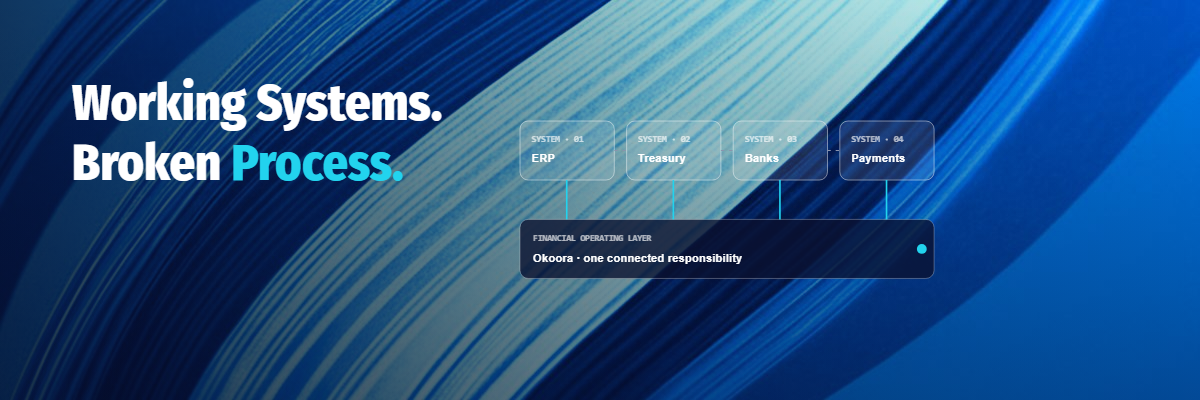
It should also preserve the role of the systems already doing their jobs. ERP can remain the authoritative source for booked transactions. Planning can remain the source for approved forecasts. Banks can remain execution venues. Treasury retains authority and judgment.
The operating layer sits across those systems and keeps the financial meaning aligned as the business changes.
Okoora is built for that layer. It operates across exposure, payments, FX, accounts and money flows, connecting current financial reality to decisions and actions by policy.
ERP remains essential. It just cannot carry the future alone.
The right conclusion is not that finance teams should move away from ERP.
It is that future financial exposure cannot be understood from accounting data alone when the business decisions that create that exposure happen earlier.
The stronger model is to connect the sources that describe what is expected with the sources that confirm what has become real, then keep both aligned with protection and policy over time.
When that happens, finance does not have to wait for the next consolidation cycle to discover that the business has moved. The financial state moves with it.
NEXT STEP See how Okoora keeps exposure, protection and policy aligned as the business changes.
See how Okoora keeps exposure, protection and policy aligned as the business changes.
Related reading: When a Purchase Order Changes, the Financial Decision Should Change With It, What Happens When the Business Changes After the Hedge Is Already in Place?.