 OkooraEditorial Team
Execution matters. But value often begins earlier.
Financial execution is where a decision enters the market. A payment is sent, a conversion is completed, a hedge is placed or a funding action is taken. That moment can create or preserve significant value.
But execution is not the first place where financial value is created.
Before a transaction happens, the company has already had to understand what is financially true, what changed, what matters, which alternatives exist, what policy allows and whether action is required at all.
A weak decision executed perfectly is still a weak financial outcome. A strong decision can create value even when the final transaction remains with the companyâs existing bank or provider.
This is the distinction between decision advantage and execution advantage. Both matter. They do not begin at the same point.
The first economic question is not âwhere should we trade?â
The first economic question is usually more basic: what should happen?
A supplier commitment may create exposure. A forecast may change the amount that needs protection. A payment may need to move earlier than planned. A market move may change the economics of an existing position. A policy threshold may be crossed. Existing protection may already be sufficient.
Only after the financial meaning is clear does execution become the next question.
This matters because companies often operate strong banks, experienced Treasury teams and established execution processes. The opportunity is not to discard those relationships. It is to improve the quality and timing of the decision that reaches them.
Decision quality depends on current financial state
A financial decision is only as good as the state it starts from.
That state may include business obligations, expected cash flows, balances, exposures, existing protection, prior actions, market context, timing, policy, approvals and relevant customer-specific economic logic.
If one of those elements changes, the decision may change with it.
This is why point-in-time analysis can become stale quickly. The system needs to know what is financially true now, not what was true when the last spreadsheet, report or meeting was prepared.
Current financial state creates the foundation for decision advantage.
Market context changes the meaning of the same business event
The same business event can justify a different decision under different market conditions.
A purchase commitment may be harmless when existing protection is sufficient and material when that protection no longer matches the underlying obligation. A funding need may have different economics when rates, liquidity or timing change. A foreign-currency obligation may require different action when the companyâs expected receipts change at the same time.
Market data alone does not decide what the company should do.
The value comes from connecting market context to the business event, the existing financial state and the companyâs policy.
Policy determines whether a good financial idea is an allowed action
Financial judgment does not operate outside governance.
A company may have limits on how much exposure can remain open, which instruments are permitted, who can approve a transaction, when escalation is required, which providers may be used and when no action is preferred.
Policy turns analysis into a governed decision.
The strongest financial operating model therefore does not simply generate a recommendation. It can explain whether the proposed action fits the companyâs rules, who has authority, what exception exists and what evidence should remain after the decision.
Sometimes the best financial decision is no action
Decision advantage also means knowing when not to transact.
A position may already be adequately protected. A market move may be visible but economically immaterial to the business. A forecast change may remain inside policy tolerance. The cost of acting may exceed the value of changing the position.
A system that produces action every time something moves is not exercising financial judgment.
The economically useful outcome is the correct decision, including the decision to leave the current position unchanged.
Execution can stay with the bank without removing the operating value
Once the decision is clear, the customer can choose where execution happens.
The transaction may remain with an existing bank because of credit lines, collateral, documentary-credit relationships, internal policy, existing operational infrastructure or simply because the bank offers the preferred terms.
That does not make the upstream decisioning less valuable.
The operating loop can still remain connected: business event, current financial state, policy, decision, approval, prepared action, external execution, returned execution result, verification and updated financial state.
The critical requirement is continuity. External execution should update the same financial reality that informed the decision so the next cycle does not begin from zero.
Better execution becomes an additional layer of value
When Okoora can also provide a stronger executable alternative, execution advantage becomes an additional economic layer.
That may come from broader provider access, price discovery, routing, liquidity, settlement path, payment rails, hedging capability or another supported execution route.
The customer can compare the available alternatives and decide.
This creates a healthier operating model: the software does not need to force execution in order to be valuable. Execution through Okoora is earned when the available economics or operating outcome justify it.
A practical way to evaluate decision advantage
Finance leaders can ask a small set of questions before they evaluate execution:
What financial responsibility has actually formed?
What is the current financial state around it?
What changed since the last accepted state?
Which business and market variables materially change the economics?
What existing protection, balances, positions or commitments already matter?
Which policy, limit or authority applies?
Is action required now?
What alternatives are available?
Can the reasoning be explained?
After execution, will the result return into the financial state and inform the next cycle?
These questions reveal whether the financial system is helping the company make a better decision or simply helping it process a transaction.
Where Okoora fits
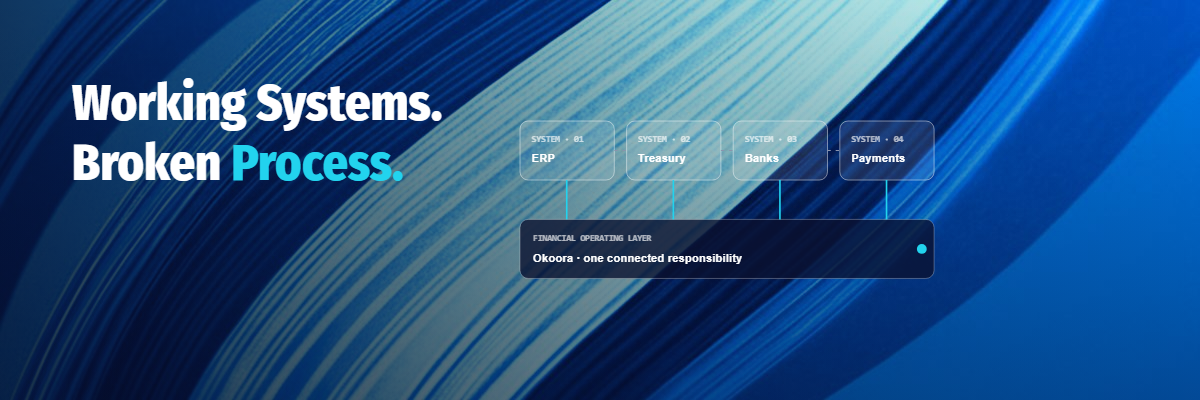
Okoora is designed to connect financial activity, business reality, current financial state, market context, policy, decisioning, control and action inside one operating model.
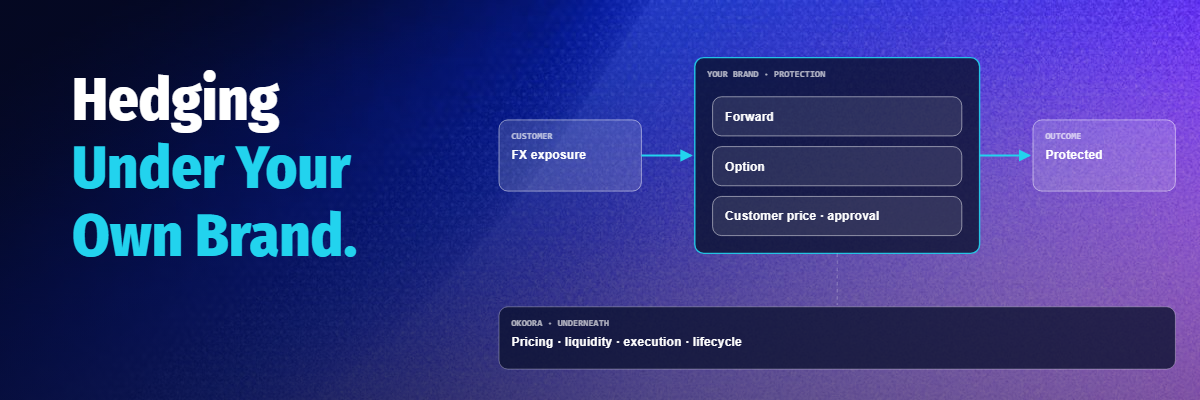
For Enterprise Self-Use, that operating value can remain complete even when the customer continues to execute through existing banks and providers. The decision, approval, record, verification and updated financial state can stay inside the same operating loop.
Where Okoora execution creates an attractive alternative, the customer can choose to use it. Where another provider remains preferable, the operating relationship can continue without losing the decision advantage.
The result is a stronger separation of responsibilities: first determine what should happen and why. Then choose where and how to execute it.
Next step: See how Okoora connects current financial reality, market context, policy and decisioning to controlled financial action, while preserving your choice of execution venue.
Related reading: Why Financial Software Can Create Deep Value Even When Execution Stays With Your Bank, Your FX Exposure May Not Be an FX Problem.