 Okoora TeamOkoora
Vertical SaaS platforms process cross-border transactions every day without owning the currency layer underneath them. Embedded FX closes that gap, giving platforms the infrastructure to detect, execute, and monetize the FX exposure already running through their invoices, payouts, and subscriptions. This post explains where that exposure hides, what it takes to build embedded FX without rebuilding core systems, and what the outcome looks like when the infrastructure is in place.
Where Does FX Exposure Hide Inside a Vertical SaaS Platform?
FX exposure hides inside the workflows that a vertical SaaS platform already runs, including invoicing, payables, receivables, and multi-currency billing. Every time a platform’s customer sends or receives payment in a currency other than their own, an FX event has occurred, whether the platform accounts for it or not.
Most vertical SaaS platforms route this exposure to external providers by default. The customer’s bank sets the rate. A third-party FX vendor takes the spread. The SaaS platform captures neither the margin nor the data. Meanwhile, its own customers experience inconsistent rates, delayed settlement, and reconciliation errors that show up as support tickets, not FX losses, because nobody upstream is naming the problem correctly.
This is margin erosion, not volatility. It compounds silently across every invoice, every payout cycle, every renewal in a foreign currency. A platform serving thousands of businesses across multiple currencies is running an FX business within its core product, yet it isn’t capturing the value of that business. The exposure doesn’t need to be created. It needs to be surfaced, executed, and reconciled inside the system where it already lives.
What Does Embedded FX Actually Mean for a SaaS Platform?
Embedded FX means the platform’s own infrastructure detects, decides, executes, reconciles, and monetizes every cross-border flow running through it.
This is the FX360 Stack: Detect → Decide → Execute → Reconcile → Monetize.
Detect. The FX Risk Engine identifies and models currency exposure in real time across every invoice, payment, and settlement moving through the platform. Nothing needs to be manually flagged or exported.
Decide. Auto-Pilot Hedging applies policy-driven hedge logic automatically. This uses rules, not people, so hedging decisions are consistent regardless of transaction volume or timing.
Execute. The FX Execution Engine handles institutional-grade, real-time trade execution embedded directly inside the platform’s existing payment flows. No separate trading desk. No manual rate-checking.
Reconcile. Reconciliation Infrastructure — the FX Wallet and FX Payment Rail together — provides continuous settlement, unified multi-currency ledgering, and audit-ready reporting, closing the gap that used to require manual reconciliation work.
Monetize. The Revenue Engine captures every client FX flow as recurring revenue through protection products, conversion economics, and, where relevant, virtual dealing capabilities via Trade Room as a Service (TRaaS).
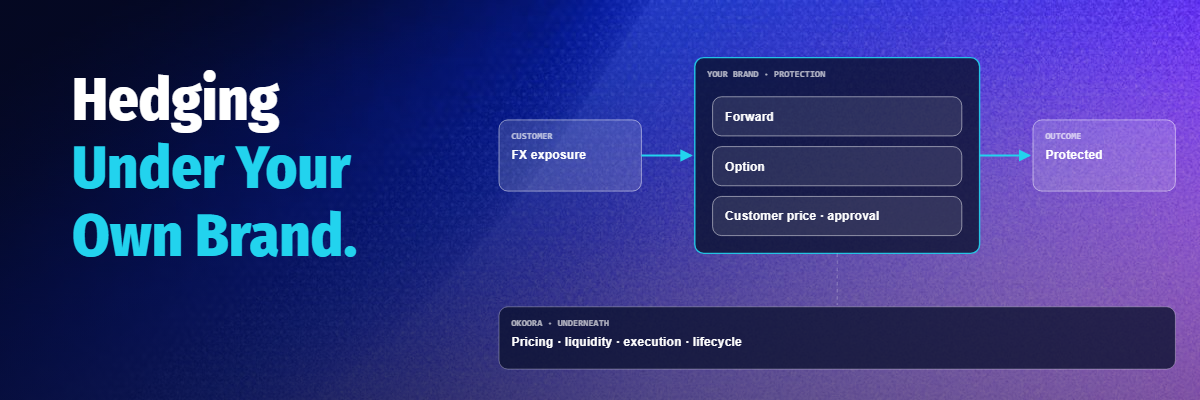
This is what distinguishes embedded foreign exchange from a bolt-on FX vendor relationship: the platform owns the full cycle, under its own brand, without exposing its customers to a third party at any step.
How Do You Build Embedded FX Without Rebuilding Your Core System?
Rather than rebuilding the platform’s architecture around FX, with Okoora, you build embedded FX by connecting FX360 to the platform’s existing invoice, payment, and billing workflows via API. This deployment model makes FX for SaaS platforms viable at the pace at which vertical SaaS actually operates.
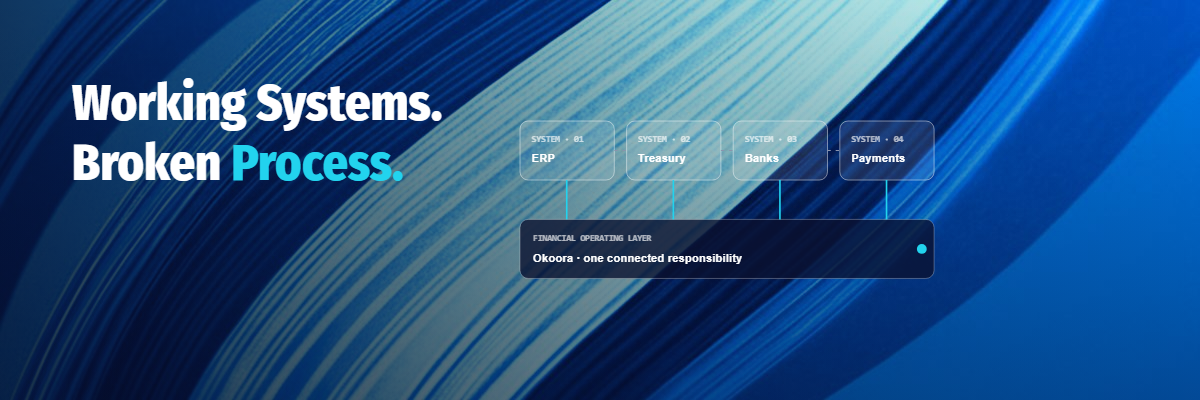
Okoora’s FX360 Stack embeds at the workflow level. It sits inside the invoicing engine, the payables and receivables flows, or the billing system that the platform already runs. The integration captures exposure at the point it’s created rather than requiring data to be exported to an external system. There is no new interface for end customers, no re-platforming of core billing logic, and no operational disruption to how the platform currently processes payments.
For a platform’s engineering team, this means the FX360 Stack is deployed alongside existing systems, not instead of them. For product and revenue teams, it means a new capability priced and branded however the platform chooses without a multi-quarter build cycle competing for the same roadmap as core product work. Deploying without rebuilding is the deployment model; embedding without disruption is the outcome.
What Does Embedded Foreign Exchange Deliver for a Platform’s Revenue?
Embedded foreign exchange converts FX flows that a platform was already processing into recurring revenue and improved retention. One ERP platform protected $15M in annual margins by embedding FX Shield directly into its invoice flows, turning currency exposure that had previously leaked to external providers into revenue that the platform now captures as its own product.
How To Start Building Embedded FX Into Your Platform
Start by mapping where cross-border transactions already flow through your platform, such as invoicing, payouts, subscriptions, or supplier payments, since that is where FX exposure already exists, whether it’s being tracked or not. From there, the FX360 Stack embeds via API at the workflow level, without requiring a rebuild of billing or payment architecture.
If your platform serves customers who transact in more than one currency, the FX exposure is already there. The question isn’t whether to build embedded FX; it’s how long the platform can afford to let that margin flow to someone else’s infrastructure.
Book a partner strategy call to map where FX360 fits inside your platform’s existing workflows.