 OkooraEditorial Team
FX liquidity is the ability to trade without moving the market too much
In practical terms, FX liquidity describes how easily a currency transaction can be executed at a competitive price without creating a large change in the market.
For a business, liquidity affects something very tangible:
How easy is it to buy or sell the required currency, in the required amount, at the required time?
A highly liquid market usually has many active buyers, sellers and liquidity providers.
A less liquid market may have fewer participants, wider pricing and less depth available at a given moment.
That difference can affect the price a business receives even when the underlying currencies have not changed dramatically.
Liquidity is not the same across every currency pair
The FX market is large, but liquidity is not distributed evenly.
Major currency pairs typically have many active dealers and deep trading activity.
Less frequently traded currencies can have fewer participants and less executable depth.
That matters because a provider pricing EUR/USD may be able to access a very different liquidity environment from the one available for a less commonly traded pair.
A business should therefore avoid thinking of a provider as simply âgood at FX.â
The more useful question is:
How strong is this provider's liquidity access for this specific currency pair and this specific transaction?
Transaction size can change the price you receive
Liquidity also depends on size.
A provider may be able to execute a modest conversion close to the prevailing market level because enough liquidity is available at that price.
A much larger order may need to consume several layers of available liquidity or be handled through a different execution method.
That can change the effective price.
This is why a quote for a small transaction should not automatically be treated as evidence of the price available for a much larger one.
For businesses with material FX flows, transaction size belongs in the pricing conversation from the beginning.
Different providers can see different liquidity
The FX market is decentralised and fragmented.
Banks, brokers and non-bank liquidity providers do not all see exactly the same market.
They may access different trading venues, liquidity pools, client flows and internal inventories.
Large banks also internalise a significant share of customer flow, matching transactions inside their own books rather than immediately going to an external market.
As a result, two providers can receive the same conversion request and still have different liquidity available to them.
That is one reason executable quotes can differ.
The price is shaped not only by the currency pair, but by the liquidity behind the provider giving the quote.
Liquidity can be internal as well as external
A provider does not always need to go into the wider market to execute a customer trade.
If it has another client flow in the opposite direction, it may be able to match the two transactions internally.
This process is known as internalisation.
The Bank for International Settlements has shown that major FX dealers match a large share of customer trades inside their own liquidity pools.
For businesses, this matters because provider inventory and client flow can influence how aggressively a provider is willing to price a transaction.
A bank may be especially competitive for one trade because the transaction fits naturally into its current flow.
Another provider may be more competitive on the next one.
Liquidity can change during volatile markets
Liquidity is not fixed.
During normal conditions, many providers may be willing to quote tightly.
During volatile periods, some may become more selective.
Spreads may widen.
Quote sizes may shrink.
Liquidity can move toward particular dealers, venues or clients.
The 2025 BIS review of FX trading showed that the market remained resilient during a period of elevated volatility, but participants continued to rely on multiple execution methods and liquidity sources to adapt.
For a business, the lesson is not to predict liquidity perfectly.
It is to avoid assuming that the liquidity available yesterday will always be available tomorrow in the same form.
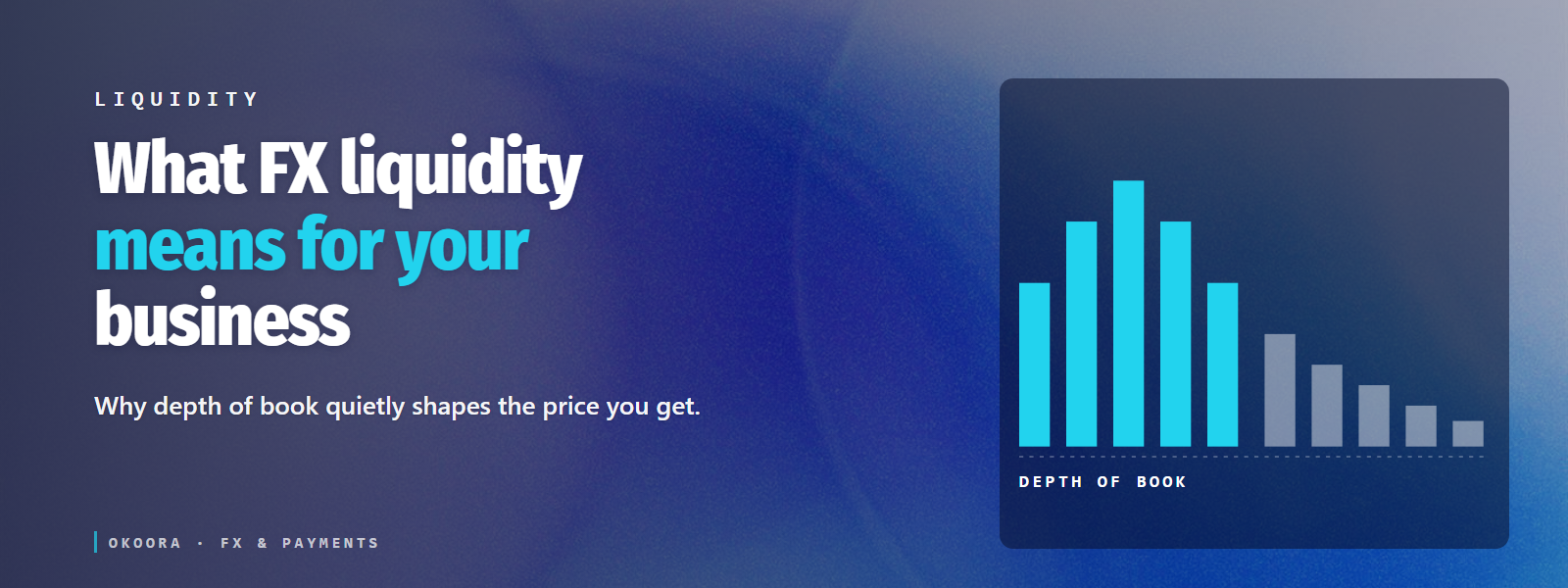
Market depth matters more than one visible quote
A quote tells you the price a provider is willing to show for a transaction.
Market depth tells you how much can actually be executed around that price.
That distinction matters for larger trades.
A provider may show an attractive price for a limited amount but need to reprice a larger transaction.
Another provider may offer slightly different headline pricing but more depth for the full amount.
For a business, the right comparison is the executable outcome for the actual transaction size.
Not the smallest visible price on a screen.
Liquidity and spread are connected
In general, stronger competition and deeper liquidity can support tighter pricing.
When liquidity is thinner, providers may need to protect themselves against higher market risk, lower certainty of offsetting the position or greater price movement during execution.
That can appear as a wider spread or less attractive executable price.
But liquidity is only one part of pricing.
Credit terms, transaction size, provider inventory, timing, relationship value and execution method can also affect the final quote.
So businesses should treat liquidity as a major pricing input, not as a complete explanation by itself.
Access to more liquidity sources can improve price discovery
If the FX market is fragmented, one provider naturally shows only the liquidity available through its own channel.
A multi-provider setup gives the business access to a broader set of banks, brokers or liquidity providers.
That does not guarantee a better price on every trade.
It does create more information.
The company can see whether available quotes are clustered closely together or vary materially.
It can identify which providers are competitive in a particular pair or transaction size.
It can understand whether the existing bank remains the strongest execution option.
That is the value of broader liquidity access: better price discovery before the decision.
More liquidity sources do not eliminate the need for policy
A business should not connect indiscriminately to every possible provider.
The provider set still needs governance.
The company can define:
Approved counterparties.
Credit limits.
Currencies.
Transaction-size thresholds.
Which providers should be used for which instruments.
Minimum comparison requirements.
Pricing tolerances.
Approval rules.
Exception handling.
The objective is not maximum connectivity.
It is controlled access to enough liquidity to make a better decision.
Liquidity also affects hedging
Liquidity matters beyond spot conversion.
Forward, swap and option markets can have different liquidity profiles across currencies and maturities.
A provider that is strong in spot FX may not be equally strong in a six-month forward or a particular option structure.
The longer or more specialised the hedge, the more provider balance sheet, funding and product expertise can matter.
That is why material hedges should be compared as complete executable structures rather than judged from the reputation of the provider alone.
Settlement still matters after the price is agreed
A good FX price is useful only if the trade can be completed safely and operationally.
The converted currencies still need to settle.
The transaction may need to fund a supplier payment, a securities purchase or another business obligation.
The BIS continues to track FX settlement risk because the market does not end at trade execution.
For a business, execution quality therefore includes:
Price.
Liquidity.
Counterparty terms.
Settlement method.
Operational confirmation.
The trade is complete only when the financial action is complete.
A practical liquidity checklist for businesses
Before executing a material FX transaction, ask:
Which currency pair are we trading?
How liquid is that pair under current conditions?
What is the actual transaction size?
Is the quote firm and executable for the full amount?
How many liquidity sources are available?
Are the providers seeing the same transaction at the same time?
Does one provider have noticeably better pricing or depth?
Could the trade size create market impact?
Would a different execution method be more appropriate?
What settlement terms apply?
Do policy and counterparty limits allow the selected provider?
Have we seen enough of the available liquidity to make an informed choice?
The point is not to turn corporate treasury into a trading desk.
It is to understand why the market can look different depending on where, how and how much you trade.
Where Okoora fits
Okoora connects businesses to multiple banks, brokers and liquidity providers through one FX marketplace.
That gives the customer broader access to executable liquidity for currency conversions and hedging transactions.
The customer can keep existing bank relationships while adding additional market access around them.
Okoora connects the transaction to multiple available sources, supports comparison under policy and then keeps execution, settlement and the updated financial state connected to the wider workflow.
The objective is not to promise the lowest price on every transaction.
It is to give the business a clearer view of the liquidity available around the transaction before it decides where to execute.
FX liquidity is invisible until you need it.
When the transaction becomes material, it becomes part of the price.
Next step: See how Okoora connects businesses to multiple banks and liquidity providers so FX transactions can be priced across a broader set of executable alternatives.