 Okoora TeamOkoora
The API tells you what the financial action costs. It does not automatically tell you what to charge
A platform can integrate accounts, payments, FX or another financial capability and still have no real monetization system. The provider returns a cost, rate or fee. The platform then has to decide what price the end customer sees. That decision determines whether the financial service becomes a revenue engine, a low-margin utility or a product that customers avoid because it is priced incorrectly.
Provider economics and customer economics are different layers
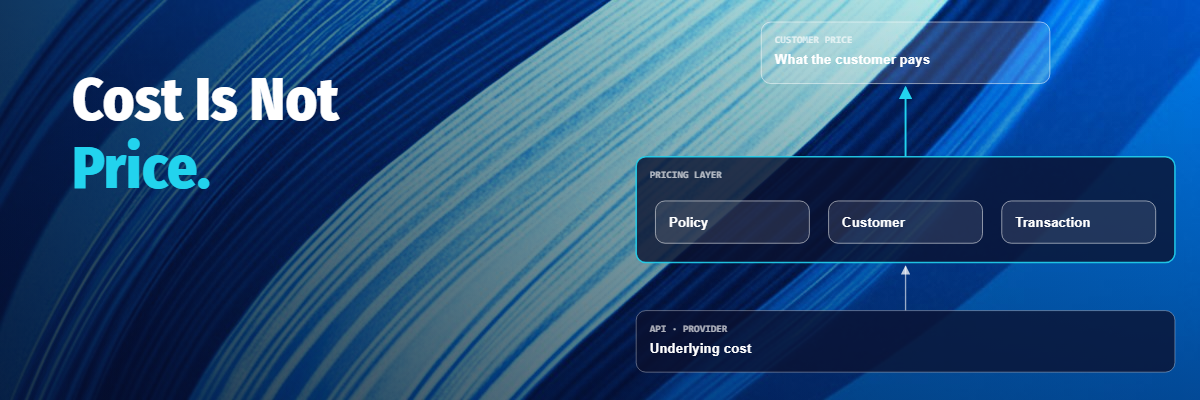
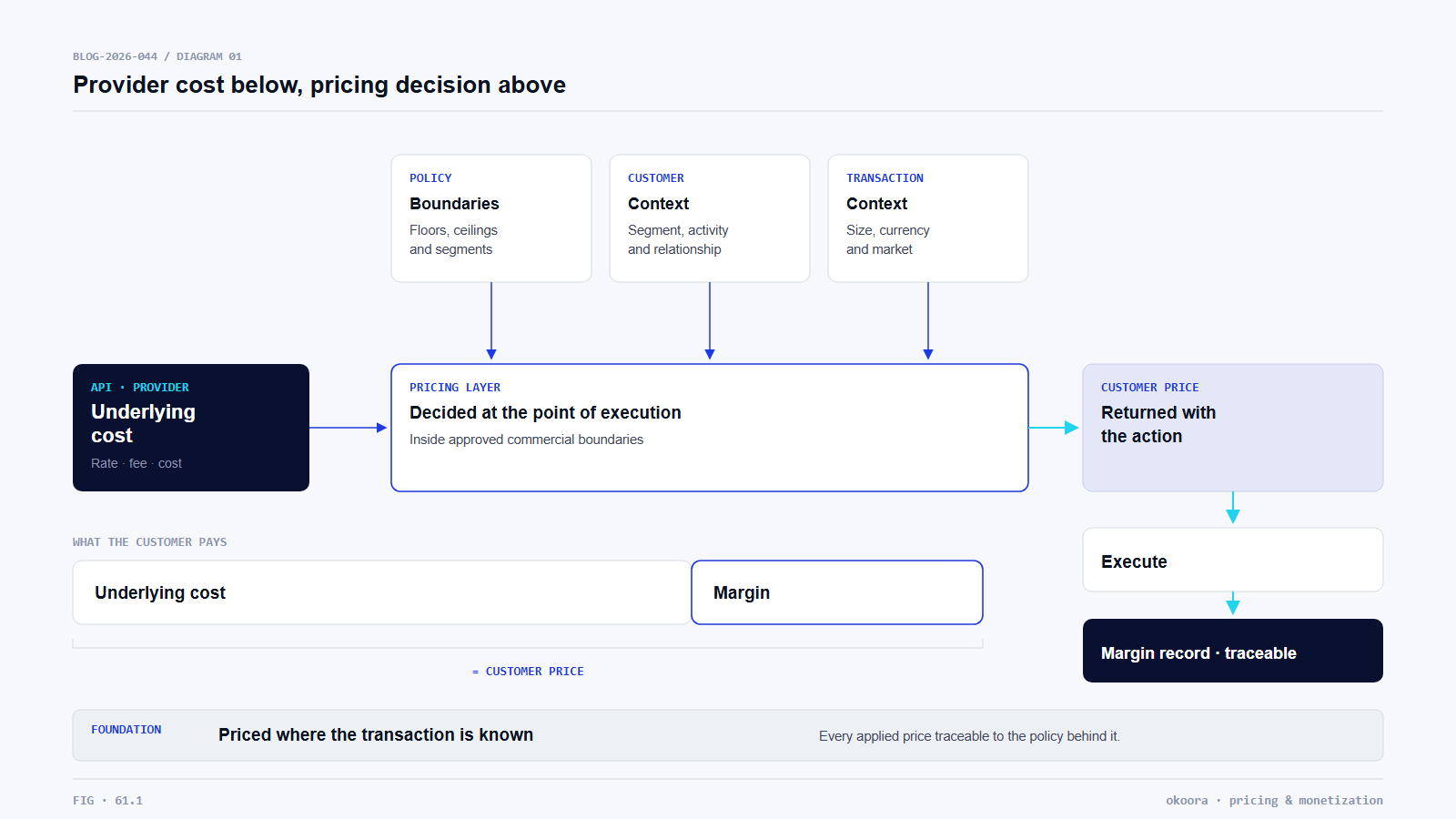
The platform buys a financial capability under one set of economics and sells a financial service under another. The difference may be a fixed fee, markup, spread or another approved pricing mechanism. Treating those two layers as the same prevents the platform from managing margin deliberately. A pricing layer makes the commercial relationship explicit: underlying cost below, customer price above.
One flat price is simple, but it is rarely neutral
Different customers create different economics. Transaction size, currency, destination, product type, activity level, market conditions and competitive context can all change what a transaction costs and what price a customer is willing to accept. A single margin may be too high for one customer and unnecessarily low for another. The problem becomes larger as volume grows because small pricing errors repeat across every transaction.
Pricing policy needs boundaries and control
Dynamic pricing should not mean uncontrolled pricing. The platform needs approved floors, ceilings, customer segments, product rules and other commercial boundaries. The system can then make a pricing decision inside that space. That preserves commercial control while allowing the final price to respond to the customer and transaction rather than relying on a single static table.
The pricing layer should sit close to execution
The best moment to price a transaction is when the actual financial action is known. That is when the customer, amount, product, market and underlying execution economics are available. Pricing far upstream from the transaction forces the platform to approximate. Pricing after execution is too late. A connected pricing layer can evaluate the transaction before completion and return the price as part of the action itself.
Revenue intelligence should be traceable
For a financial service to be operated as a business, the platform should be able to explain what price was applied, which policy governed it and what economics resulted. This matters for internal control, customer support and commercial learning. It also allows the organization to improve its pricing strategy from real activity instead of relying only on assumptions made when the product launched.
Where Okoora fits
Okoora provides pricing intelligence for financial services such as FX and money movement, together with the financial infrastructure those transactions use. Platforms can define pricing boundaries and commercial policy while Okoora evaluates the customer and transaction context underneath. The result is a financial service that can be priced and operated as a revenue line, not only delivered as an API feature.