 OkooraEditorial Team
The customer relationship already contains financial economics
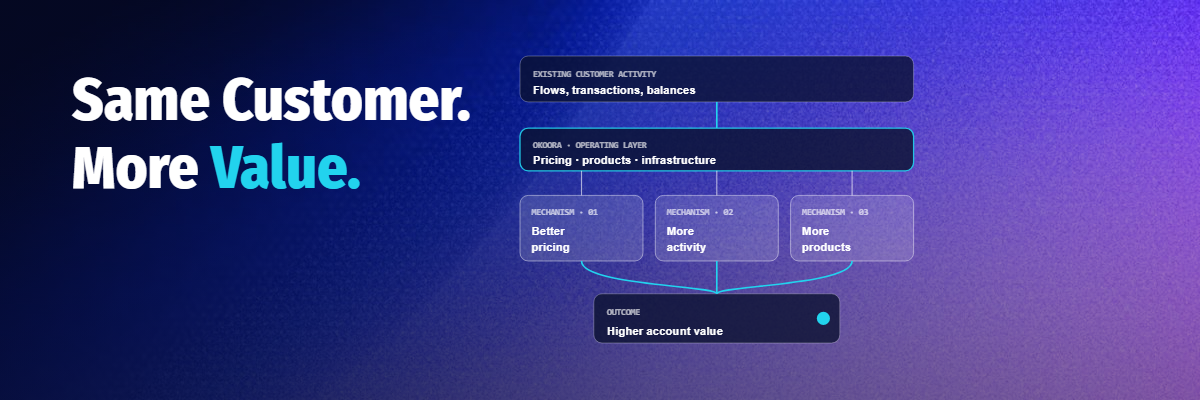
Banks often think about new revenue through new customer acquisition. That matters, but the existing customer base already contains a large amount of financial activity. Customers convert currencies, move money, hold balances, pay suppliers, receive funds, manage risk and need additional financial products.
The infrastructure underneath those activities determines how much of the economics the bank can see, price, retain and expand. Better financial infrastructure can therefore become a revenue engine, not only an operating cost.
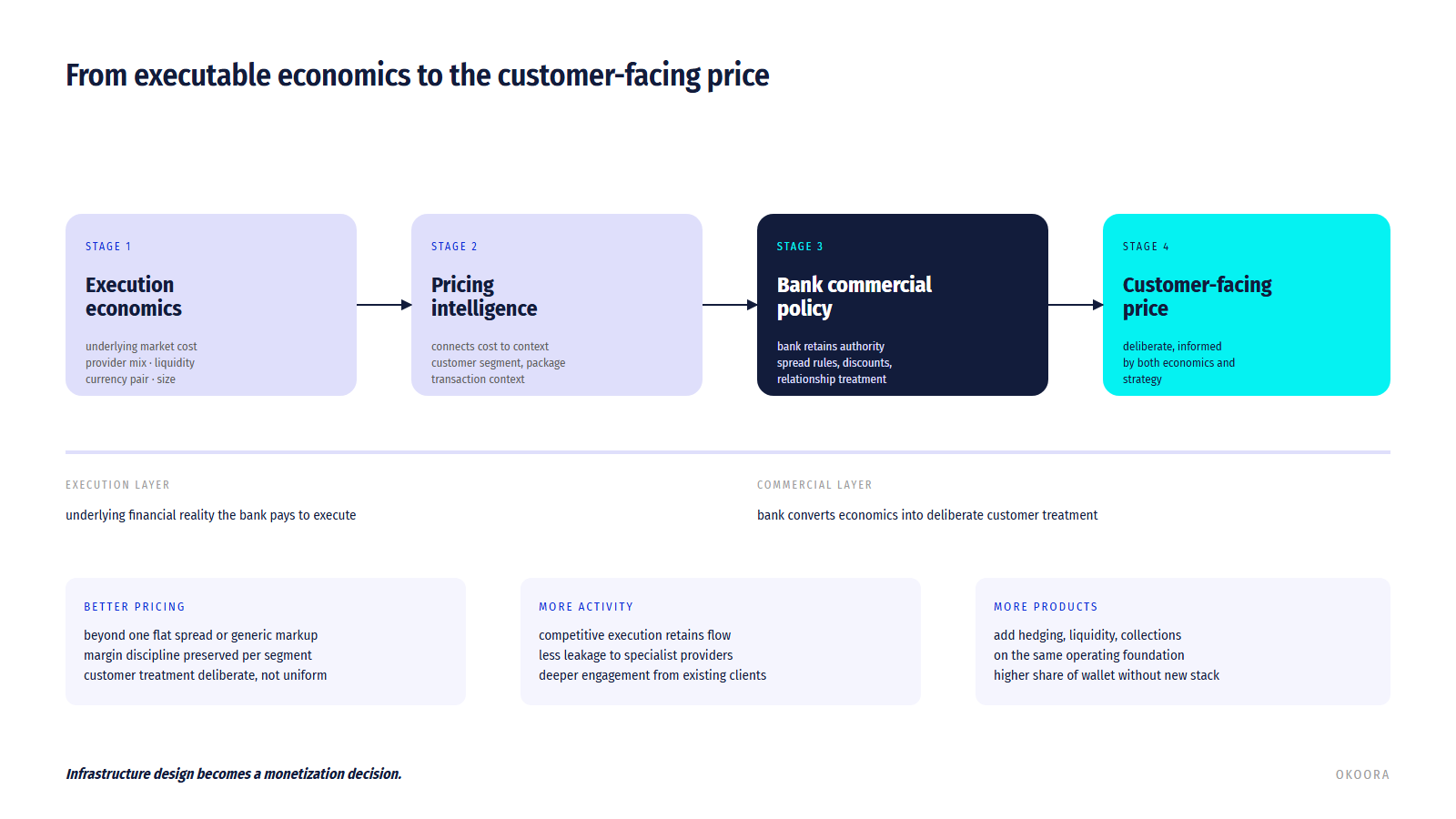
There are three basic ways infrastructure can create more value
The first is better pricing. The second is more customer activity. The third is more financial products. These mechanisms reinforce one another.
A bank that understands execution economics more precisely can price customers more intelligently. Better pricing and execution can make the product more competitive, which can keep more activity inside the relationship. A deeper infrastructure foundation can then support additional products without requiring a new stack for each one.
Better pricing begins with separating execution economics from customer economics
The price the bank pays to execute a transaction and the price the customer sees are not the same decision. The underlying market produces an executable economic cost. The bank then applies its own commercial policy based on factors such as customer segment, package, transaction size, currency pair, relationship or context.
When infrastructure exposes those layers clearly, the bank can move beyond one flat spread or one generic markup. Commercial policy becomes more deliberate because the bank can understand the economics underneath the customer price.
Customer-level pricing does not mean uncontrolled discounting
More granular pricing can support both competitiveness and margin discipline. A high-value relationship may justify one commercial treatment. A smaller occasional user may justify another. A transaction in a liquid currency pair may have different execution economics from a more complex or less liquid trade.
The important point is that the pricing decision becomes informed by the underlying financial reality and the bank's own commercial strategy rather than by one blunt rule for every customer and transaction.
Better infrastructure can keep more activity inside the relationship
Customers often move activity away from a bank because another provider solves one part of the financial job better. A specialist provider offers local payments. Another offers more competitive FX. Another provides a simpler account structure. Over time, the bank retains the customer relationship but loses parts of the customer's financial activity.
A broader embedded infrastructure layer can help the bank bring more of that activity back into its own proposition. The bank keeps the customer-facing relationship while adding the capabilities and execution depth required underneath.
More financial products increase share of wallet
A transactional relationship can become deeper over time. An SME that begins with accounts and FX may later need local payments, cross-border payments, collections, scheduled conversion, hedging, exposure monitoring, liquidity support or financial policy.
If every capability requires a separate product stack and integration, expansion becomes slow and expensive. If the financial infrastructure is already shared, the bank can activate deeper products on the same operating foundation. That can increase the economic value of the relationship without requiring a new customer.
Infrastructure can turn customer activity into commercial intelligence
The bank already sees customer behavior. Financial infrastructure can add more economic context around that behavior. Which customers trade frequently? Which transactions carry higher execution cost? Where is margin leaking? Which clients have recurring currency needs? Which customers might benefit from protection rather than repeated spot conversion?
Used responsibly, that context can help the bank design better products and commercial policy around real financial activity rather than generic customer categories.
The goal is not to maximize margin on every transaction
A strong monetization model is not about extracting the highest possible spread from each customer. That can damage trust and reduce activity. The objective is to maximize long-term account value by balancing customer value, competitiveness, execution economics, activity retention and product expansion.
Sometimes the right commercial decision is a lower margin that keeps more flow. Sometimes deeper financial capability creates more total value than a higher spread. Infrastructure should give the bank enough information to make that decision deliberately.
This changes how the bank should evaluate infrastructure
A narrow evaluation asks how cheaply a provider can process FX or payments. A broader evaluation asks what the infrastructure allows the bank to earn, retain and expand across the customer relationship.
The bank should therefore consider whether the infrastructure supports customer-level pricing, broader provider access, more financial products, product expansion, reusable customer context and economic measurement. Those capabilities determine whether the platform is simply processing transactions or helping the institution create more commercial value.
Where Okoora fits
Okoora connects executable market economics, customer-level pricing intelligence, financial products and provider infrastructure under one operating layer. The institution keeps the customer relationship and the commercial decision. Okoora can operationalize pricing, routing, execution and deeper financial capability behind that relationship.
The objective is to help financial institutions create more value from activity they already own, not only to process it more efficiently.
Next step: See how Okoora can connect executable market economics, customer-level pricing and broader financial capability to help institutions create more value from existing customer activity.
Related reading: How Existing Customer Payouts Can Become New Financial Products, How Financial Institutions Can Turn Existing Customer Activity Into New Revenue.