 Benjamin AvrahamCEO
A platform rollout is not the same as operational adoption
Enterprise financial software can be deployed widely and still sit outside the work that matters. Users may have access. Data may be connected. Dashboards may be available. Training may be complete. None of those things, on their own, mean the software has become part of a real financial operating process.
The stronger starting point is smaller and deeper: choose one recurring financial process, understand where it really begins, connect the information required to keep it current, define the decisions and actions inside it, and prove that the process can run repeatedly through the system.
That approach changes the goal from “roll out the platform” to “operate one piece of financial work well.” Once that operating spine is real, expansion becomes much easier.
Start with the work, not the software
A finance team does not experience its business as a collection of software modules. It experiences obligations, payments, purchases, collections, exposures, approvals, conversions, protections, bank balances and deadlines.
The first implementation question should therefore be: which recurring financial process matters enough to operate end to end?
For an importer, that process might begin when a purchase commitment becomes financially real. For another company it may begin with an invoice, a forecasted obligation, a payment request or another recurring business event. The exact event differs. The principle does not.
Start where the financial responsibility begins, not where the software happens to have a convenient screen.
Find the earliest meaningful origin event
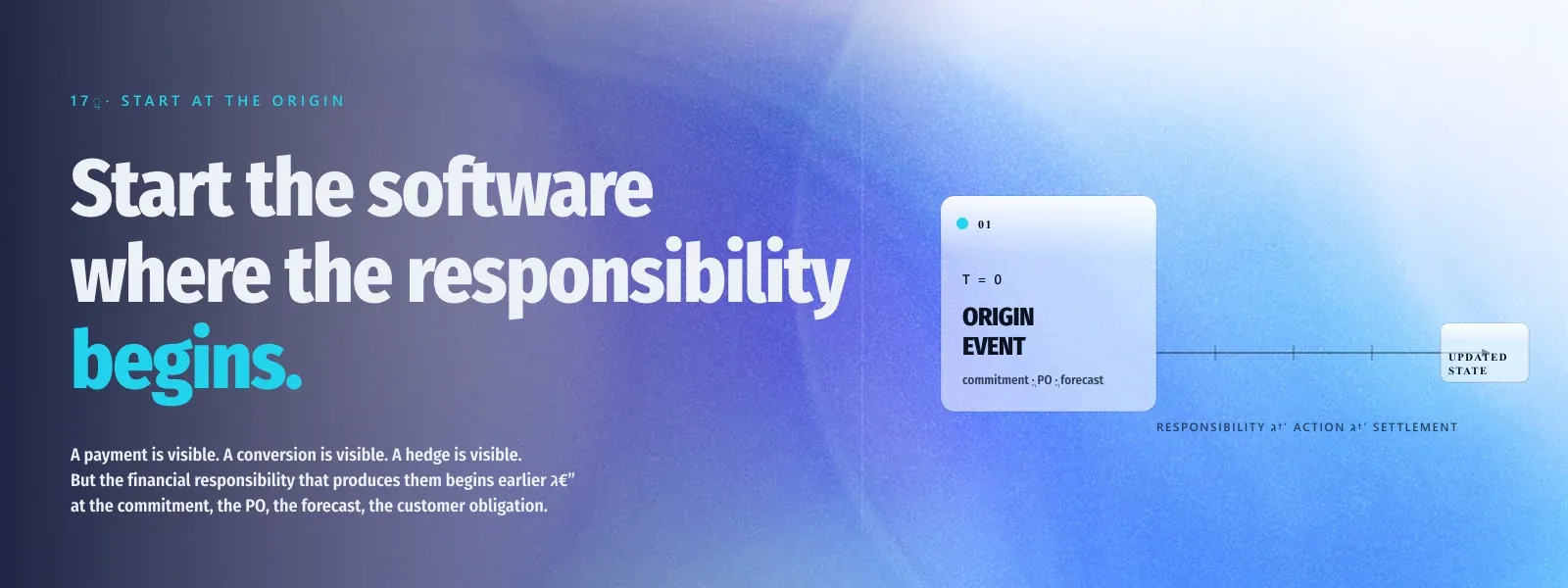
Every recurring financial process has an event that creates responsibility. Something happens and, from that point forward, the company has financial work to do.
That event may create a payment obligation, a currency need, an exposure, a liquidity requirement, a control requirement or several of these at once.
Identifying the origin event matters because downstream systems often see the process only after important financial meaning already exists. If a team starts too late, the software may report what happened without understanding why the obligation exists, what should happen next or how related actions connect to it.
A good first implementation follows one real example from beginning to end and asks: when did this become financially real, who first saw it, where was it recorded, and what financial work started because of it?
Connect the minimum durable truth
The next objective is not to collect every available dataset. It is to establish the minimum recurring truth required to keep the first process alive.
That usually means identifying the authoritative source for each material fact. The purchase commitment may live in one system. Bank balances may come from another. Existing protection may be maintained elsewhere. Policy and approval authority may sit in yet another source.
There is no requirement for all financial truth to originate in one system. What matters is knowing which source actually determines each fact and establishing a reliable path for the required information to reach the operating layer repeatedly.
The connection itself should be practical. An existing connector, Open Banking, a read-only API, a secure database view, SFTP or a scheduled automated export can all be valid. Technical sophistication is not the objective. Durability, security, maintainability and time to value are.
Turn incoming data into financial state
Rows, files and API responses are not yet an operating process. The system has to understand what the information means financially and preserve the relationships that matter.
For a simple import workflow, that may mean understanding the entity, supplier, obligation, currency need, exposure, existing protection, conversion, payment and bank account as related financial objects rather than disconnected records.
The system should know what is open, what changed, what is protected, what has been converted, what was paid, what still requires action and what is complete.
This persistent state is what allows software to operate continuously. Without it, each review starts by reconstructing the picture again.
Confirm one operating path before building the experience
Once the financial reality is connected, the next step is not to ask the customer what screen they want. It is to agree on the first operating path.
That path should describe how the work moves from the origin event through the financial decisions and actions that follow. A process may run from obligation to exposure to protection decision. Another may run from obligation to currency need to conversion to payment. A deeper path may connect all of those stages.
The customer should validate whether the operating path reflects reality: what requires judgment, what needs approval, what can progress routinely within policy, what should stop as an exception, and what counts as completion.
Only after that is clear should the implementation team decide how the process should appear in software.
The screen is the surface, not the process
A dashboard, workspace, notification, approval action or payment screen can all be useful. But none of them is the operating process itself.
The product is the combination of current financial state, operating logic, policy, decisions, approvals, actions, exceptions and completion. The surface is how the user encounters that system.
This distinction prevents an implementation from being designed around whichever existing module is easiest to expose. Instead, the interface is selected because it serves the agreed process.
The result can be simpler for the customer because complexity remains inside the operating system instead of being pushed onto the user.
Prove depth through repeated real cycles
One successful demonstration is useful, but it does not prove operational adoption. A recurring financial process has to survive real change.
A useful test is simple: when the source reality changes, does the system update the relevant financial state without someone rebuilding the picture manually? Then, when the next real cycle arrives, can the same process operate again?
Repeated financial action matters. A payment, conversion or protection action should occur through the operating process across real cycles. Human assurance may be used during activation, but recurring production should not depend on an Okoora employee or customer manager reconstructing the work every time.
The deepest test is operational dependency. If the system were unavailable tomorrow, would a real recurring financial process be materially disrupted? If the only thing missing is an optional dashboard, the implementation has not yet reached the same depth.
Expand from a proven financial spine
Starting narrowly does not mean thinking small. It creates a controlled entry point into a much larger financial operating environment.
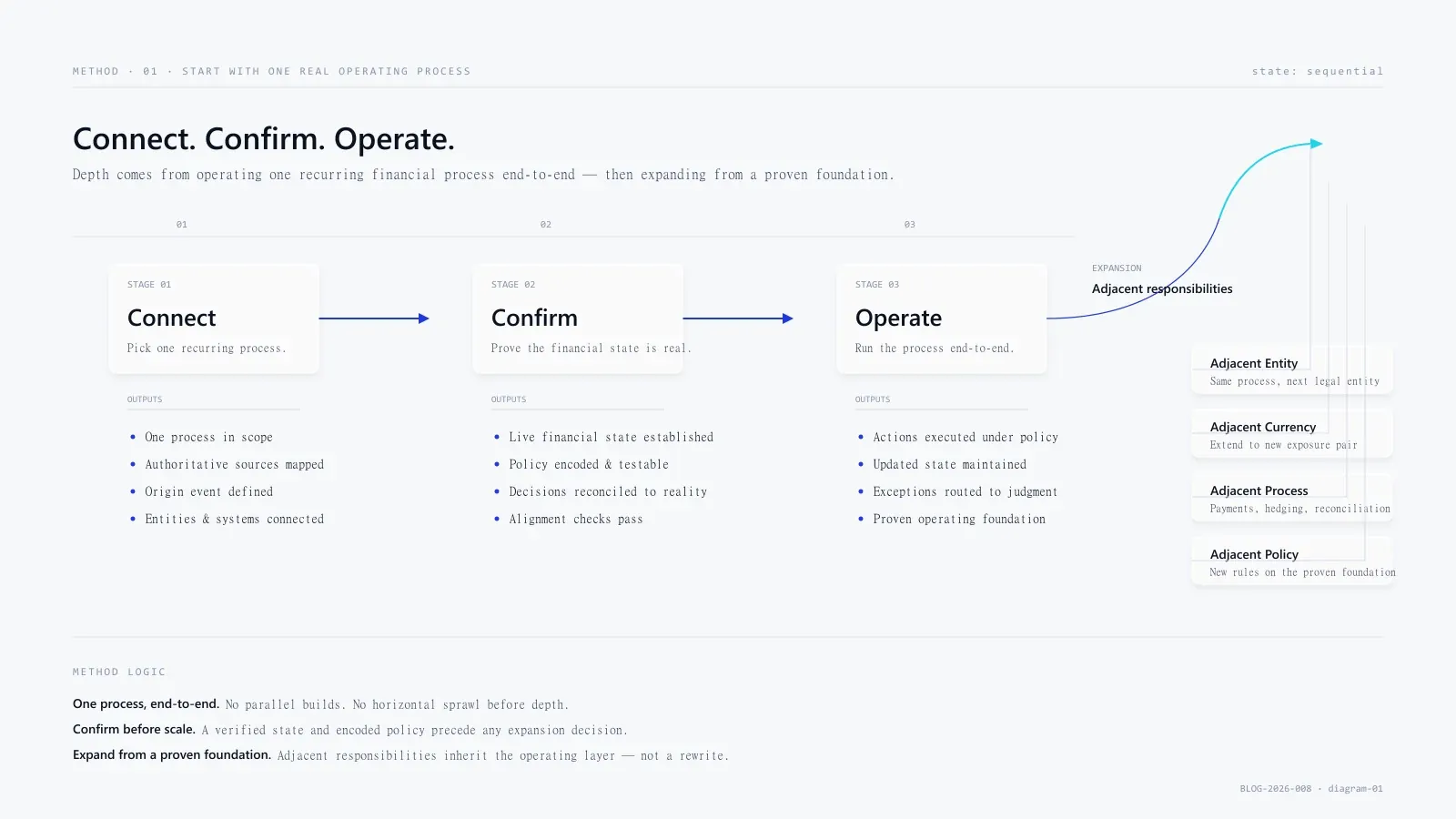
Once one process has a durable data path, persistent state, agreed logic and repeated financial action, adjacent responsibilities become easier to add. The same obligation may connect to payment planning, conversion, protection, liquidity, policy, approvals and reconciliation. Other entities, currencies, suppliers or process populations can follow.
This creates a different expansion model from a broad platform rollout. Instead of asking teams to adopt many features at once, the system earns depth in one workflow and then takes responsibility for more financial work from the same connected reality.
The implementation grows because the operating layer becomes useful, not because more modules were enabled.
What a strong first operating process looks like
A strong first process is recurring, financially meaningful and narrow enough to put into production. Its origin event is identifiable. Its required sources of truth can be connected. Its financial state can remain current. It leads to a real decision or financial action. Its boundaries can be defined. And success can be observed across more than one operating cycle.
That is enough to begin. The enterprise does not need to map every system, migrate every workflow or design the final architecture before first value.
The objective is to establish one live operating spine and build from truth.
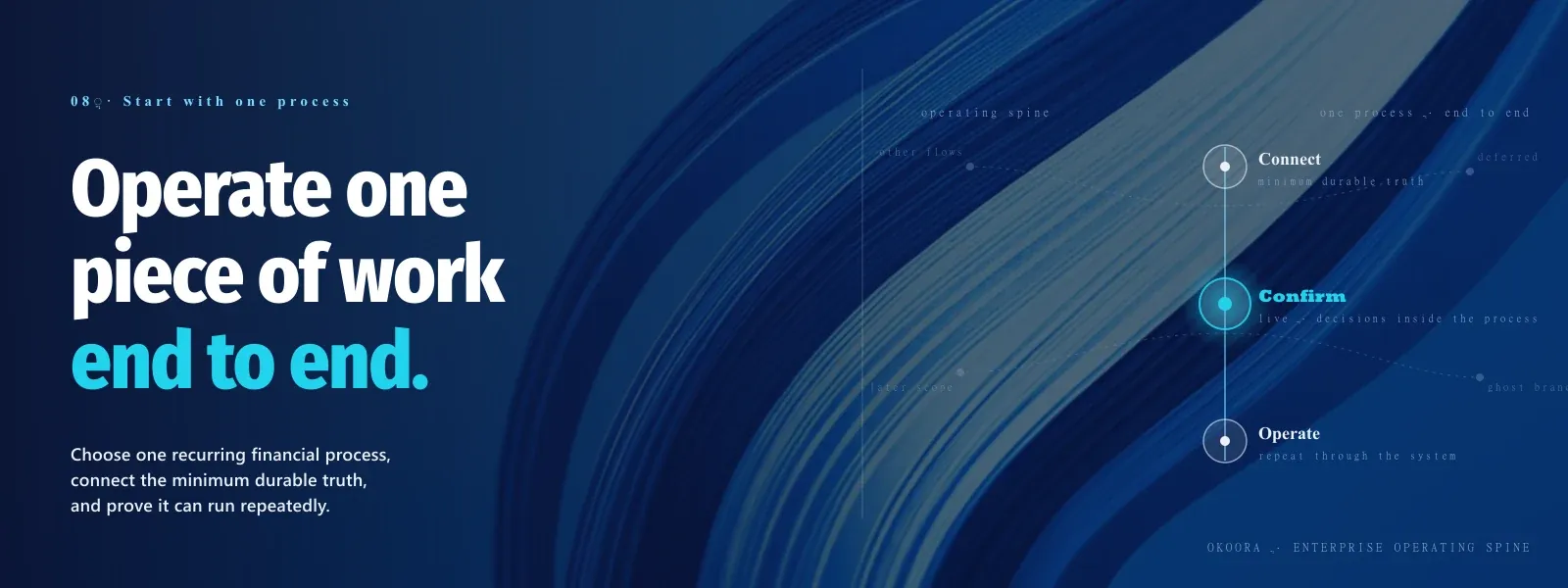
Connect. Confirm. Operate.
Okoora uses a simple activation method for enterprise financial operations.
Connect means establishing the minimum durable financial reality required for one recurring process. Confirm means agreeing on one operating path and its boundaries. Operate means implementing that path so the financial state, decisions, approvals and actions can run through Okoora in production.
This is how financial software moves from being another system the enterprise can access to becoming part of how financial work actually gets done.
Okoora operates across intelligence, infrastructure, execution and control so enterprises can start with one real process, make it operational and expand from there.
NEXT STEP See how Okoora can start with one real recurring financial process and operate it through connected financial intelligence, execution and control.