 Benjamin AvrahamCEO
The financial process often starts before the financial system notices it
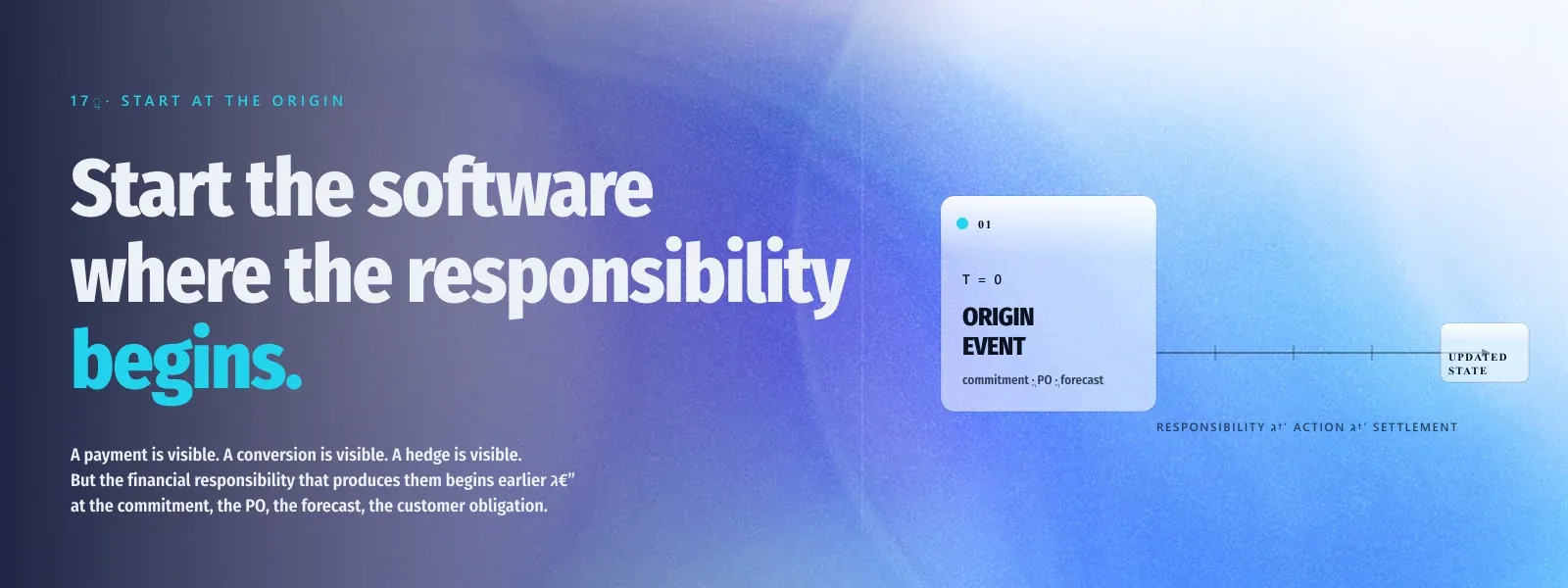
A payment is visible. A conversion is visible. A hedge is visible. A bank balance is visible. But the financial responsibility that eventually produces those actions usually begins earlier.
A supplier commitment may create a future payment need before an invoice arrives. A purchase order may create a currency need before cash moves. A forecast may become operationally binding before it becomes an accounting entry. A customer obligation may create a financial responsibility before settlement is scheduled.
If financial software starts only when the transaction reaches the bank, the system is entering the process after important decisions have already been created.
Start with the origin event
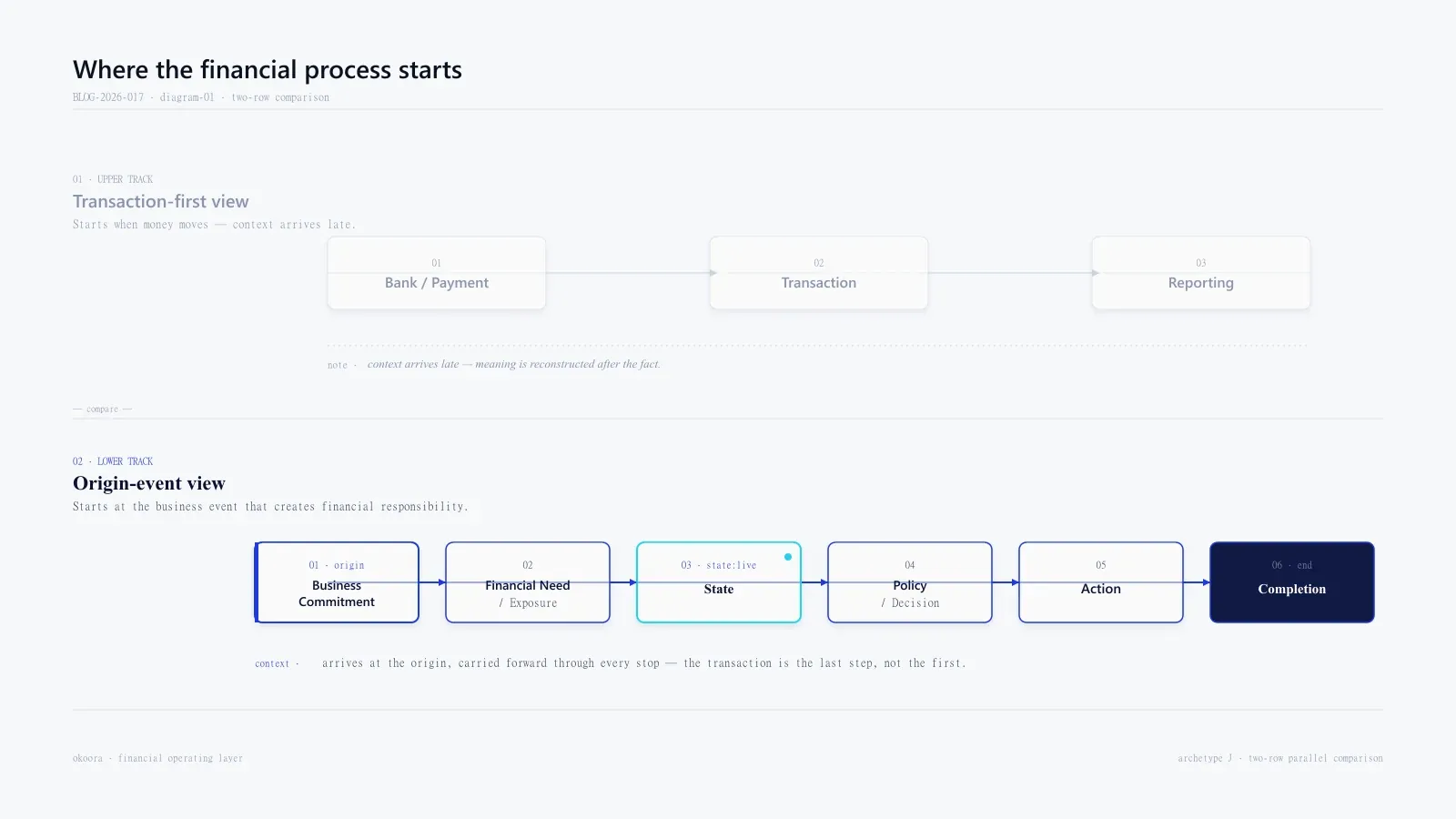
The better starting point is the earliest recurring event at which a financial responsibility becomes real for the business.
That event is not universal. In one company it may be a purchase order. In another it may be an approved invoice, a supplier commitment, a forecast milestone, a customer payout obligation or another business event. The important question is not which label sounds most financial. It is which event actually causes the organization to become responsible for something financially meaningful.
Once that origin event is identified, the rest of the operating chain becomes easier to understand. The business can ask what obligation was created, what currency will be needed, what exposure exists, what liquidity is required, which policy applies, who must approve the next action and what completion looks like.
Why starting from the bank is usually too late
Bank data is authoritative for cash that has moved or is currently held. It is not always the first source of truth for the financial work that caused that cash movement.
The same is true of many ERP records. ERP systems are essential sources of business and accounting truth, but the event that matters financially may exist in procurement, planning, order management, treasury files, contract systems or another source before it appears in a downstream posting.
This does not make the bank or ERP less important. It means financial reality is distributed across the systems that create, record, approve, protect and settle the underlying work.
The origin event changes what the system needs to know
Once the process starts from the event that creates responsibility, the required context changes. A transaction amount alone is rarely enough.
The system may need to understand the legal entity, supplier or counterparty, currency, due date, business purpose, existing protection, available liquidity, approval authority, policy limits and related actions. It may also need to understand whether the obligation changed, was cancelled, was paid, was converted, was protected or now requires a new decision.
This is the difference between processing a transaction and maintaining the financial meaning around it.
Different facts can have different sources of truth
A useful financial operating model does not force every fact into one master system simply for architectural neatness.
The purchase obligation may be authoritative in an ERP. The bank balance may be authoritative at the bank. An existing hedge may be authoritative in a treasury record or execution source. Policy may live in a governance document. Market data comes from another source. The system needs to know which source determines which fact and how often that truth changes.
That source-of-truth discipline matters because a financial decision is only as reliable as the state it is based on.
From an event to a persistent financial state
The objective is not to collect as much data as possible. It is to maintain enough durable truth to keep one real financial process current.
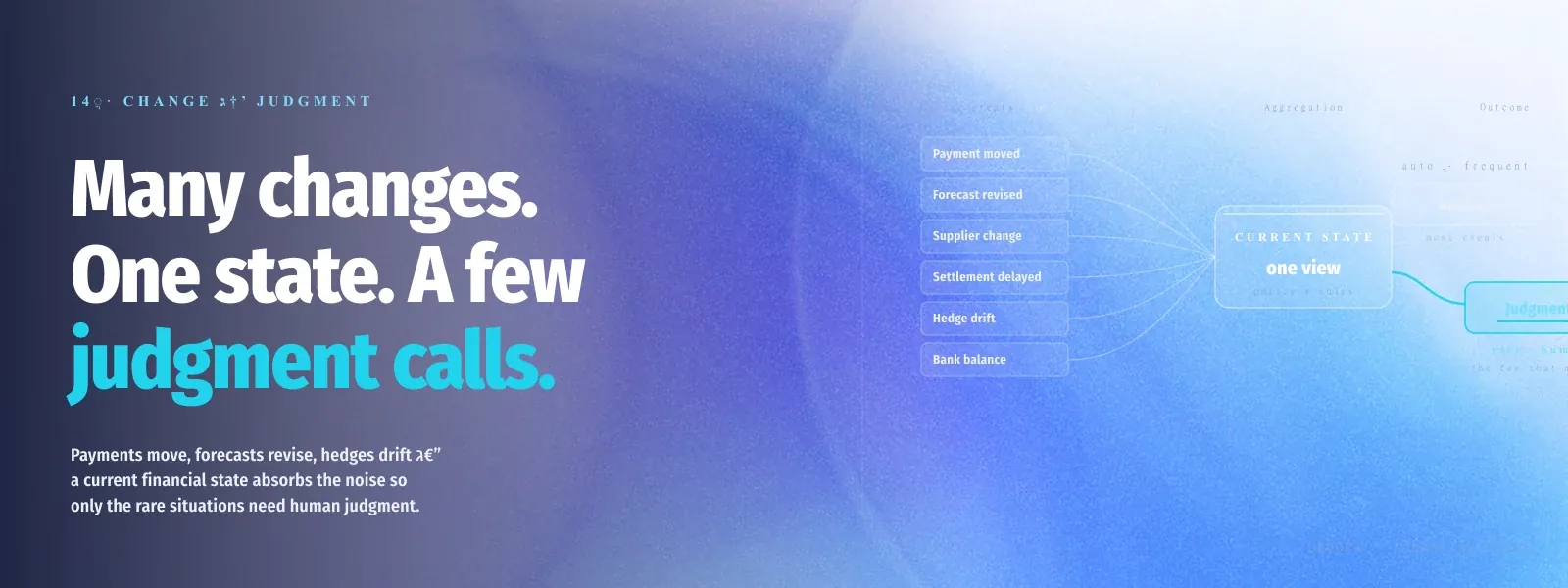
When a new obligation appears, the financial state should update. When the amount changes, the state should update. When the due date moves, a payment or hedge relationship may need to be re-evaluated. When an action is completed, the system should know that the obligation, exposure or payment state has changed.
The important shift is that the financial picture does not need to be reconstructed from spreadsheets, emails and meetings every time someone wants to make a decision. It persists across the lifecycle.
Policy becomes operational when it is attached to the real event
Policy is often documented separately from the work it is supposed to govern. Starting from the origin event creates a way to connect the two.
A real obligation can be evaluated against the relevant rules. The system can determine what is routine, what requires approval, what exceeds authority, what should become an exception and what financial action is allowed next.
That can apply to payments, currency conversion, protection, liquidity decisions or other controlled financial actions. The value is not that the policy exists in software. The value is that the policy operates on the financial reality that created the decision.
Start narrow, but enter early in the lifecycle
This approach does not require a broad transformation program. In fact, the stronger implementation pattern is usually the opposite.
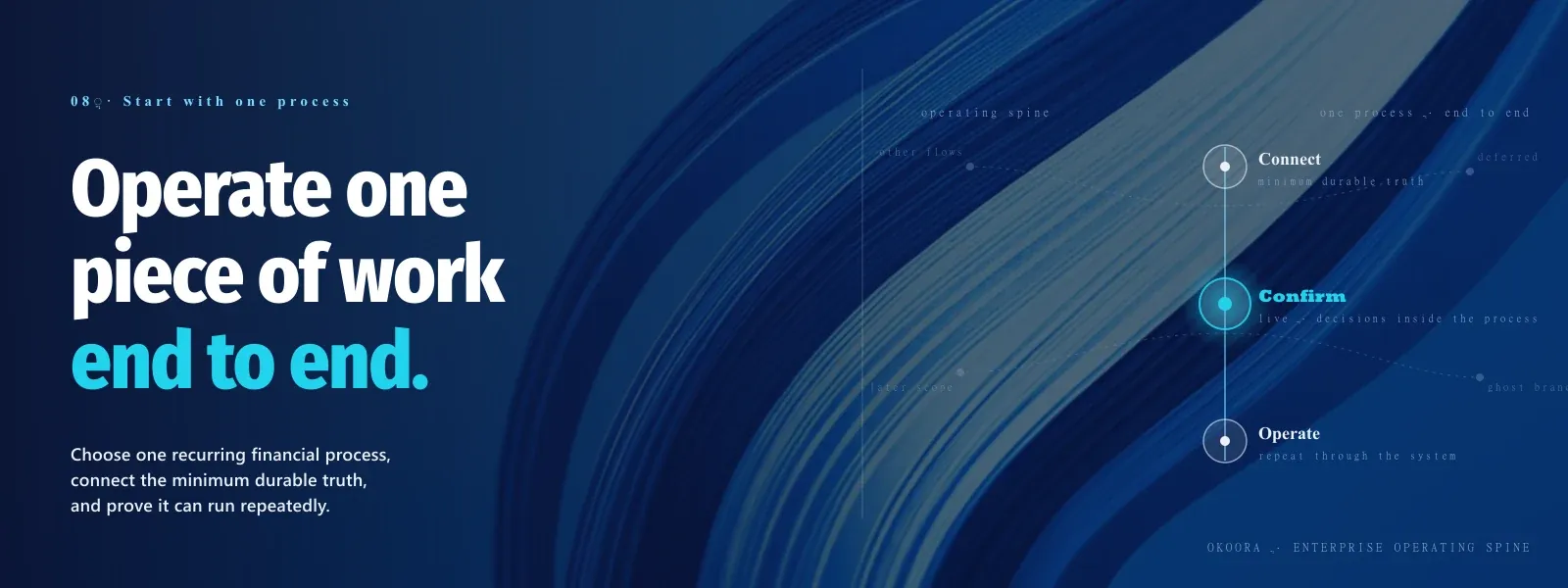
Choose one recurring process, one population, one entity, one supplier group, one currency set or another bounded perimeter. Then enter that process as early as practical and follow the lifecycle deeply enough to reach a real decision or financial action.
A narrow scope reduces implementation risk. An early origin point creates operating depth. Together, they make it possible to prove value without turning the first deployment into a multi-year integration project.
A simple example
Consider a company that regularly imports goods in foreign currency. If the financial process starts only when Treasury sees an invoice due for payment, the system may miss the earlier commitment that created the future currency need.
Starting from the purchase commitment changes the sequence:
Purchase commitment becomes financially real.
The system identifies the amount, currency, entity, supplier and timing.
The future currency need and any resulting exposure become visible.
Existing protection and relevant policy are evaluated.
A decision or action is prepared when required.
Conversion, protection or payment occurs through the approved execution path.
The financial state updates when the underlying reality or action changes.
The point is not that every importer should use exactly this sequence. The point is that the system follows the business event that creates the financial responsibility rather than waiting for the final transaction to appear.
What good financial operating software should be able to answer
For one recurring process, a useful system should be able to answer a small set of practical questions continuously:
Where did this financial responsibility begin?
Which sources determine the relevant facts?
What is the current financial state?
What changed since the last cycle?
Which policy and authority apply?
What decision or action is required now?
What can progress routinely and what must stop as an exception?
What proves that the process is complete?
When those answers remain current, the software is no longer just showing transactions. It is operating part of the financial work created by the business.
Where Okoora fits
Okoora is designed to connect business and financial sources, understand the financial context around real activity, maintain financial state, apply policy and move the work toward controlled action.
That can begin from the earliest meaningful event that creates an obligation, exposure, payment need, currency need or control requirement, then continue through the decisions and financial actions that follow.
The objective is not to replace every source system. It is to operate the financial work that spans them.
Next step: See how Okoora can operate financial work from the moment responsibility becomes real.
See how Okoora can operate financial work from the moment responsibility becomes real.