 Benjamin AvrahamCEO
A transaction is a fact. Financial meaning comes from context
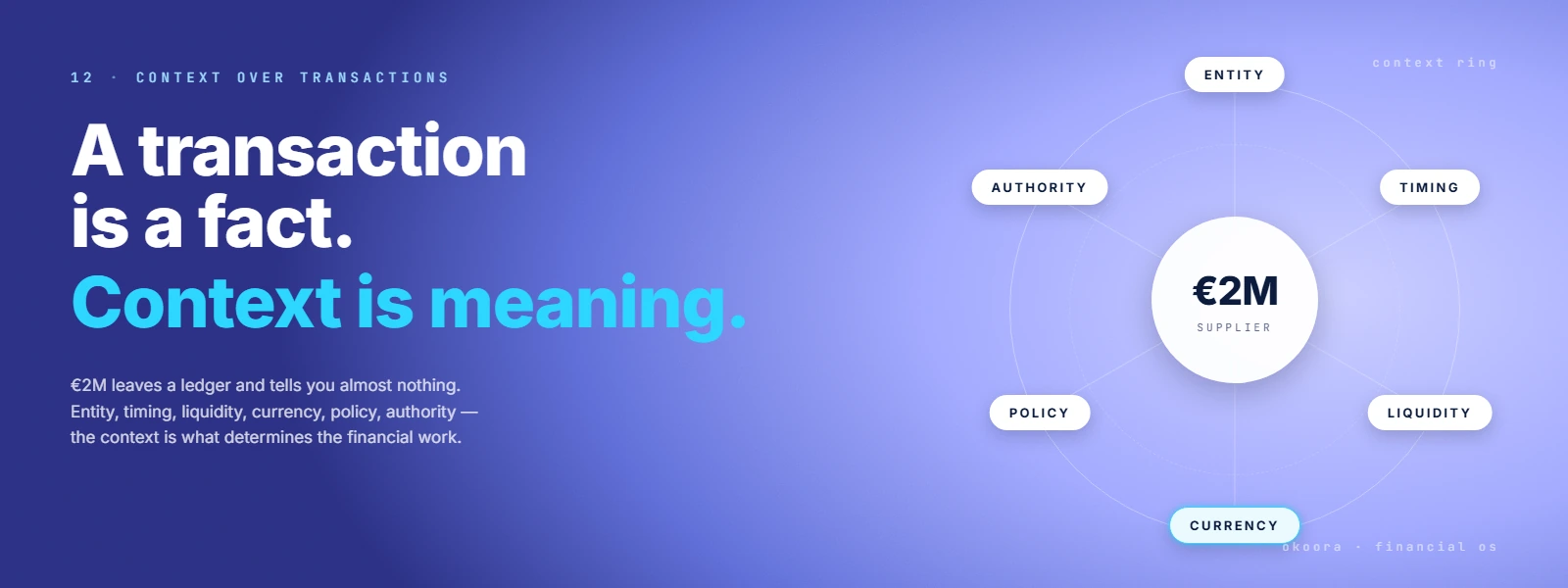
A company receives an invoice for €2 million. On its own, that fact is surprisingly incomplete.
Which legal entity owes the money? Which supplier is involved? What purchase or commitment created the obligation? When is it due? Is the amount fixed or expected to change? Does the company already hold euros? Is there an existing hedge? Which policy applies? Who can approve the payment? What other obligations compete for the same liquidity?
The amount and currency are real. But they are not yet enough to determine the financial work that follows.
This is a basic limitation of transaction-centric financial software. A transaction record tells the system that something happened. An operating system has to understand what that event means inside the wider financial reality of the business.
The difference matters because finance is relational. Obligations connect to payments. Payments connect to liquidity. Currency needs connect to exposure. Exposure connects to protection. Protection connects to policy. Decisions connect to authority. Execution changes the state that the next decision depends on.
The same transaction can require completely different actions
Consider the same €2 million supplier obligation in two companies.
Company A already holds sufficient euros, has no material competing cash need and can pay within an approved authority path. Company B holds mostly dollars, has a forward hedge linked to the expected payment date, faces a revised delivery schedule and operates under a policy that requires review when hedge timing no longer matches the underlying obligation.
The transaction amount is identical. The operating consequence is not.
A system that sees only the payment record may treat both cases similarly. A system that understands context can recognize that one is largely an execution task while the other affects liquidity, exposure, protection, timing, policy and approval.
That is why more connected transactions do not automatically create better financial intelligence. The system needs the relationships that explain what each transaction changes.
Financial context is made of relationships, not just more fields
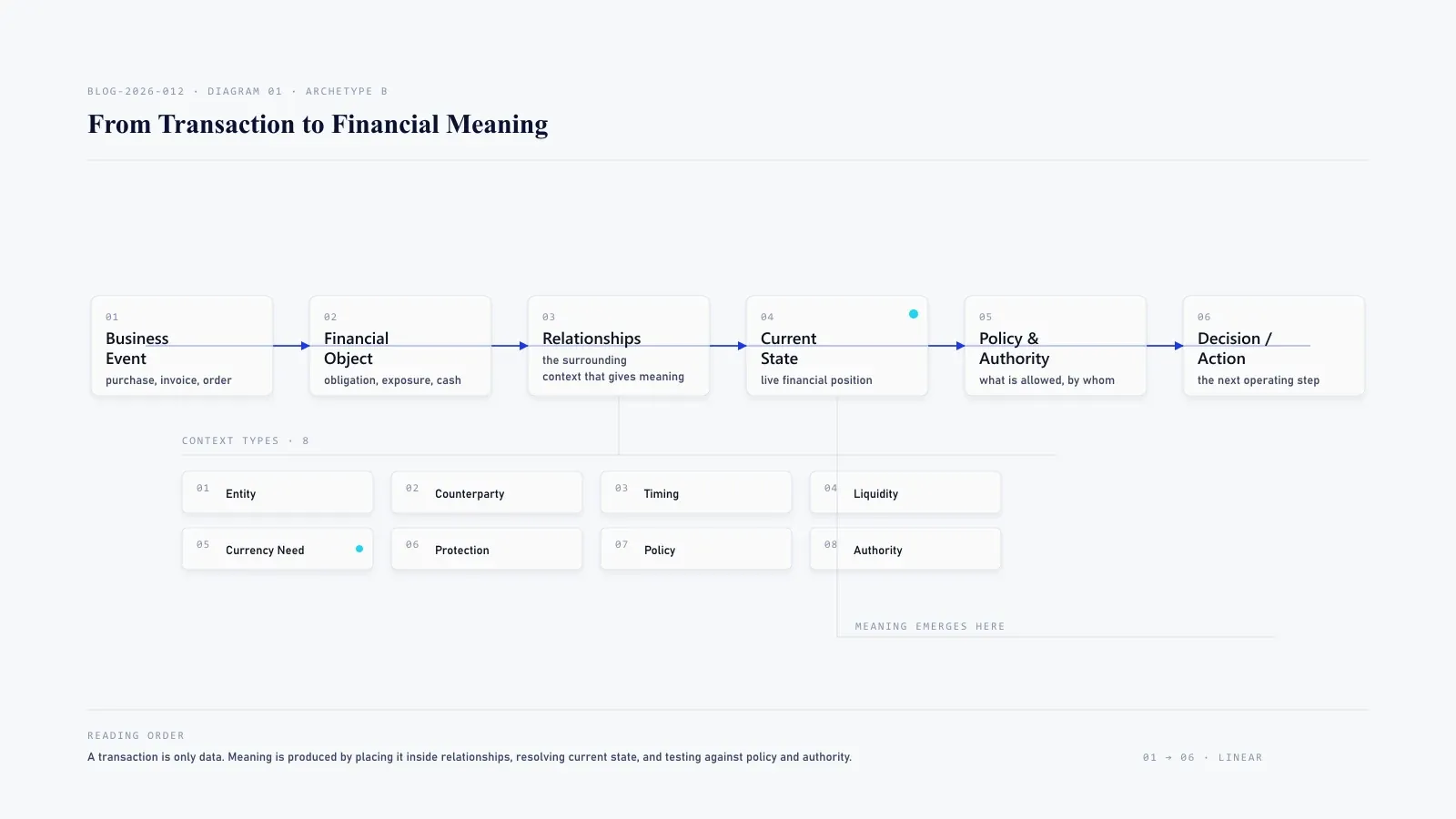
It is tempting to solve this by adding more columns. Entity. Counterparty. Due date. Currency. Cost center. Status. Approval level.
Those fields help, but context is not simply a larger record. It is the relationship between financial objects and the state of those relationships over time.
A purchase commitment may create an import obligation. That obligation creates a future currency need. The currency need may create exposure. A hedge may protect part of it. A forecast revision may reduce the obligation. A delayed shipment may move the timing. The system then has to determine whether the existing protection still matches the updated financial need.
Each object can live in a different source. The purchase may begin in a procurement or ERP system. Forecasts may sit in planning tools. balances come from banks. Hedging positions may come from a treasury file or execution provider. Policy may live in governance documents or workflow configuration.
The objective is not to force every fact into one source. It is to maintain one coherent financial reality across the authoritative sources that already exist.
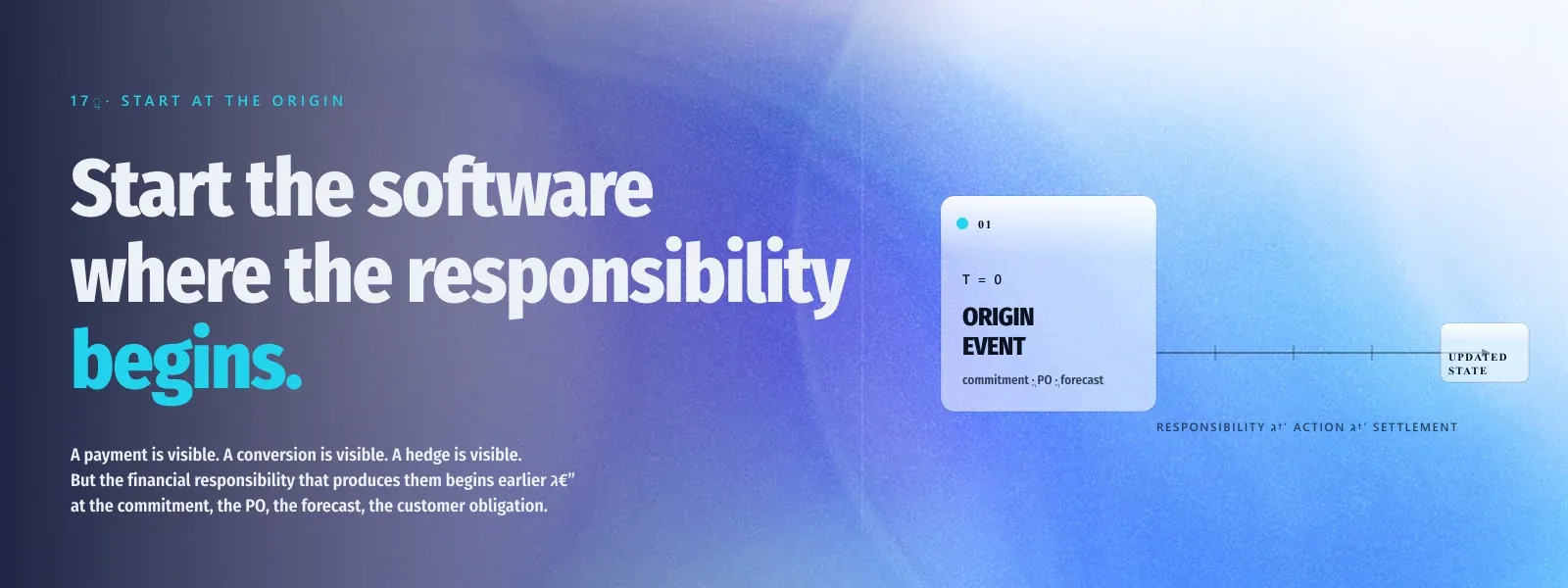
Context should begin where financial responsibility becomes real
One of the most important design choices is where the financial process begins.
If software starts only when a payment is initiated, much of the context already exists elsewhere. The company may have known about the obligation weeks or months earlier. Currency need may have been created at purchase commitment. Exposure may have emerged at forecast or order stage. Liquidity planning may already have changed because of the expected payment.
The better starting point is the earliest recurring event at which the financial responsibility becomes meaningful enough to operate.
That event will differ by business. It may be a purchase order, supplier commitment, invoice, forecast, customer booking, claim approval, settlement obligation or another recurring event. What matters is not the label. What matters is that the event creates real financial work.
Beginning there allows the system to follow the financial lifecycle rather than entering only at the final execution step.
Policy turns context into operating logic
Context explains what a financial event means. Policy explains what the company wants to happen because of that meaning.
A company may define target protection ranges, payment authorities, permitted instruments, minimum liquidity thresholds, timing rules, pricing tolerances, counterparty rules or escalation conditions. Those policies are not separate from the transaction. They are part of how the transaction should be operated.
When context and policy are connected, the system can distinguish between routine activity and activity that requires judgment.
A payment may progress because the amount, account, authority and liquidity are inside policy. A hedge mismatch may become a prepared decision because coverage moved outside an approved range. A currency conversion may require approval above a threshold. An exception may stop because the relevant authority is missing.
The objective is not to remove human authority. It is to make the company’s authority model part of the operating system so that people spend judgment where judgment is actually required.
Context has to survive execution
Financial context loses value if it disappears after the action.
When a payment is executed, the obligation should change state. When a conversion occurs, the relevant currency position should update. When a hedge is resized, protection should be re-evaluated against the underlying need. When an approval is given or rejected, the workflow should know what changed and what remains open.
Otherwise the next decision begins with another reconstruction exercise.
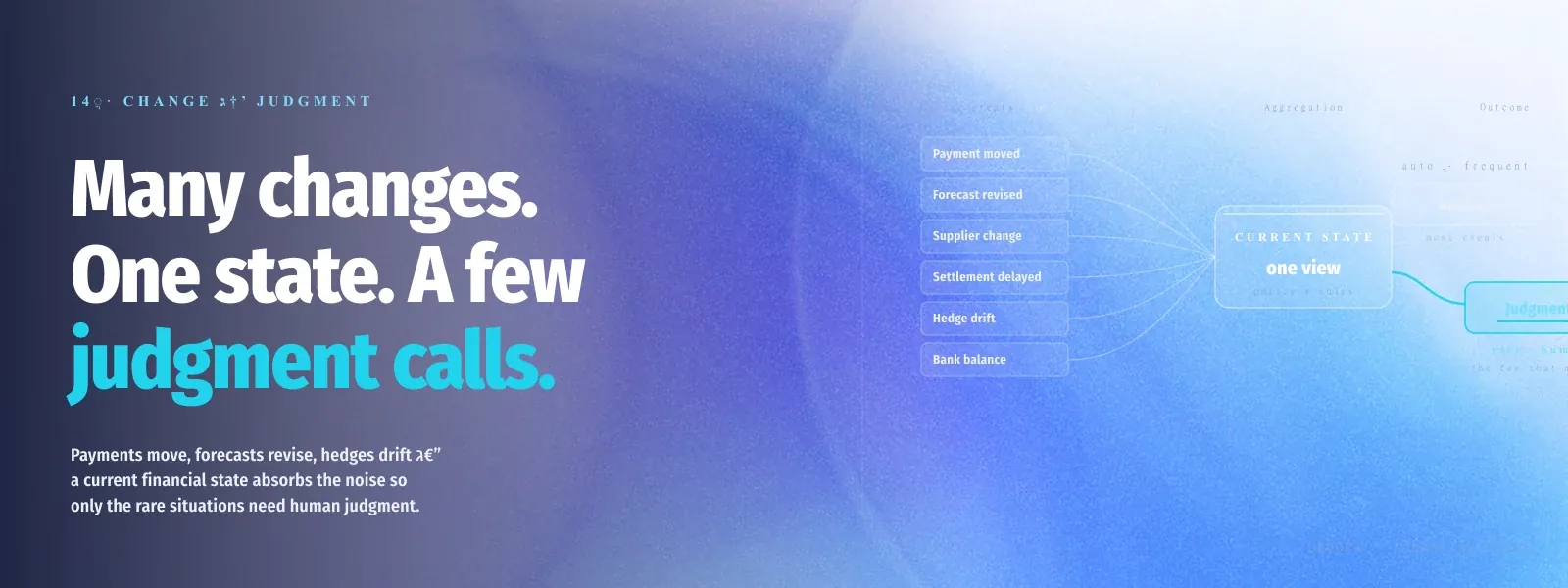
This is why persistent financial state is so important. The system should not repeatedly ask the finance team to rebuild the relationship between an obligation, the funds available for it, the protection attached to it and the action already taken.
The financial reality should remain alive as the business changes.
The user should see the consequence, not reconstruct the context
Good financial software should make deep context useful without forcing the user to navigate all of its complexity.
A CFO may need to see that a material group-level liquidity requirement changed. Treasury may need to see that protection no longer matches the revised timing of an obligation. A controller may need to see the source and approval state. An operator may only need the action that is ready to execute.
The underlying context can be deep while the operating surface remains simple.
That is an important design principle. More intelligence should not automatically create more dashboards, more screens or more information for the user to interpret. The system should use context to reduce the amount of reconstruction required from the team.
The visible experience should answer the financial question relevant to the user: what changed, why does it matter, what needs to happen now and what requires my decision?
This is the difference between connected data and connected financial reality
Many financial transformation programs focus on connectivity. Connect the ERP. Connect the banks. Connect the payment provider. Connect market data. Connect planning systems.
Connectivity is necessary. But a network of connected sources is still not an operating model.
The higher-value layer is the one that can interpret how the facts relate to each other financially. It understands that a supplier commitment creates an obligation, that the obligation creates a currency need, that the need may already be protected, that timing changes can create mismatch, that policy determines what is acceptable and that execution must update the state.
That is connected financial reality.
It allows software to move from displaying transactions to operating the work those transactions create.
Financial software becomes more useful when every event has meaning
The future of financial software is not simply more integrations or more transaction data. It is software that can understand the business context around financially significant activity and maintain that understanding as the activity changes.
That requires connected authoritative sources, persistent financial state, relationships between financial objects, policy, authority, decisions, execution and control.
The transaction remains important. It is the observable event.
Context is what turns it into financial meaning.
Okoora operates across financial activity, context, policy, execution and control so that companies can move from isolated financial records to a current operating reality where the next decision and action are connected to what actually created the need.
NEXT STEP See how Okoora connects financial activity, context, policy and execution into one operating layer.
See how Okoora connects financial activity, context, policy and execution into one operating layer.
Related reading: What a Live Financial State Actually Means in an Operating Business, Why Financial Software Should Start With the Event That Creates Financial Responsibility, How to Keep Financial State Current Across a Multi-Entity Group, Financial Software Should Maintain State, Not Just Show Dashboards.