 Benjamin AvrahamCEO
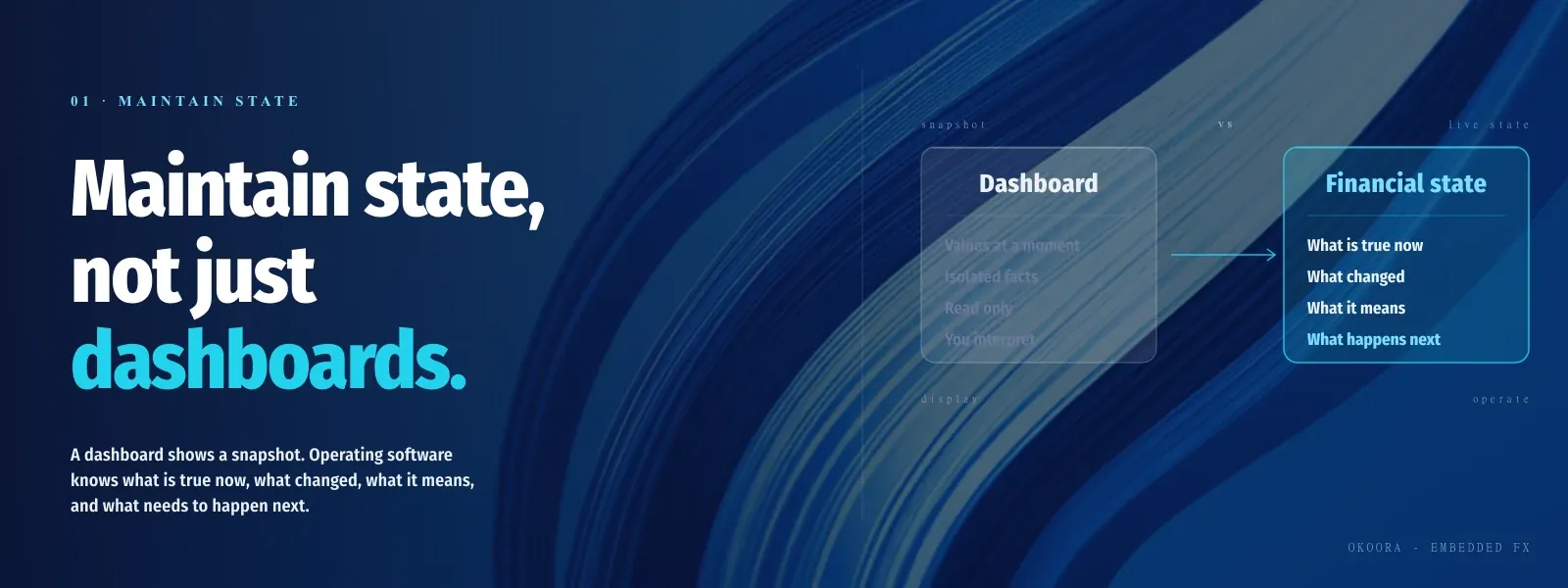
A dashboard can tell you what finance looked like at a moment in time. Operating software should know what is true now, what changed, what that change means, and what needs to happen next.
A snapshot is not a financial state
Finance teams do not work with isolated numbers. They work with relationships that change over time.
A supplier commitment creates a future payment. That payment may create a currency need. The currency need may create exposure. Existing protection may cover some of it. A change in timing may make the protection misaligned. A policy may determine what should happen next. An approval may be required before action can continue.
A dashboard can display each of those facts. That is useful. But displaying them is not the same as maintaining the financial reality that connects them.
The difference matters because financial work does not stop after a report is generated. The business keeps moving.
What maintaining state actually means
A financial state is the current, connected understanding of the objects that matter to a financial process and the relationships between them.
For a cross-border purchase, that state might include the legal entity, supplier, commitment amount, currency, due date, expected payment, available cash, existing hedge, policy limits, approval authority, execution status, and final reconciliation.
The important part is not the number of fields. It is that the system understands how they relate and keeps those relationships current as the underlying business changes.
A file can contain data. A dashboard can display information. A financial operating system must preserve meaning over time.
The business event should update the financial reality
Consider an illustrative example.
A global manufacturer has forecast purchases in a foreign currency and has already protected part of that expected exposure. Demand weakens. Procurement reduces the forecast. The amount that needs protection is now lower, but the hedge book has not changed.
A reporting system can show the new forecast and the existing hedge. A system that maintains financial state should go further. It should recognize that the relationship between the two has changed, calculate the new coverage position, test it against policy, identify whether the position is now outside tolerance, and prepare the relevant decision.
The same principle applies when the amount stays the same but timing changes. Annual coverage may still look correct while a hedge maturity no longer matches the underlying payment. The financial state has changed even if the headline ratio has not.
This is why the trigger should be the business event itself, not the next reporting cycle.
State turns data into operating work
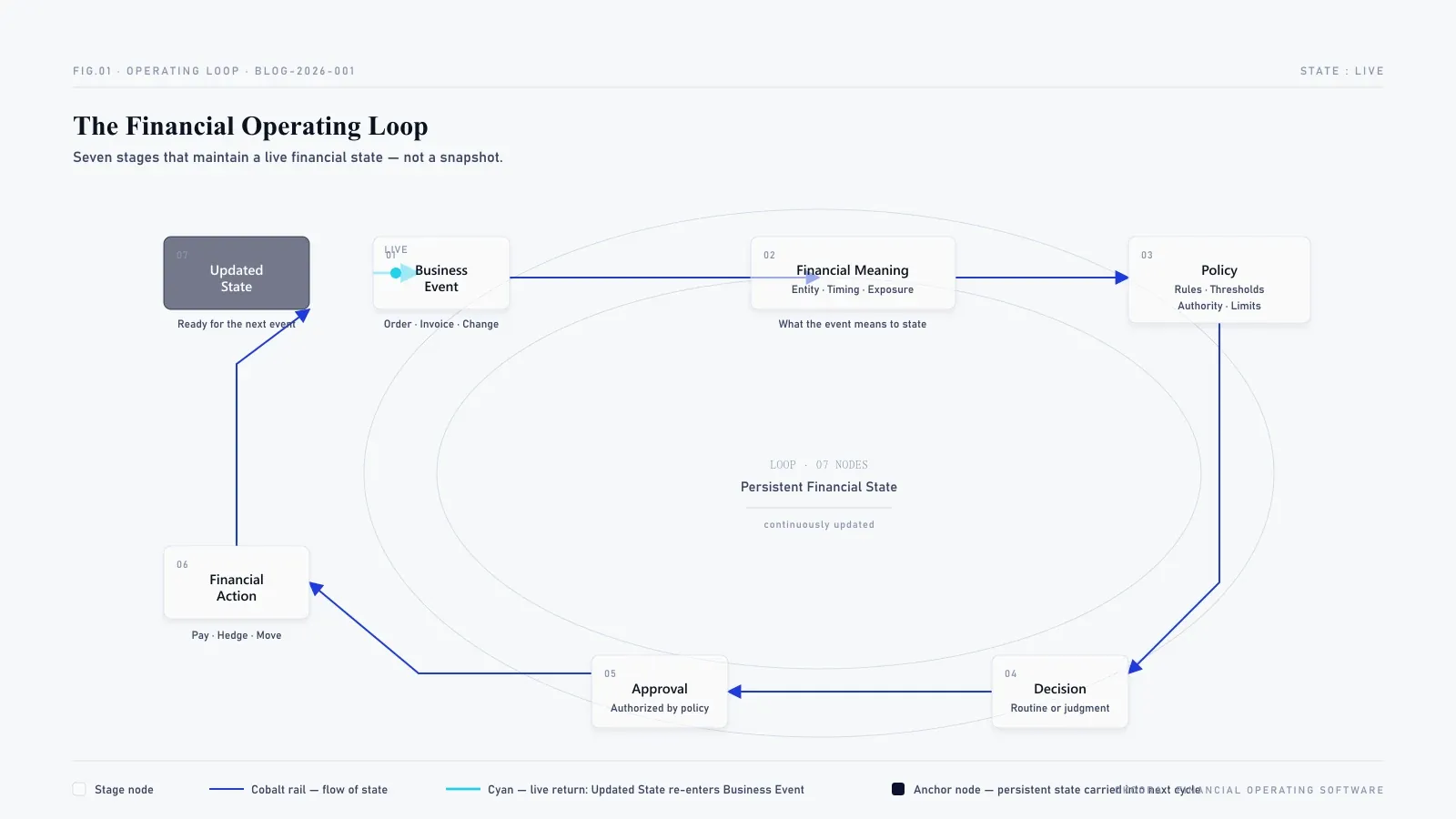
Once the financial state is persistent, software can do more than report.
It can detect change. It can apply policy. It can determine whether a decision is routine or exceptional. It can prepare an action. It can route an approval. It can execute where authority allows. It can record the result and update the state again.
That creates a continuous loop:
Business event → financial meaning → policy → decision → approval → action → updated state
The value is not that every step is automated. The value is that the system carries the recurring work between human decisions, while preserving the customer's authority over the points that require judgment.
Why this matters in complex organizations
Large organizations rarely have one source that contains the full financial truth.
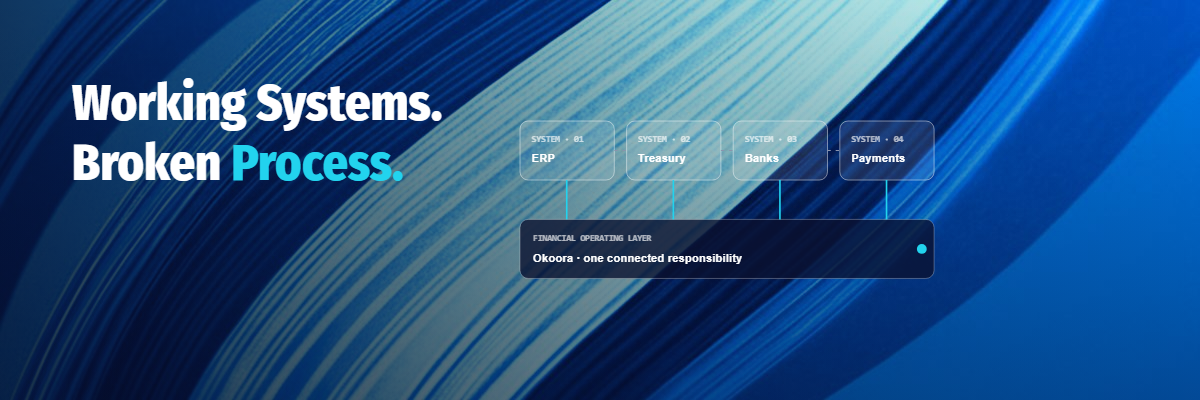
An ERP may hold invoices and open obligations. A planning system may hold future forecasts. Banks hold balances and executed transactions. Treasury files may hold protection positions. Policies and approval rules may live somewhere else again.
Replacing all of those systems is usually unnecessary. The more useful question is whether a financial operating layer can connect the minimum durable truth required for one real workflow, understand it as one financial state, and keep that state alive.
This changes the implementation model. Instead of beginning with a broad integration project, the work can begin with one recurring financial process and the earliest event that makes the responsibility real.
For one company, that event may be a purchase commitment. For another, an invoice. For another, a forecast that creates a material currency need. The origin is different, but the operating requirement is the same: the state must stay current without being rebuilt manually every cycle.
The dashboard becomes a surface, not the product
When software maintains financial state, the dashboard has a different role.
It is no longer the place where the user reconstructs what is happening. It becomes one surface through which the user encounters work the system is already operating.
The most useful screen may therefore be surprisingly simple. It might say that the financial position is current and that two decisions require review. Thousands of records, routine updates, reconciliations, and policy checks can remain underneath.
That is a much higher standard than making information visible.
A practical test for financial software
There is a simple way to distinguish reporting depth from operating depth.
If the software disappeared tomorrow, would a real recurring financial process be materially disrupted, or would the team simply lose a useful view?
If the answer is only that a dashboard is missing, the software is probably still adjacent to the work.
If the organization loses a current financial state, policy evaluation, prepared decisions, recurring actions, or the continuity of a real workflow, the software has become part of how the financial operation runs.
From financial visibility to financial operation
The next generation of financial software will not be defined by how many dashboards it can produce.
It will be defined by whether it can understand financially significant activity as it forms, maintain the relationships that give that activity meaning, decide by policy, carry work forward, and keep the financial state current after every action.
Visibility remains important. But visibility is the beginning.
The deeper opportunity is software that operates the financial work itself.
See how Okoora operates inside your organization: How Okoora Operates.