 Benjamin AvrahamCEO
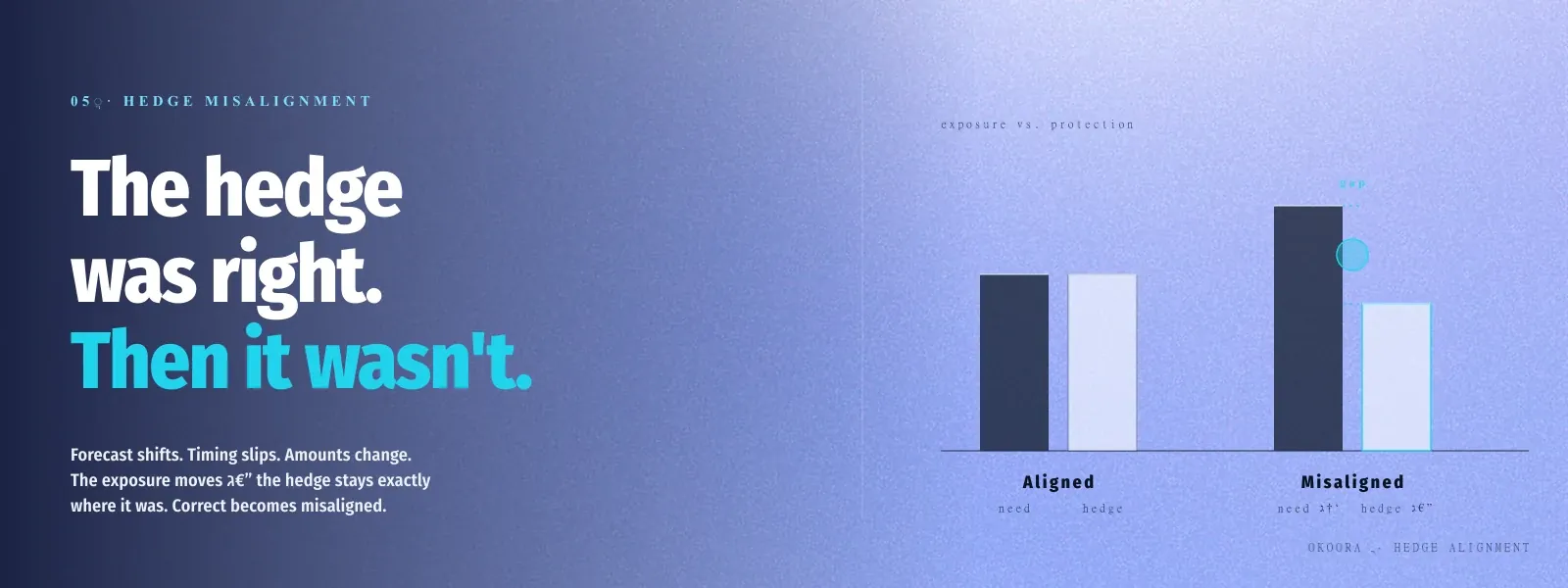
The hedge was right. Then the business moved.
A company forecasts a foreign-currency purchase and hedges part of it. At the moment of execution, the decision is sensible. The amount is supported by the forecast. The maturity matches the expected payment date. The coverage ratio sits inside policy.
Then the business changes.
The supplier shipment is delayed. The purchase forecast falls. A customer order is cancelled. A payment moves from November to February. A natural offset appears somewhere else in the group. The hedge remains exactly where it was.
This is one of the most important realities of financial risk management: a hedge does not become operationally correct forever simply because it was correct when it was executed.
The real problem is not hedging. It is alignment.
Most treasury teams know how to execute a forward, swap or other approved instrument. The harder operating problem begins after execution.
The business keeps generating new information. Forecasts are revised. Orders are amended. Expected cash flows shift. Existing protection does not automatically reinterpret itself when those changes occur.
That creates a recurring alignment question: does the protection still match the financial reality it was intended to protect?
To answer it, finance needs more than a hedge book and more than a forecast. It needs a current view of the relationship between the underlying business activity, the resulting exposure, the protection already in place, timing, natural offsets and policy.
Three ways a correct hedge becomes misaligned
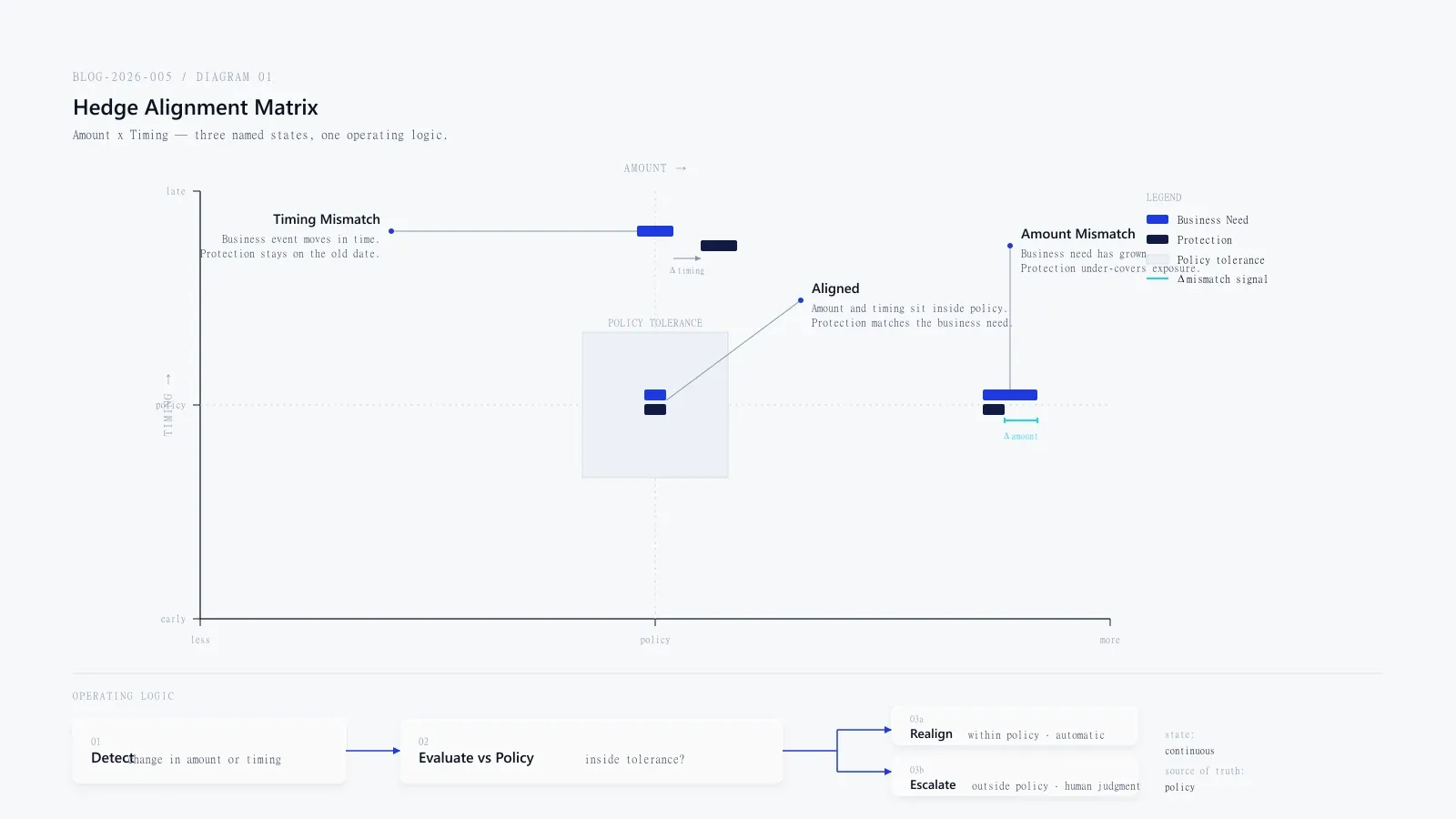
There are many variations, but three patterns appear repeatedly.
1. The amount changes
Suppose a company expected purchases of 100 units of a foreign currency and protected 75. If the forecast falls to 80 while the hedge remains 75, the coverage ratio jumps from 75% to 93.75%. Nothing changed in the hedge. The business changed underneath it.
The reverse creates underprotection. If expected purchases rise and protection remains unchanged, the company can fall below its intended policy range.
2. The timing changes
The annual amount can remain exactly the same while the position becomes wrong in time. A purchase expected in November may move to February. If the hedge still matures in November, aggregate annual coverage can look correct while the November protection no longer matches an underlying need and February becomes insufficiently protected.
This is why a coverage ratio without time is incomplete.
3. The net position changes
Gross forecasts are only part of the picture. A new customer receipt, intercompany flow or other natural offset can reduce the net exposure. A cancellation or delayed inflow can increase it. Protection that was appropriate against the previous net position may no longer fit the current one.
The most dangerous mismatch may still look “hedged”
A finance team can look at a portfolio and see that 70% or 80% of forecast activity is hedged. That number can be accurate and still hide an operating problem.
The protection may sit in the wrong month. It may belong to a forecast that has since been reduced. It may no longer reflect the latest natural offsets. Or the underlying event may have moved while the hedge remains attached to an older assumption.
The operating question is therefore not simply, “What percentage is hedged?” It is, “What is protected, against which underlying activity, for which period, under which policy, and is that relationship still current?”
Finance needs a living relationship between exposure and protection
The stronger model is to treat exposure and protection as connected financial objects that remain linked as the business changes.
The system should know where the expected financial need came from, when it is expected to become real, what protection is currently associated with it, which policy applies, and what changed since the last review.
When a forecast changes, the financial state should be re-evaluated. When timing moves, maturity alignment should be checked. When natural offsets change, the net position should be recalculated. When a policy boundary is crossed, the relevant decision should become visible.
This does not mean every change should create a human task. Quite the opposite. Most changes should be absorbed and re-evaluated automatically. Treasury attention should be reserved for the exceptions that actually require judgment.
A simple example: amount is right, timing is wrong
Consider an illustrative case. A company expects a USD 4 million purchase in November and has USD 3 million of protection maturing in November, consistent with a 75% target coverage ratio.
The purchase is then delayed to February. The annual purchase forecast remains USD 4 million. The total protection remains USD 3 million. On an annual view, the coverage ratio is still 75%.
But the operating position has changed. November now contains protection without the expected underlying purchase. February contains the purchase without matching maturity. The amount is not the problem. Timing is.
A current financial operating state should surface that mismatch and prepare the relevant decision, for example whether to roll the protection, leave it in place for a justified reason, or take another action permitted by policy.
A simple example: the business shrinks but the hedge does not
Now consider a different illustrative case. A company expects CNY 120 million of purchases and has CNY 90 million protected, again equal to 75% coverage.
The purchase forecast falls by 20%. Expected purchases are now CNY 96 million, while the hedge remains CNY 90 million. Coverage has moved to 93.75%.
The original hedge was not necessarily a mistake. It may have been exactly right when executed. The issue is that the operating state changed afterward.
That distinction matters because it changes how finance should think about the problem. The goal is not to eliminate forecast change. The goal is to detect when change has created a financial decision.
The system should compress change into decisions
Large businesses generate thousands of changes across forecasts, orders, invoices, payments, balances and market positions. Treasury should not have to review every change manually.
A modern operating layer should continuously absorb those changes, update the financial state, compare exposure with protection and policy, and surface only the financially significant exceptions.
The useful output is not another file of changed rows. It is a small number of clear decisions: protection is now above policy; this maturity no longer matches the expected cash flow; this exposure has increased beyond the current hedge; no action is required.
That is a different operating model from periodic spreadsheet reconstruction. It is continuous financial alignment.
Existing systems can stay where they are
This model does not require replacing the systems that already do important jobs.
Planning systems can remain authoritative for approved forecasts. ERP can remain authoritative for booked obligations and actual transactions. Banks can remain execution venues. Treasury keeps judgment, policy and approval authority.
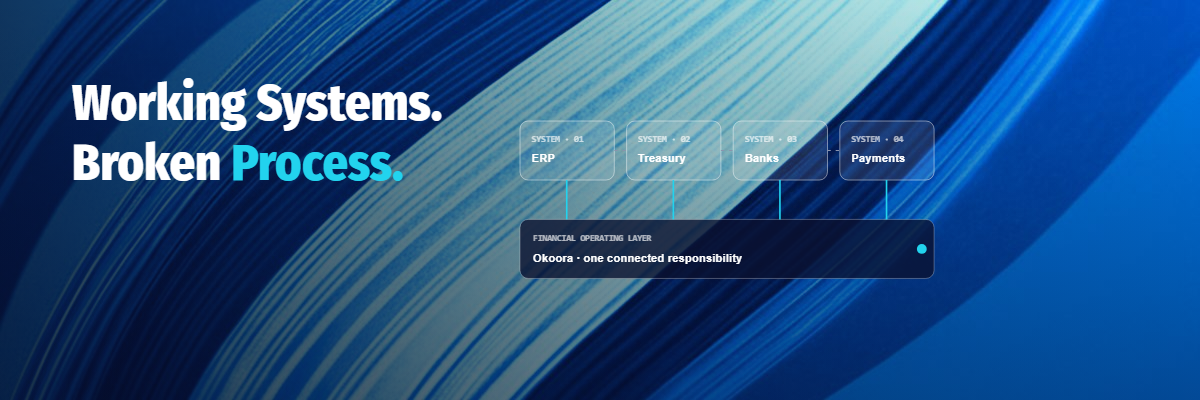
The operating layer connects those sources and maintains the relationship between the business reality and the financial action that follows from it.
Okoora is built for that layer. It operates across exposure, payments, FX, accounts and money flows, keeping financial state, policy and execution connected as the underlying business changes.
A hedge is a decision at a moment in time. Alignment is continuous.
The deeper lesson is simple: hedging is not finished when the trade is executed.
If the business keeps changing, the relationship between exposure and protection has to keep changing with it. The best operating model is one that knows what changed, understands the financial meaning, applies policy, and brings Treasury only the decisions that require human judgment.
That is how protection stays connected to the business it was meant to protect.
NEXT STEP See how Okoora keeps exposure, protection and policy aligned as the business changes.
See how Okoora keeps exposure, protection and policy aligned as the business changes.
Related reading: When a Purchase Order Changes, the Financial Decision Should Change With It, Why ERP Data Alone Is Too Late for Managing Future Financial Exposure.