 OkooraEditorial Team
A purchase order is not a static financial fact
A purchase order may look definite when it is created. There is an amount, a currency, an expected delivery date and an expected payment date. Finance can use that information to estimate cash requirements, identify currency exposure and decide whether protection or funding is needed.
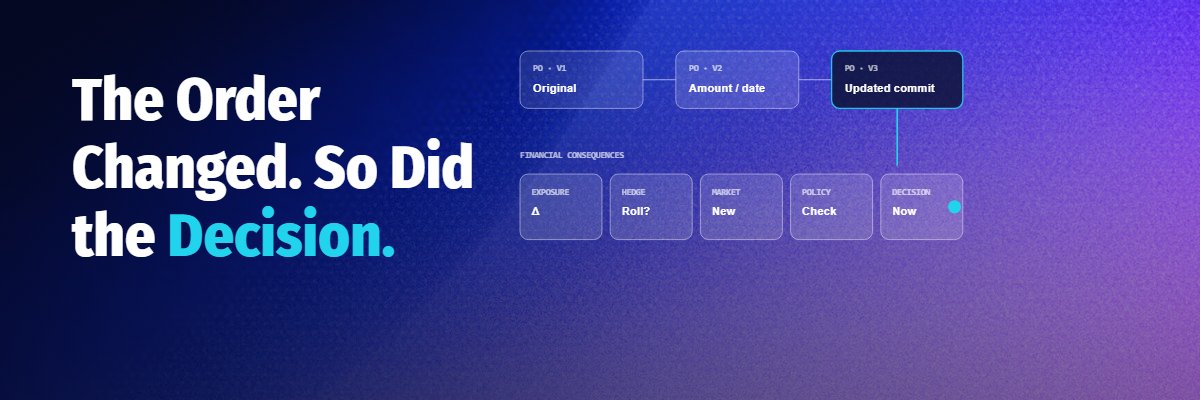
Then the business changes. The quantity is reduced. Delivery moves. The supplier changes the schedule. A shipment is split. The commercial team postpones part of the order. The commitment that Finance originally acted on is no longer the same commitment. If the financial decision stays fixed while the business reality moves, the company can end up managing yesterday's exposure.
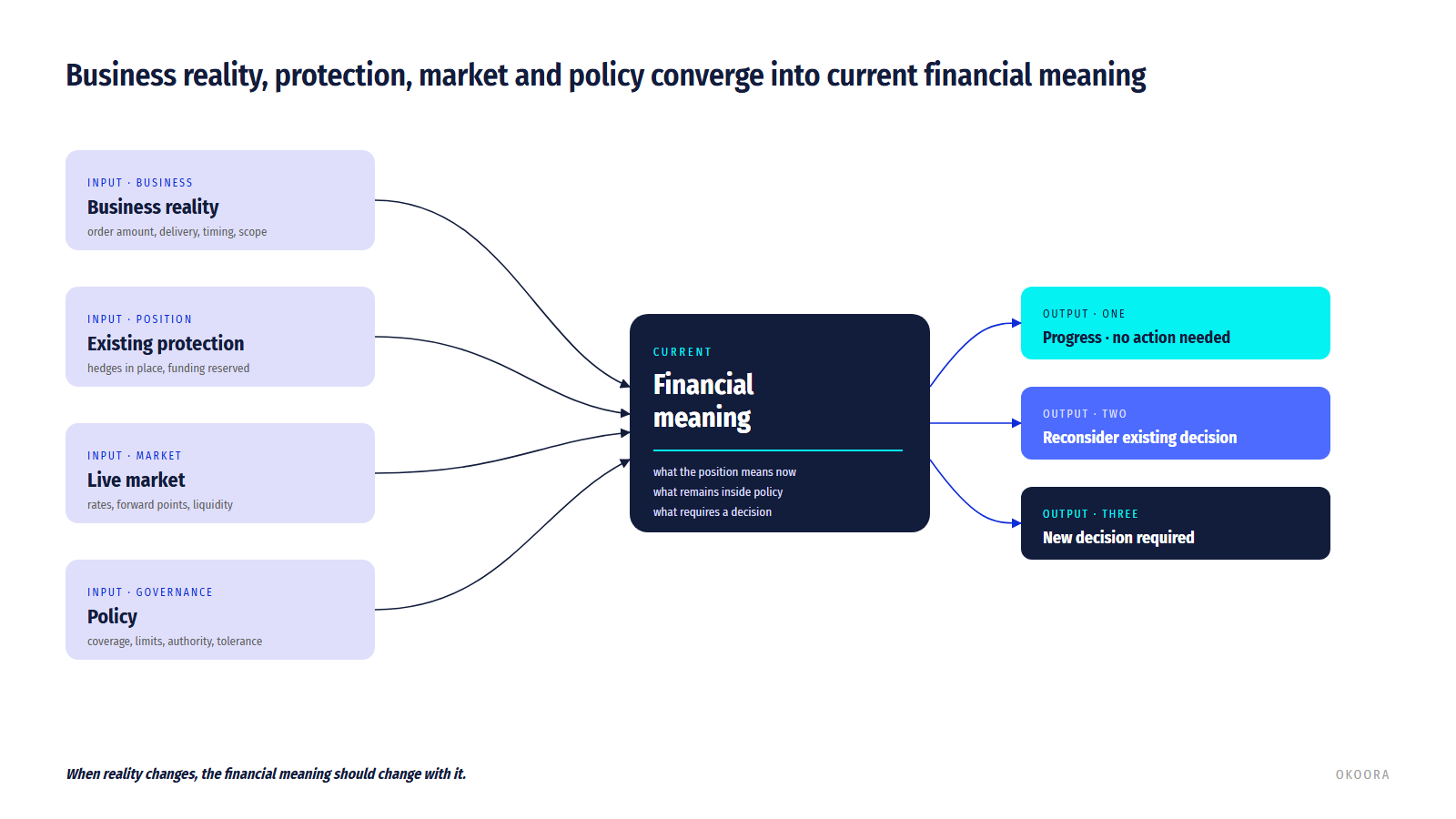
The financial meaning sits behind the order
The order itself is only the business event. Finance cares about what that event means financially. How much currency will be required? When will it be required? Which entity will pay? How much of the exposure is already protected? Which funding source is expected? What payment route may be used? Which policy applies?
When the order changes, those answers can change too. The financial system therefore needs to preserve the connection between the commercial commitment and the financial decisions created around it.
Amount changes can create over-hedging or under-hedging
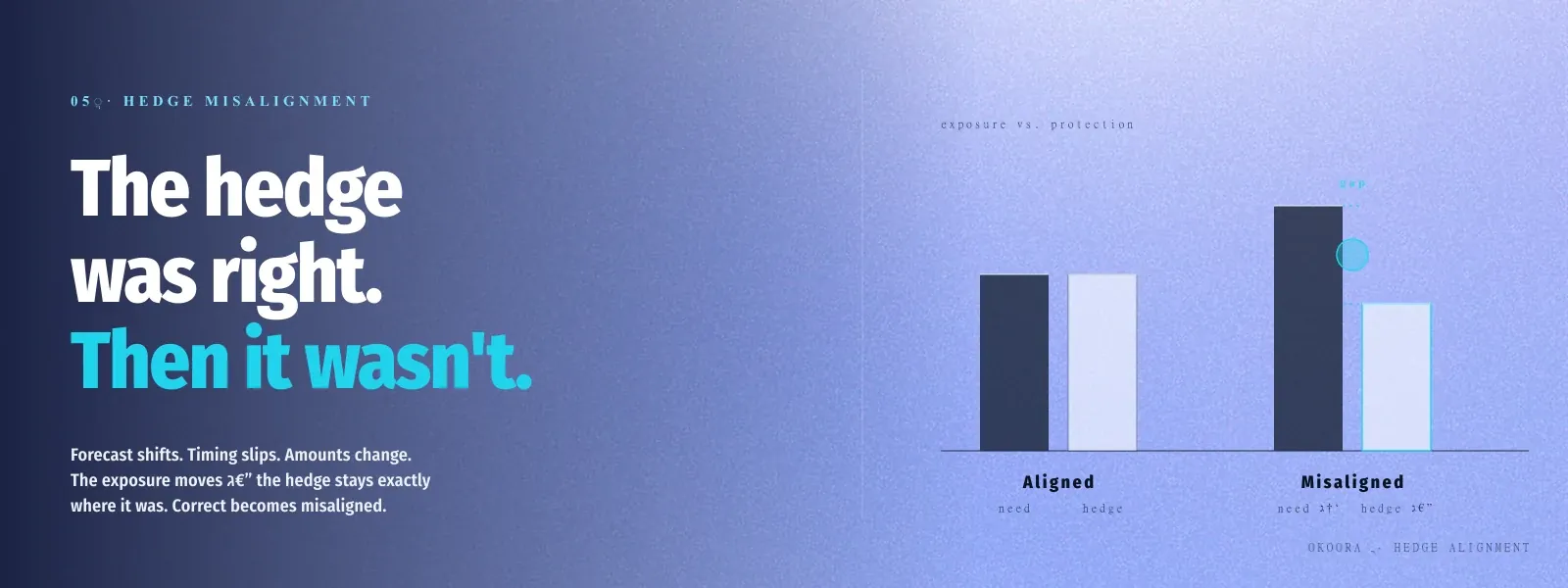
Suppose a company expected to purchase a certain amount in EUR and protected most of the expected exposure. If the order quantity falls materially, the existing hedge can become too large relative to the revised obligation. If the order grows, the company may become under-protected.
Neither condition is visible if the hedge book and the business commitment live in separate worlds. The hedge can still be recorded correctly. The order can still be recorded correctly. The problem is that the relationship between them has changed.
Timing changes can be just as important
A commitment can keep the same amount and still require a different financial decision because the timing moved. A payment expected next month may be delayed by a quarter. A shipment expected later may be accelerated. A hedge or funding decision that matched the original date may no longer align with the revised cash requirement.
This is why finance needs more than a periodic snapshot of exposure. It needs a current relationship between obligation, timing and protection.
Market conditions add another moving layer
The business reality changes while the market is changing too. Exchange rates move. Forward points change. Hedge pricing changes. Funding conditions move. A decision that looked appropriate when the purchase order was created may not have the same economics after the order changes.
The finance team therefore needs to understand two updates at the same time: what changed in the business, and what that change means under current market conditions. One without the other is incomplete.
Policy should be evaluated against the updated reality
A company may have rules about required coverage, timing, permitted instruments, approval thresholds or tolerance ranges. Those rules should apply to the current obligation, not the original version of the obligation.
If the commitment changes, the system should be able to ask whether the current hedge position is still inside policy and whether any action is now required. The decision may be to keep the existing protection, resize it, roll it, add coverage or do nothing. The important point is that the decision is based on the current financial meaning of the commitment.
The problem is not bad data. It is disconnected responsibility.
An ERP can record the revised order. A treasury system can record the hedge. A bank can provide a current market price. Each system can be correct on its own and the finance team can still lack the answer it actually needs.
The missing layer is the relationship among them. Finance needs to know that this particular commercial commitment changed, that this protection was connected to it, that the market moved and that the resulting state now requires or does not require a decision.
This is what a live financial state should do
A live financial state is not simply a dashboard with fresh prices. It is a current understanding of what the company owes, what it owns, what it has already protected, what the market now offers and what policy says about the resulting position.
When a purchase order changes, the state should change with it. When the state changes materially, the decision should be reconsidered. That is how financial intelligence stays connected to the actual business.
Where Okoora fits
Okoora can connect changing business commitments with existing protection, live market conditions, policy and decisioning. Instead of treating an order, a hedge and a market quote as separate records, Okoora can maintain the financial context around the responsibility as it changes over time.
The objective is not to create more treasury activity. It is to keep the financial decision aligned with the business reality that created it.
Next step: See how Okoora can keep business commitments, protection, market conditions and policy connected as the underlying commercial reality changes.
Related reading: What Happens When the Business Changes After the Hedge Is Already in Place?, Why ERP Data Alone Is Too Late for Managing Future Financial Exposure.