 Benjamin AvrahamCEO
A payout is usually designed as the end of a process
Many financial institutions move significant amounts of money to customers as part of their normal business. Insurance claims are paid. Refunds are issued. Benefits are distributed. Rebates, rewards and other customer entitlements are settled. The operational objective is usually clear: approve the amount, send the money to the customer, reconcile the payment and close the case.
That is a perfectly valid service model. But it also creates a strategic question that is easy to miss: what happens to the financial relationship after the payout leaves the institution?
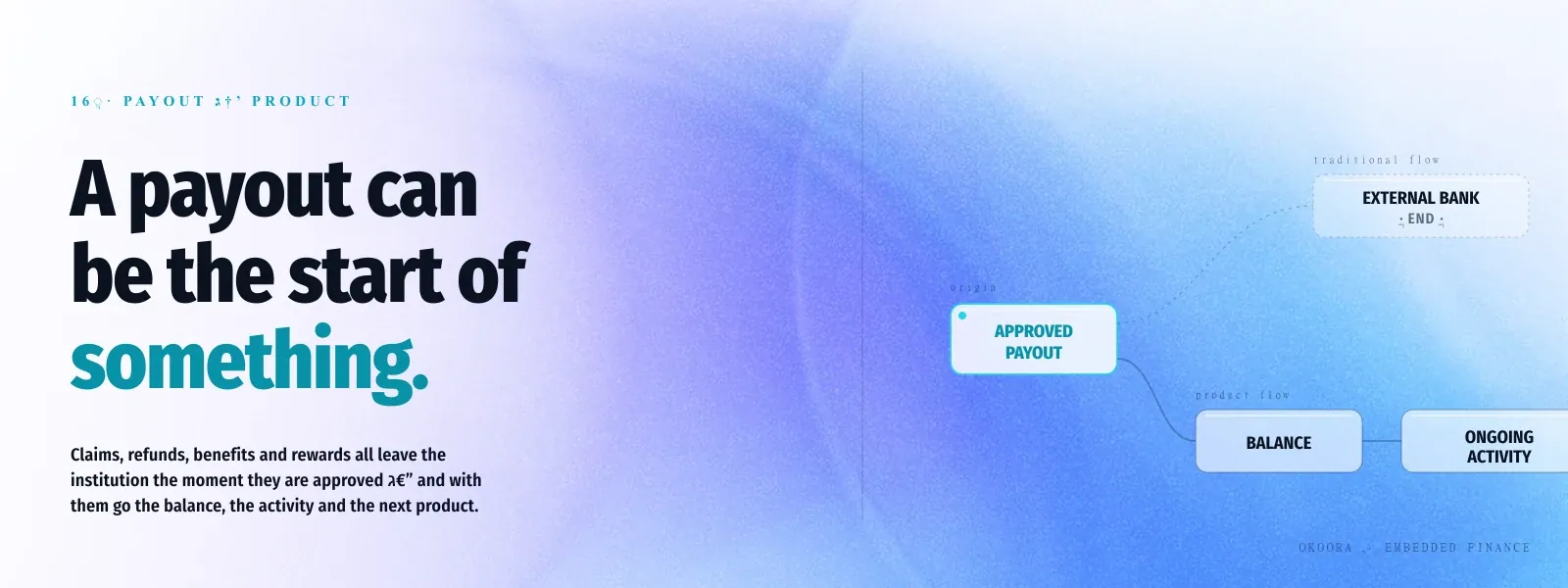
In the traditional flow, the money moves to an external bank account and the financial interaction ends. The institution has completed the service, but the economic activity, the customer usage and the next financial action now happen somewhere else.
For some institutions, that final payment can be redesigned as the beginning of a new customer financial product.
The opportunity begins with activity that already exists
The strongest embedded-finance opportunities do not always require inventing new customer behavior. Often, the better starting point is a financial event that already happens at meaningful scale.
A payout is particularly interesting because three conditions are already present. The institution has a customer relationship. There is an approved financial obligation. And money is already scheduled to move.
Instead of asking customers to discover a completely new product from scratch, the institution can ask a simpler question: once the money is available, what useful financial experience could begin next?
That may include holding a balance, transferring money, making a payment, converting currency or using another financial capability that fits the customer context. The exact product depends on the institution, the customer need and the regulatory model. The important point is that the entry moment already exists.
The product should improve the customer experience first
A monetization idea is weak if the economics only work for the institution. The customer needs a reason to choose the embedded route.
The customer experience should therefore be designed around a real benefit. The money may become available immediately inside the institution's existing digital environment. The customer may be able to use it without first waiting for an external transfer. A cross-border use case may allow the customer to pay or convert in the same flow. A recurring payout may become easier to manage because the balance and activity remain visible in one place.
The commercial opportunity follows from usefulness. It should not be the substitute for usefulness.
A simple choice can create a much longer financial lifecycle
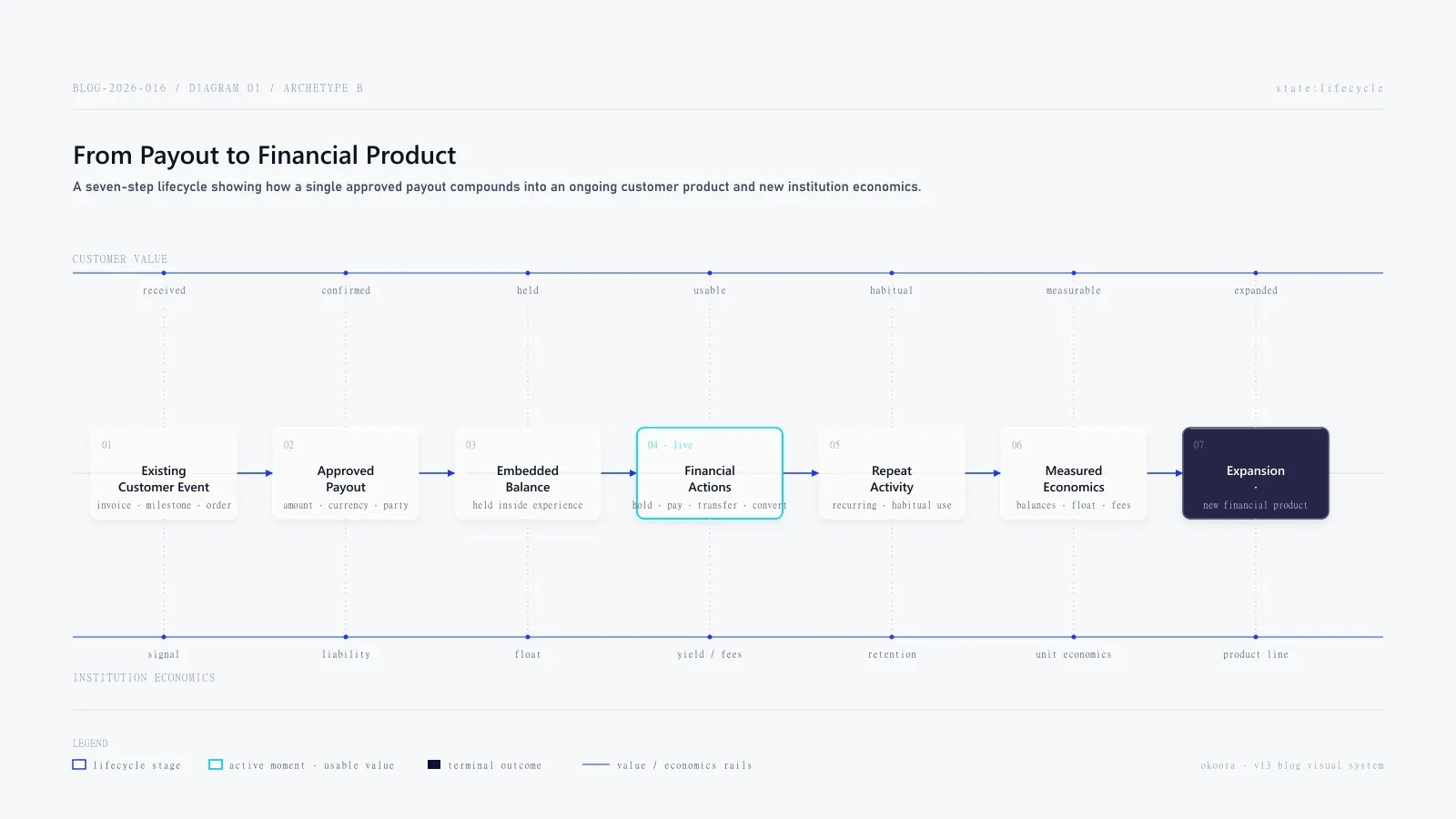
Consider a generic payout flow. The original sequence may be:
Customer event is approved.
The institution sends the payout to an external bank account.
The operational case closes.
An embedded model can add an optional path:
Customer event is approved.
The customer chooses to receive the funds into a balance inside the institution's experience.
The balance becomes available for approved financial actions.
The customer can hold, transfer, pay, convert or use the money within the supported product scope.
The institution remains part of the financial relationship after the original event is complete.
The customer still receives the value they are entitled to. What changes is the financial lifecycle around that value.
One payout can create several economic layers
Once funds remain inside an institution-branded financial environment, several forms of economic activity can become possible. The exact economics depend on the legal structure, product design and commercial agreements, but the model can include value associated with balances, payment activity, cross-border movement, FX conversion or other permitted services.
This is why the right commercial model should not be reduced to a single transaction fee. The better question is what financial activity the new product can support over the customer relationship.
A payout that used to create one operational event can potentially create a sequence of customer financial actions. That sequence is where the larger economic opportunity may emerge.
The institution should own the customer experience
The strongest version of this model is not a referral to somebody else's financial product. It is an embedded experience in which the institution continues to own the customer relationship, brand, product rules and commercial proposition.
The underlying financial infrastructure can operate behind the scenes.
That distinction matters. The customer should not feel that they have been handed from the institution to an unrelated provider. The financial capability should feel like a natural extension of the product relationship they already have.
Behind the simple experience is a full financial system
A balance appearing in an app can look simple. Operating it safely and reliably is not.
The underlying model may require a wallet or account structure, a ledger, payment rails, settlement, liquidity management, reconciliation, controls, auditability, APIs and, where relevant, FX conversion and cross-border execution. The product also needs to handle operational states such as pending transactions, validation failures, refunds, rejected payments and reconciliation exceptions.
This is the core infrastructure challenge. The front end should become simpler while the financial system underneath becomes more connected.
Start with one payout pool, not the entire institution
A broad financial transformation program is usually the wrong first move. The better starting point is one payout population where the customer benefit, operational feasibility and economic potential are sufficiently clear.
Useful selection criteria can include:
Meaningful existing payment volume.
A customer journey that is already highly digital.
A clear reason for the customer to keep or use funds inside the experience.
A manageable regulatory and operational perimeter.
Enough repeat activity to learn from real usage.
A natural path to additional financial services if the first use case works.
The first objective is not to maximize theoretical revenue. It is to prove that a real customer population chooses the experience, uses the financial capability and creates repeatable economics.
Measure behavior before scaling the business case
A credible business case should move quickly from assumptions to observed customer behavior.
The first operating scope should therefore measure practical indicators such as adoption, average effective balance, holding time, payment activity, repeat usage and, where relevant, cross-border or FX activity. Those figures can then replace illustrative assumptions in the economic model.
This prevents a common mistake in embedded finance: building a large revenue forecast around behavior that has never been tested.
The right sequence is narrower and more disciplined: identify the pool, launch the first experience, observe the financial behavior, calculate the realized economics, then decide where expansion is justified.
Expansion can happen across both customer groups and financial capabilities
Once one payout population is operating successfully, expansion does not have to mean only adding more customers. The institution can expand in several directions.
It may extend the same financial experience to additional payout types. It may add new financial actions around the balance. It may support more currencies or cross-border activity. It may connect the product to other parts of the customer relationship.
The result is a compounding model. The initial payout creates the entry point. Customer usage creates data and operating evidence. That evidence helps the institution decide which capabilities and populations are worth adding next.
The strategic shift is from completing a transaction to operating a relationship
A payout is an obligation that must be completed. But it can also be a moment when the institution already has customer attention, financial relevance and real money in motion.
That does not mean every payout should become an embedded financial product. It means the institution should deliberately evaluate which financial flows are currently treated as endpoints even though they could become useful beginnings.
The strongest opportunity appears when three things align: the customer gets a better financial experience, the institution extends the relationship, and the underlying financial activity creates sustainable economics.
Where Okoora fits
Okoora provides the financial infrastructure and intelligence that can sit behind institution-branded financial experiences, connecting balances, payments, FX, settlement, data, controls and execution as one operating layer.
The institution can keep ownership of the customer, brand, policy and use case while Okoora operates the underlying financial infrastructure behind the experience.
That makes it possible to test a focused financial product around an existing customer flow and expand only when the customer behavior and economics justify it.
Next step: Explore how Okoora can help turn existing financial activity into new customer products and revenue opportunities.
Related reading: How Financial Institutions Can Turn Existing Customer Activity Into New Revenue.