 Benjamin AvrahamCEO
The customer activity already exists
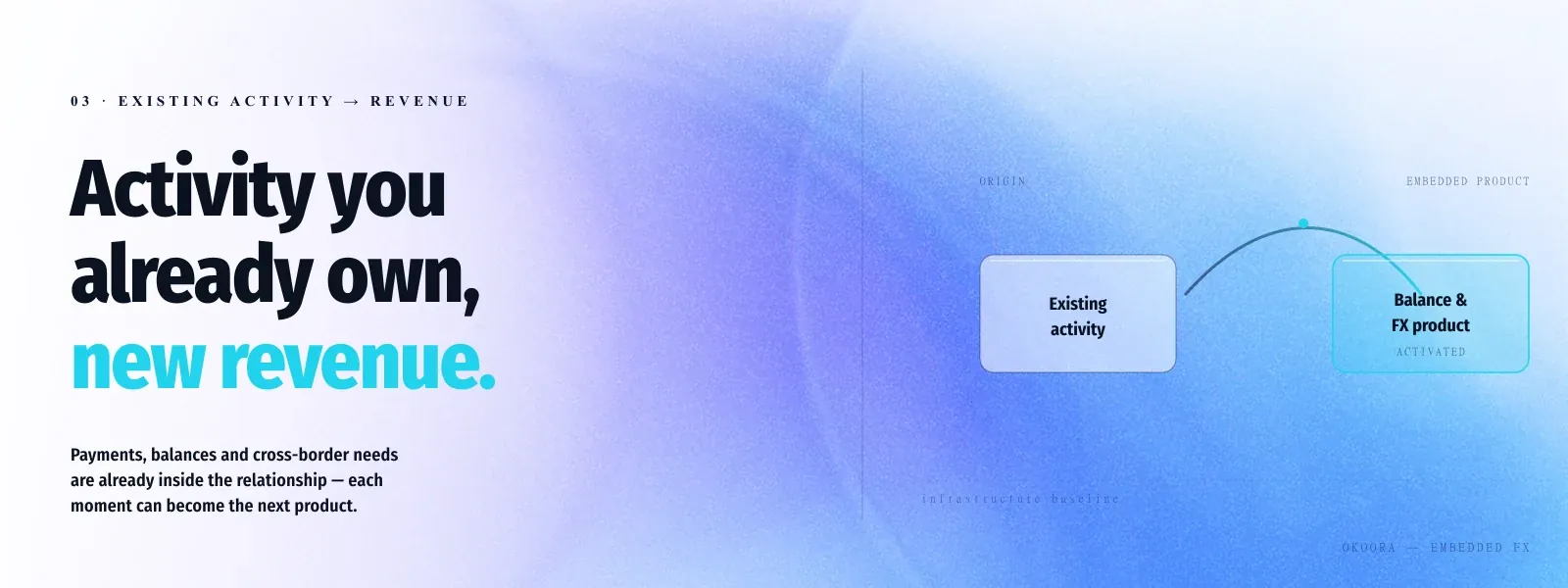
A financial institution does not always need a new audience to create a new revenue line. In many cases, the customer relationship is already there. The transaction is already happening. The financial need is already visible. What is missing is the capability that keeps more of that activity inside the institution's own product.
Consider the moments that already exist around a customer relationship. A claim is paid. A business customer needs to pay a supplier abroad. A marketplace seller receives funds in one currency and needs another. A traveler books today and settles later. A business holds a balance before using it. A platform customer needs protection against a future exchange rate.
Each moment can be treated as the end of a process, or as the beginning of another financial product.
That distinction is increasingly important. The strongest embedded-finance opportunities often do not begin by inventing behavior. They begin by recognizing financial behavior that already exists and deciding whether the institution wants to operate more of it under its own brand.
Two ways existing activity becomes a new product
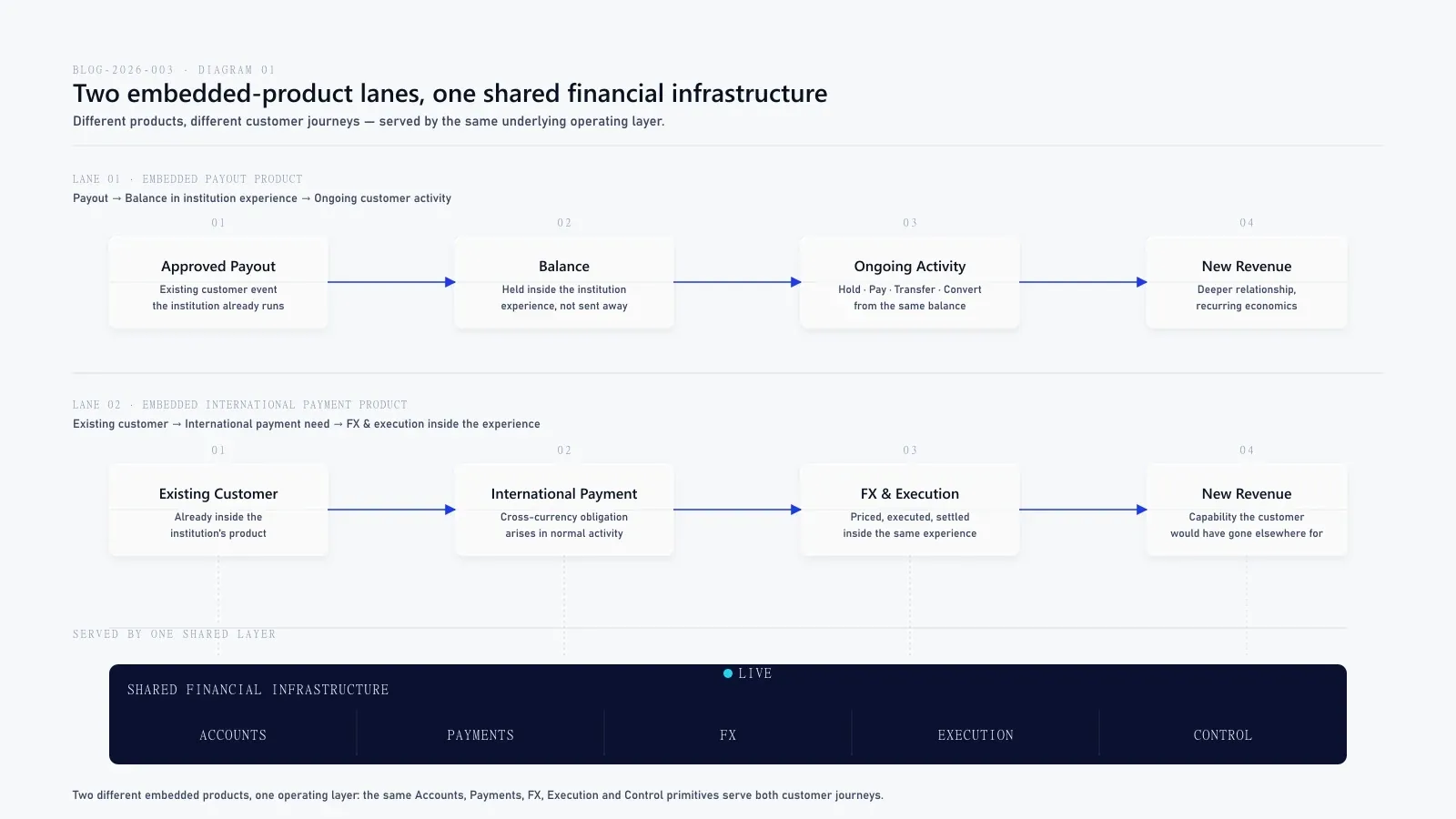
There are two recurring patterns.
The first is to extend an existing financial flow. A customer is already receiving or moving money through the institution. Instead of letting the relationship end when the money leaves, the institution can give the customer a reason to keep, use, convert or move that value inside its own environment.
The second is to add a new capability to an existing customer relationship. The institution may already own the customer, the distribution and the trust, but the customer completes a financial job somewhere else. International payments, currency conversion, protection, wallets, accounts or transaction pricing can become part of the institution's own offer rather than an external destination.
In both cases, the strategic asset is not the feature itself. It is the combination of existing customer activity, existing distribution and a new financial capability that can be offered in context.
The customer sees one simple experience. Underneath it, several financial systems may need to operate as one.
A payout does not have to be the end of the relationship
Imagine an insurer paying an approved claim. In a conventional flow, the claim is processed, the payment reaches an external bank account, and the financial interaction ends.
An alternative model is to let the customer receive the value inside the insurer's own environment and choose what happens next. The customer can hold the balance, transfer it, use it for another payment or convert it where relevant. The insurer remains part of the financial experience after the original service event has been completed.
The important point is not the wallet. The wallet is only one possible mechanism. The strategic change is that an event that previously ended the financial relationship can become the beginning of continued activity.
That continued activity can create several forms of economic value depending on the commercial model, the customer use case and the regulatory structure. The exact economics should be calculated from real volumes, adoption, balance behavior, transaction usage and relevant fees rather than assumed in advance.
A customer relationship can also support a capability the institution never offered before
Now consider a card issuer serving business customers. Those customers already trust the issuer, use its product and generate transaction activity. Some of them also need to pay suppliers abroad.
The issuer can add an international supplier-payment experience inside its own product. The customer selects the beneficiary, amount and currency, receives a quote, authorizes the transaction using the issuer's existing payment relationship, and follows the payment through completion.
To the customer, this can feel like one new service from a provider they already use. Underneath, the flow may require beneficiary validation, FX pricing, card authorization, cross-border execution, settlement, status management, controls and reconciliation.
The institution does not need to become the builder and operator of every underlying financial component. It needs to own the customer experience, decide the policy and economics, and connect to infrastructure capable of operating the rest.
Revenue comes from the system around the transaction, not from one fee
When institutions evaluate embedded financial products, it is easy to reduce the opportunity to a single transaction fee. That is usually too narrow.
The economic system may include balances, payment activity, FX conversion, pricing margin, cross-border usage, repeated customer engagement, retention and expansion into additional services. Which elements matter depends on the product and on what the institution is permitted and positioned to operate.
The first job is therefore to define the economic pool correctly. What customer activity already exists? What portion could realistically move through the new experience? What balances or transaction volume could remain inside the environment? Which activities create revenue? What value should stay with the customer? What role does the infrastructure provider play?
This is why a credible business case should begin with the institution's own data. Existing customer count, transaction volume, payment events, currency activity, adoption assumptions, holding time and usage behavior create a much more useful model than a generic embedded-finance market-size estimate.
Start with one financial activity pool
The fastest way to make the opportunity real is usually not to launch a broad financial super-app.
Start with one recurring customer activity where the commercial value and implementation path are clear. A specific payout population. A defined international payment use case. One customer segment with recurring currency needs. One transaction type where a new pricing or protection capability is relevant.
The first pool should be large enough to matter, simple enough to operate, and clear enough to measure. The institution can then track adoption, usage, transaction economics, operational behavior and customer response before expanding.
This creates a disciplined expansion model: prove one financial capability inside a real customer flow, then extend into adjacent services when the data supports it.
The simple experience depends on deep infrastructure
A strong embedded product should feel simple to the customer. That simplicity is created by depth underneath.
Accounts or wallets may need a ledger. Payments need routing, settlement and status. Cross-border activity may require multiple currencies and local or international rails. FX requires pricing and execution. Customer money requires controls, reconciliation and regulated infrastructure. Every action needs to remain connected to the institution's customer, policy and product experience.
That is why assembling the offering from disconnected providers can become a product problem of its own. The institution may end up integrating accounts in one place, payments in another, FX somewhere else, and control and reconciliation across several systems.
A unified financial infrastructure layer changes the build-versus-buy question. The institution can focus on the customer proposition, distribution, policy and economics while the underlying financial capabilities operate as one system.
The brand should stay in front
For the customer, the new capability should belong to the institution they already chose.
The institution owns the customer relationship, product experience, commercial model and policy. Okoora operates underneath as the financial infrastructure and intelligence layer, connecting accounts, payments, FX, pricing, execution and control where the use case requires them.
This is the difference between sending a customer elsewhere and extending what the institution itself can offer.
When the infrastructure stays behind the product, the institution can create a new financial experience without fragmenting the customer journey or rebuilding the full financial stack.
From customer activity to a new revenue engine
The deepest opportunity in embedded finance is not to add as many financial features as possible.
It is to identify financially significant customer activity that already exists, understand the next useful financial job around that activity, and decide whether the institution should own more of that experience and its economics.
A claim payment can become continued financial activity. A card relationship can become an international payment product. Existing cross-border customers can become users of FX conversion or protection. Existing transaction volume can support smarter pricing. The entry point changes, but the commercial logic is the same.
The institution already has the customer. The activity is already happening. The infrastructure makes it possible to turn that activity into a product the institution can offer, operate and expand under its own brand.
NEXT STEP See how Okoora helps you embed financial capabilities under your brand and turn customer activity into revenue.
Related reading: How Existing Customer Payouts Can Become New Financial Products, How to Find the First Financial Activity Worth Turning Into an Embedded Product, How to Launch a New Financial Product Without Rebuilding the Financial Stack, Why Financial Infrastructure Should Help Banks Make More Money From Existing Customers.