 Benjamin AvrahamCEO
The problem is not that enterprises have too few systems
Large organizations rarely run finance in one place. A group may have several ERPs, different banking relationships, local finance systems, planning tools, treasury files and approval structures. Each system can be perfectly valid for the job it was designed to do.
The operating problem appears when one financial decision depends on facts that live across several of them.
A future supplier payment may begin as a purchase commitment in one system. The relevant cash position may sit across several banks. The currency requirement may depend on entity, due date and invoice timing. Existing protection may be tracked elsewhere. Approval authority may depend on policy that is not encoded in the same place as the transaction.
No single record is necessarily wrong. The difficulty is that the financial meaning exists across the relationships between those records.
Do not begin by replacing the systems that already work
The natural response to fragmentation is often a large consolidation or replacement program. Sometimes that is justified. But it is not the only way to create a coherent financial operating model.
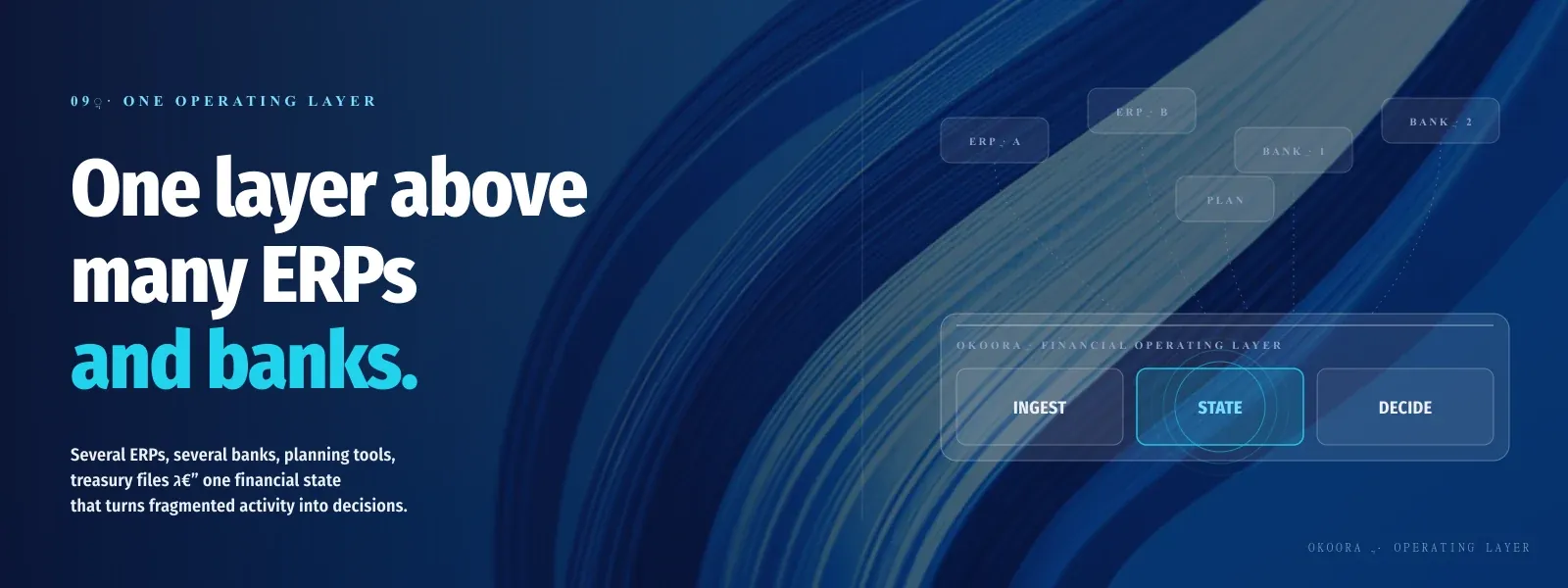
A different approach is to keep the systems that remain authoritative and place a financial operating layer above them.
That layer does not need every system to become the same system. It needs to know which source determines each material fact, how those facts relate financially, when they change, and what work should follow.
The ERP can remain the source of a purchase obligation. A bank can remain the source of cash and settlement status. A treasury source can remain authoritative for existing hedges. Local entities can keep their operating systems and approval structures. The operating layer connects the financial reality without pretending that one application owns all of it.
Start from the business event that creates financial responsibility
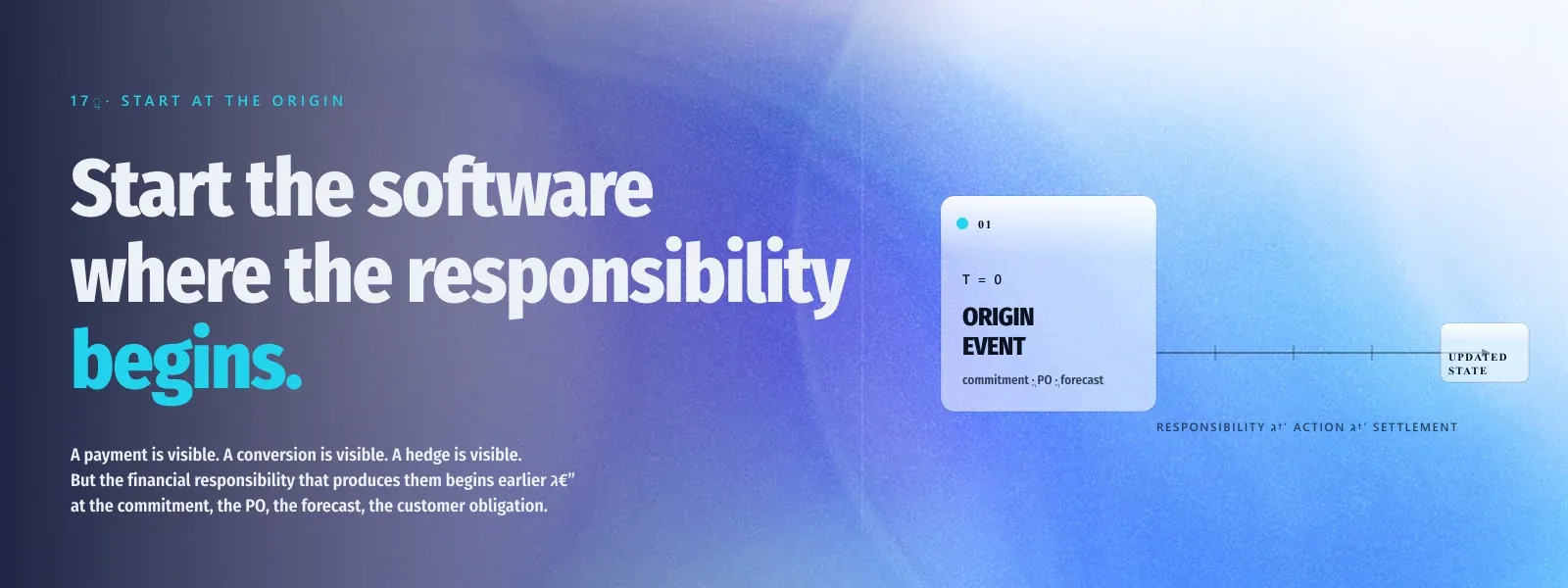
The strongest operating layer begins before the bank transaction.
Consider a foreign-currency purchase commitment. The important financial work may begin when the company becomes responsible for the purchase, not when the payment file reaches the bank weeks or months later.
From that one event, several questions can become relevant: Which entity owns the obligation? Which supplier is involved? What currency will be needed? When is the amount due? Is the requirement already protected? Which policy applies? Is there enough liquidity? What needs approval? Should the company convert, hedge, wait or take another action?
The event is not merely a row in an ERP. It is the beginning of a financial lifecycle.
Create one financial state across many sources
Connecting systems is useful only if the incoming information becomes a coherent financial state.
That means the operating layer needs to understand objects and relationships such as entity, counterparty, obligation, currency need, exposure, protection, bank account, conversion, payment, policy and approval authority.
The same financial reality should be understandable from different perspectives. A finance leader may want a group-level picture. Treasury may need to see currency, maturity and protection. A business unit may need the status of a supplier obligation. IT may need source lineage, access boundaries and update status.
Those are not separate realities. They are different views of the same connected financial state.
Context is what turns data into a decision
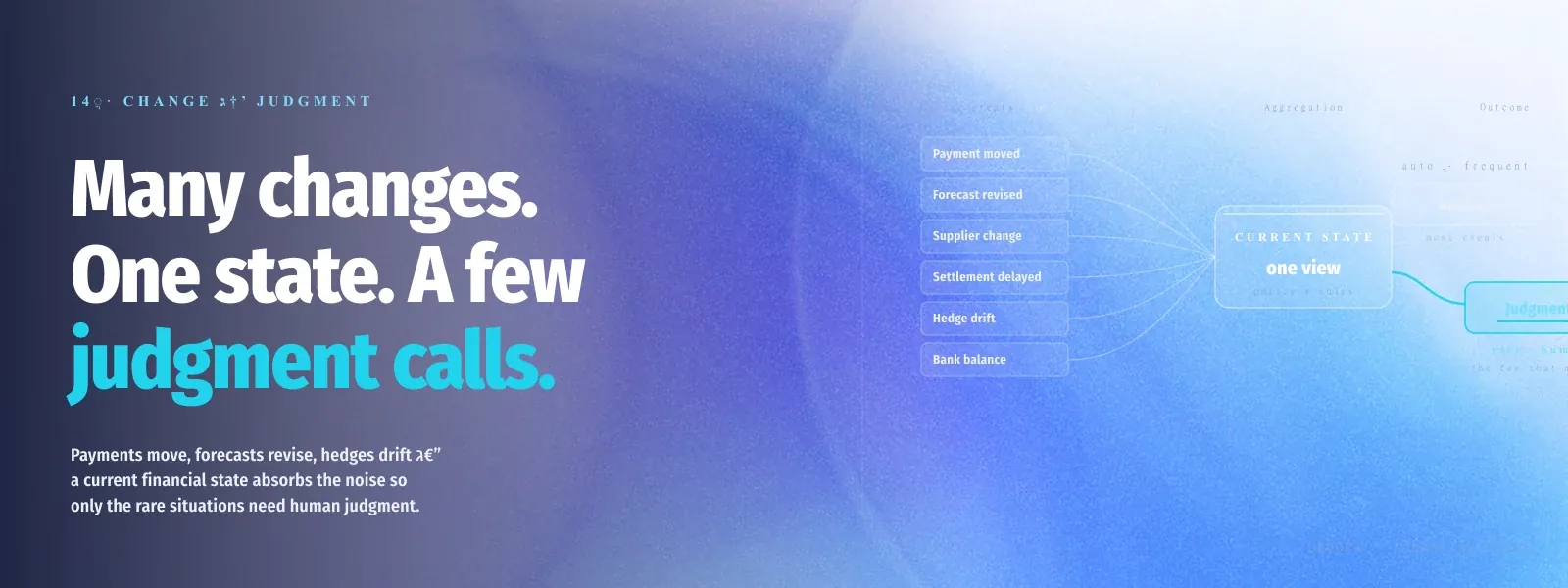
A payment amount by itself says very little. The same amount can require a completely different decision depending on the company, supplier, currency, due date, available cash, existing protection, policy and approval authority.
That is why aggregation alone is not enough. A financial operating layer must preserve context.
When context is available, the system can move from “there is a payment” to “this obligation creates this currency need, is covered to this extent, falls under this policy, requires this approval and can progress through this action path.”
That is the difference between collecting financial data and operating financial work.
The financial picture should lead directly to action
A consolidated group view is valuable, but visibility is only the entry point.
The stronger model connects the financial picture to the work that follows: what changed, what it means financially, what decision is required, who has authority, what can proceed under policy, what should stop as an exception, and what action should execute.
The action may be a payment, conversion, hedge, financing decision, approval or another financial step. Execution does not have to move to a new provider on day one. Existing banks and counterparties can remain part of the operating model.
The operating layer creates continuity between understanding and action, even when execution is distributed across existing providers.
Policy and authority must travel with the financial state
Group-wide orchestration cannot mean removing local control. Multi-entity companies often need different authorities, thresholds, policies and responsibilities across companies and teams.
A useful operating layer therefore has to understand not only what should happen, but who is allowed to decide and act.
This creates a governed path from financial state to decision to approval to execution. Routine work can progress inside approved boundaries. Material exceptions can be surfaced to the right person. The group gains coordination without flattening the authority model that the business actually uses.
Start with one operating perimeter, then expand
The ambition may be group-wide, but the implementation should not begin by connecting everything.
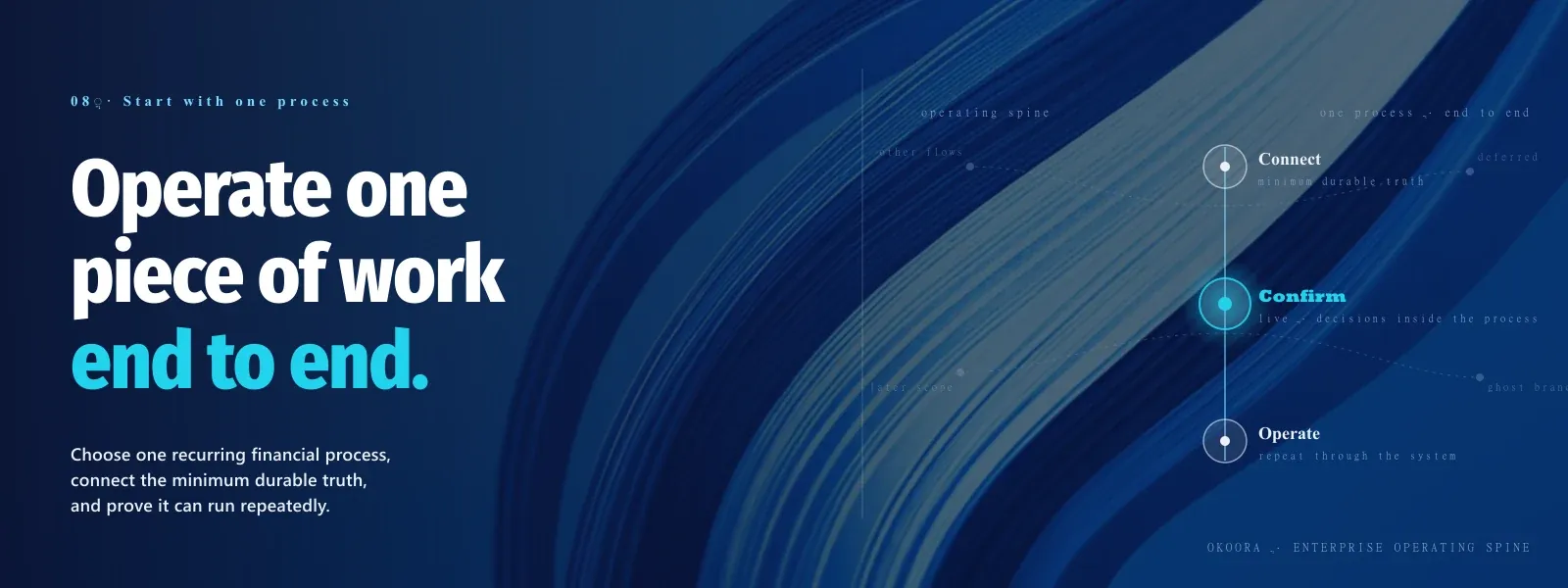
A stronger first step is one bounded operating perimeter: one recurring process, one population of obligations, one entity or business unit, one set of currencies or another scope narrow enough to put into production.
Connect only the sources required to maintain that process. Prove that the financial state stays current. Confirm the decisions, approvals and actions inside the path. Then operate it across repeated real cycles.
Once that operating spine works, the same connected reality can support adjacent responsibilities. A purchase commitment can extend into exposure, protection, conversion, payment, liquidity, approvals and reconciliation. Additional entities, systems and populations can be added from a proven foundation.
What the architecture looks like in practice
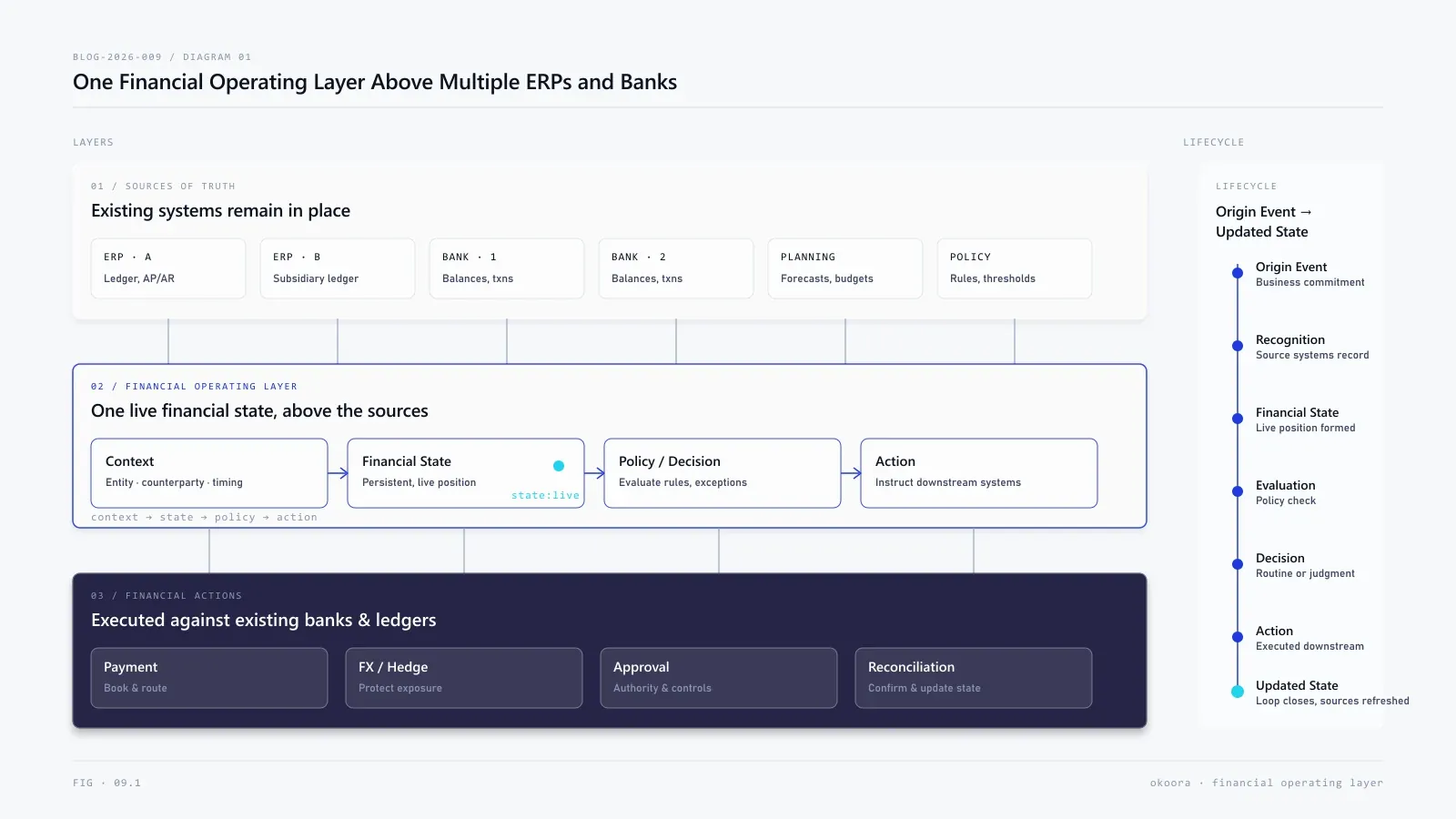
A practical financial operating layer has three responsibilities.
First, it connects to the systems and institutions that hold authoritative facts. Those can include ERPs, banks, planning systems and other financial sources.
Second, it maintains financial intelligence and operating logic: context, current state, policy, decisions, exceptions and authority.
Third, it connects that intelligence to financial execution and control, including payments, FX conversion, protection and other approved actions.
The important point is not the diagram. It is that information, financial meaning and action operate as one continuous system.
One layer, without one-system thinking
The objective is not to make every company in a group work in the same application. It is to create a financial layer that understands what is happening across the group and can operate the work that follows from it.
Existing ERPs can stay. Existing banks can stay. Local operating models can stay where they make sense.
What changes is the gap between them.
Instead of reconstructing the group financial reality every time a decision is required, the operating layer keeps that reality current, understands its context and connects it to policy, decisions and action.
Okoora operates across intelligence, infrastructure, execution and control, creating one financial operating layer above existing systems so enterprises can make better decisions, execute financial work and expand from one connected process to a broader operating model.
NEXT STEP See how Okoora can connect existing systems and financial activity into one operating layer for decisions, execution and control.