 Benjamin AvrahamCEO
A financial picture is only the beginning
Finance teams have more visibility than ever. Balances are available in banking portals. Obligations sit in ERP systems. Forecasts live in planning tools. Exposure can be modeled in spreadsheets or specialist applications. Payment status, FX positions and market data can all be displayed somewhere.
That visibility matters. But it does not, by itself, operate the work.
The real financial question is what should happen because the picture changed. A supplier commitment moves forward. A forecast is revised. A balance falls below a threshold. A payment date changes. A hedge no longer matches the underlying need. A transaction creates a new currency requirement. Someone has to understand the meaning, apply policy, decide what needs judgment and move the financial process forward.
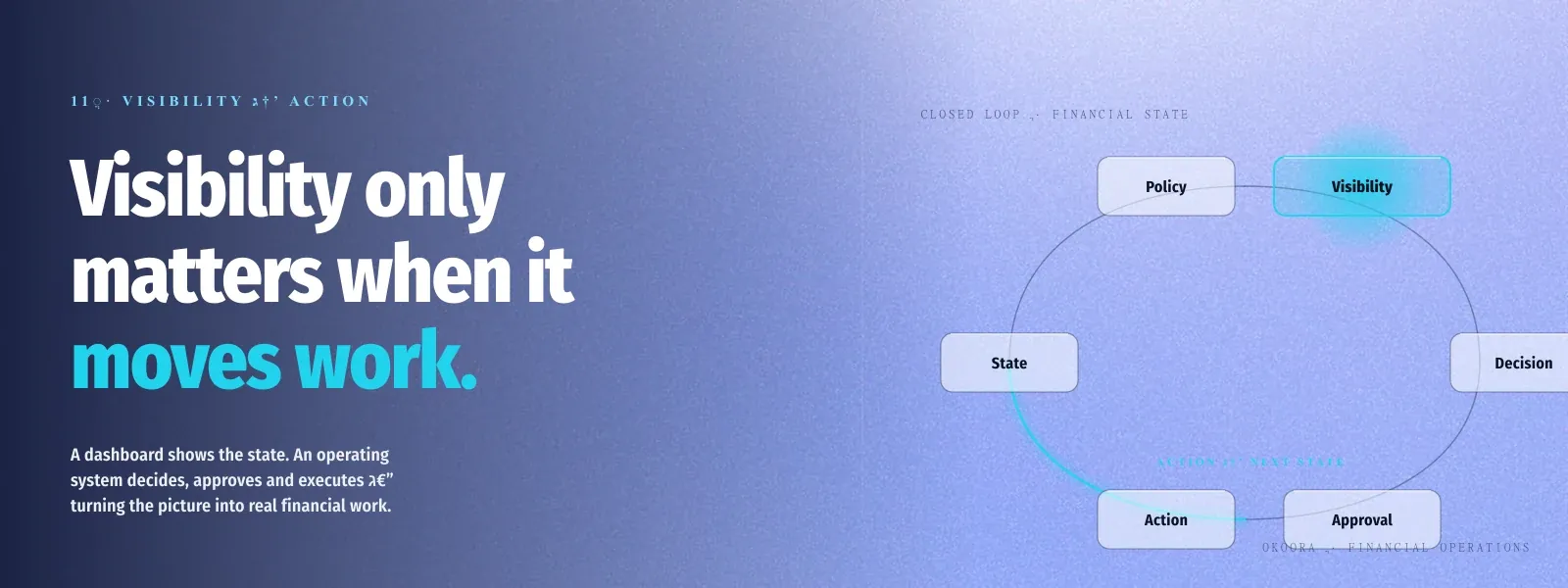
A dashboard can show the state. An operating system has to know what the state means and what comes next.
Reporting answers “what is there?” Operating answers “what now?”
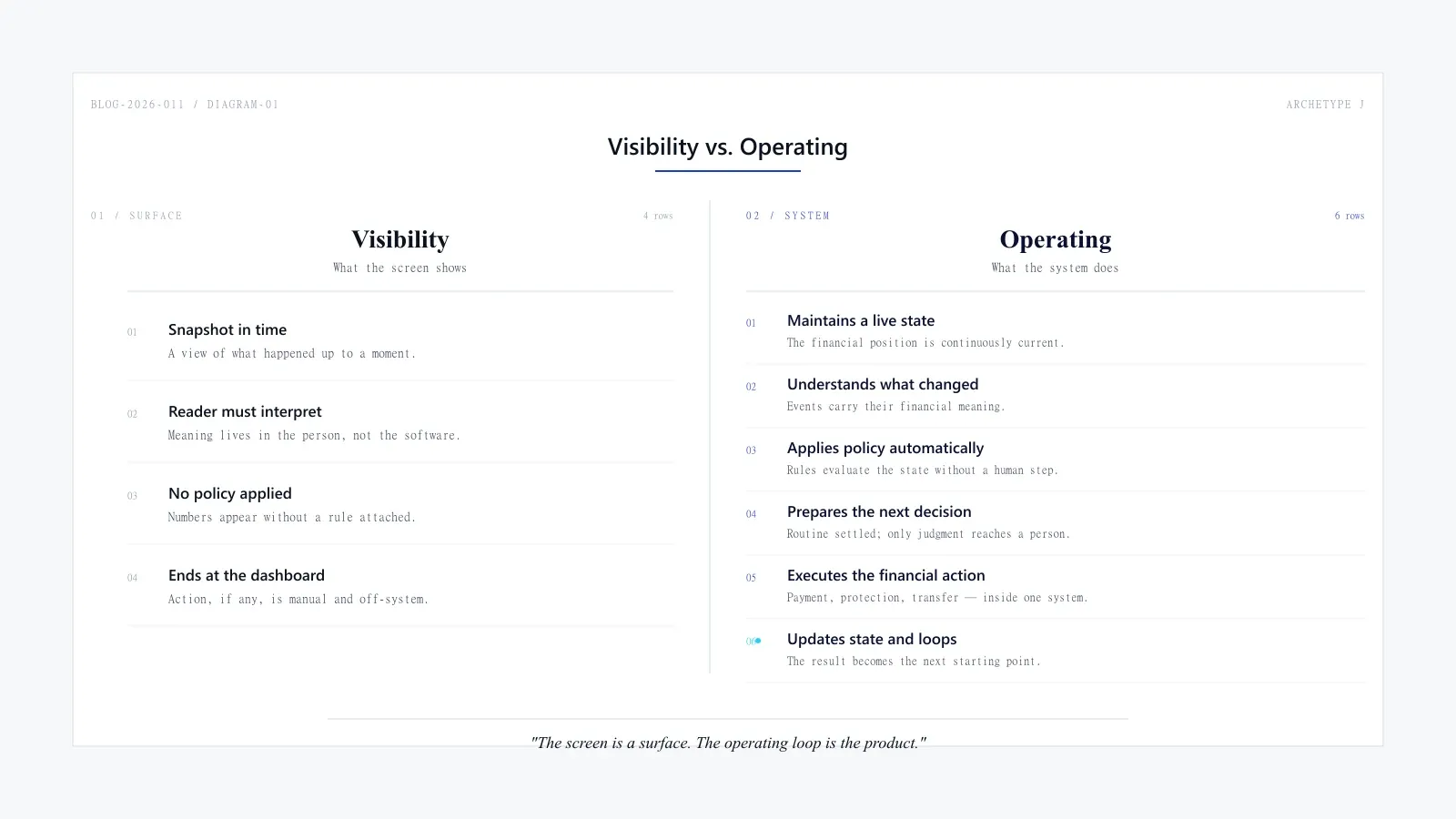
Reporting systems are designed to make information visible. They aggregate, classify and present facts so a person can inspect them. That is useful when the next step is human analysis.
Operating systems have a different responsibility. They maintain the relevant financial state, detect material change, interpret that change in context, apply the company’s policy and authority model, and move the work toward a decision or action.
The difference becomes obvious when a business event changes after the original financial decision was made. A purchase forecast may fall, a delivery may move, a receivable may be delayed, or a committed payment may change currency or timing. The important issue is not that the system can display the new number. The important issue is whether the system can identify what the change affects.
Does it alter liquidity? Does it create a new currency need? Does existing protection still fit? Does someone need to approve an action? Can the process continue automatically within policy? Should it stop as an exception?
Those are operating questions.
The operating chain starts with financial context
A financial amount rarely explains itself. A €2 million obligation is not only an amount and a currency. Its meaning depends on context: which entity owns it, which supplier or counterparty is involved, when it becomes payable, whether the company already holds the currency, whether protection exists, what policy applies, who has authority and what other obligations compete for the same liquidity.
That is why a useful financial system needs more than connected data. It needs a current model of the customer’s financial reality and the relationships between the relevant objects.
A purchase commitment can create a future payment need. That payment need can create a currency requirement. The currency requirement may create exposure. Existing protection may cover part of it. Policy may define an acceptable range. The remaining gap may require a decision, approval and execution.
When those relationships are visible to the system, financial activity stops being a set of disconnected records and becomes an operating chain.
A strong system compresses activity into judgment
One of the most valuable outcomes of financial intelligence is not more information. It is less unnecessary attention.
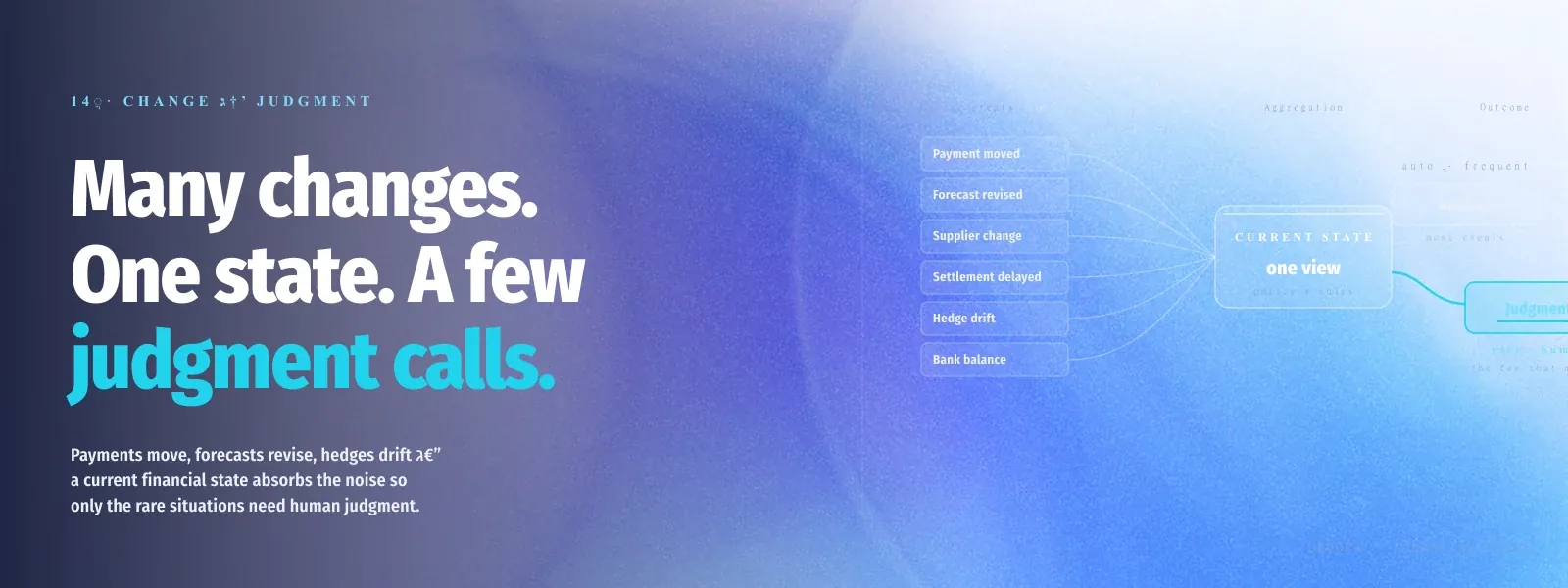
An enterprise may generate thousands of source changes across invoices, forecasts, bank balances, payments, orders and positions. Most changes should not become human tasks. The system should absorb routine updates, recalculate the relevant financial state and surface only the changes that are materially important or outside policy.
This creates a different experience for Finance and Treasury. Instead of opening several systems and reconstructing the situation, the team sees the small number of decisions that actually require judgment.
The value is not simply automation. It is decision compression: turning a large volume of financial activity into a small number of clear, explainable actions.
Policy has to be part of the operating logic
Visibility without policy leaves the final operating burden with the user. The team can see that something changed, but still has to determine whether the change matters and what is allowed.
Policy changes that. Target coverage ranges, liquidity thresholds, payment authorities, permitted instruments, timing rules, approval limits and exception conditions can become part of the system’s operating logic.
This does not mean removing human authority. It means making authority explicit.
Routine activity can progress when it is inside policy. Material deviations can become prepared decisions. Actions requiring approval can be routed to the right person with the relevant financial context attached. Activities outside permitted boundaries can stop rather than continue silently.
The system should not merely recommend an action. It should understand the boundary between what it can operate, what the customer must decide and what requires escalation.
The loop is not complete until action changes the state
Financial software often stops at insight. The system identifies a problem, presents a recommendation and leaves the user to execute somewhere else.
Sometimes that separation is necessary. A relationship bank may remain the execution venue. A treasury desk may keep a specific dealing process. A payment provider may continue to move the funds.
But the operating loop still needs to close.
If a payment is executed, a hedge is resized, a conversion occurs or a decision is deferred, the system should know that it happened and update the financial state accordingly. Otherwise the next view is already detached from reality.
The operating sequence is therefore continuous: financial activity changes, the state updates, the system interprets the change, policy is applied, a decision or action occurs, and the new result becomes part of the next state.
Visibility is one moment inside that loop, not the destination.
This changes how enterprise financial systems should be designed
The design implication is significant. If the objective is only visibility, the natural starting point is the screen: which dashboard should we build, which metrics should we display, which reports should be consolidated?
If the objective is operating financial work, the starting point changes.
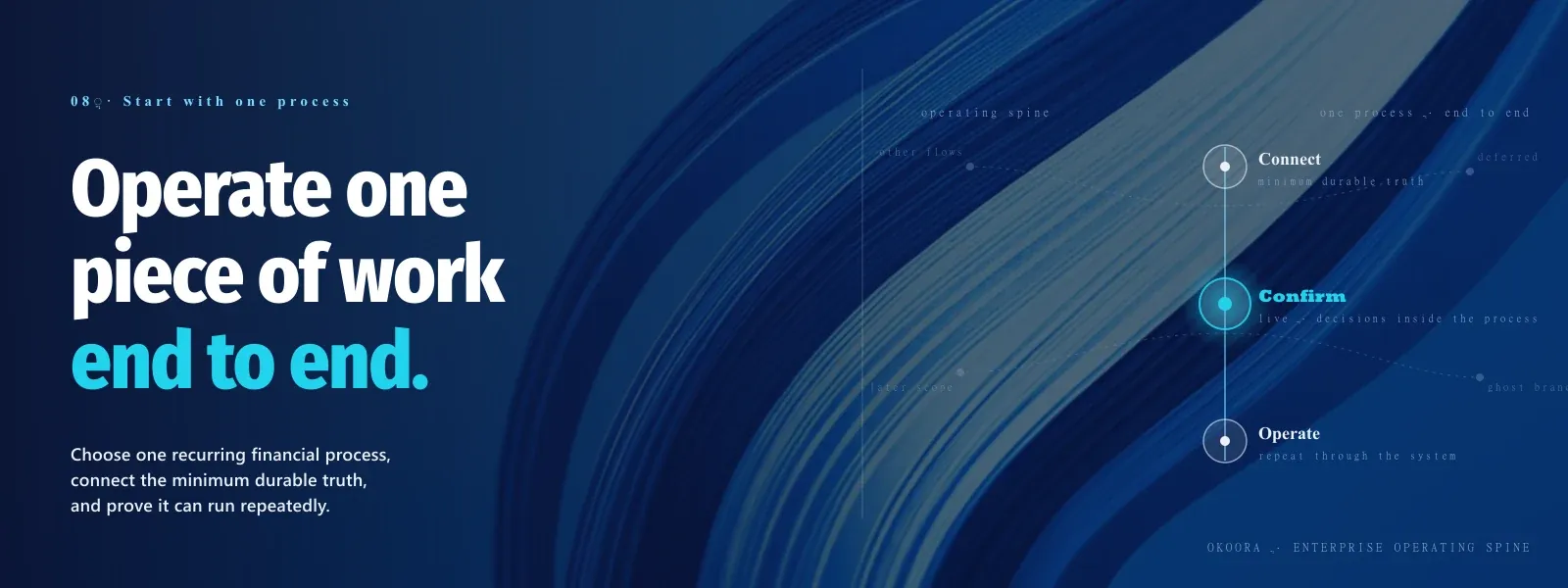
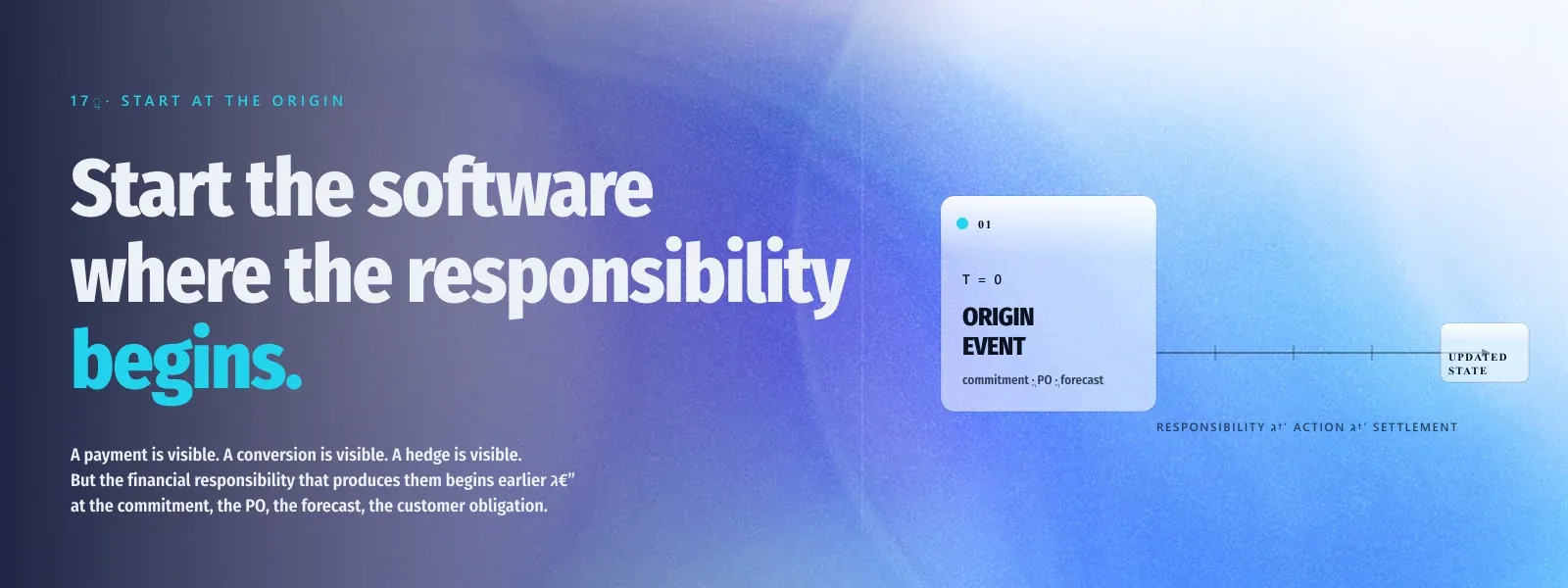
First identify the recurring event that creates financial responsibility. Then identify the authoritative sources that define the relevant facts. Maintain the minimum durable financial state required to understand the process. Define the decisions, policy, approvals, exceptions and completion conditions. Only then decide which surface the user needs.
The final surface may be a dashboard, workspace, notification, action screen, conversational interface or API. But the screen is how the user encounters the operating process. It is not the process itself.
What good financial visibility should lead to
A useful test for any financial visibility initiative is to ask what becomes possible after the information is visible.
Can the system identify a meaningful change without the team rebuilding the picture manually? Can it explain the financial consequence of that change? Can it apply policy consistently? Can it distinguish routine activity from an exception? Can it prepare the right decision for the right person? Can it connect the decision to execution? Can it update the state after the action occurs?
If the answer ends at “the team can now see it,” the system may be a better reporting layer. That can still be valuable.
But a financial operating layer should go further. It should make the financial reality current, understandable and actionable, then keep it current after the action happens.
The real shift is from seeing finance to operating it
The next generation of financial software will not win by producing more dashboards. It will win by reducing the distance between business activity and financial action.
That means understanding the financial meaning of real events, maintaining a persistent state across systems, applying policy, preparing decisions, respecting authority, enabling execution and learning from the resulting state.
Finance teams still own judgment. Institutions still own policy. Existing banks and providers can remain part of the operating environment.
The software takes responsibility for keeping the work connected.
Okoora operates across financial state, intelligence, policy, execution and control so that financial activity can move from information to decision and from decision to action without forcing teams to reconstruct the process each time.
NEXT STEP See how Okoora connects financial state, policy, decisions and execution into one operating layer.
See how Okoora connects financial state, policy, decisions and execution into one operating layer.