 Benjamin AvrahamCEO
A group can have many systems and still need one financial reality
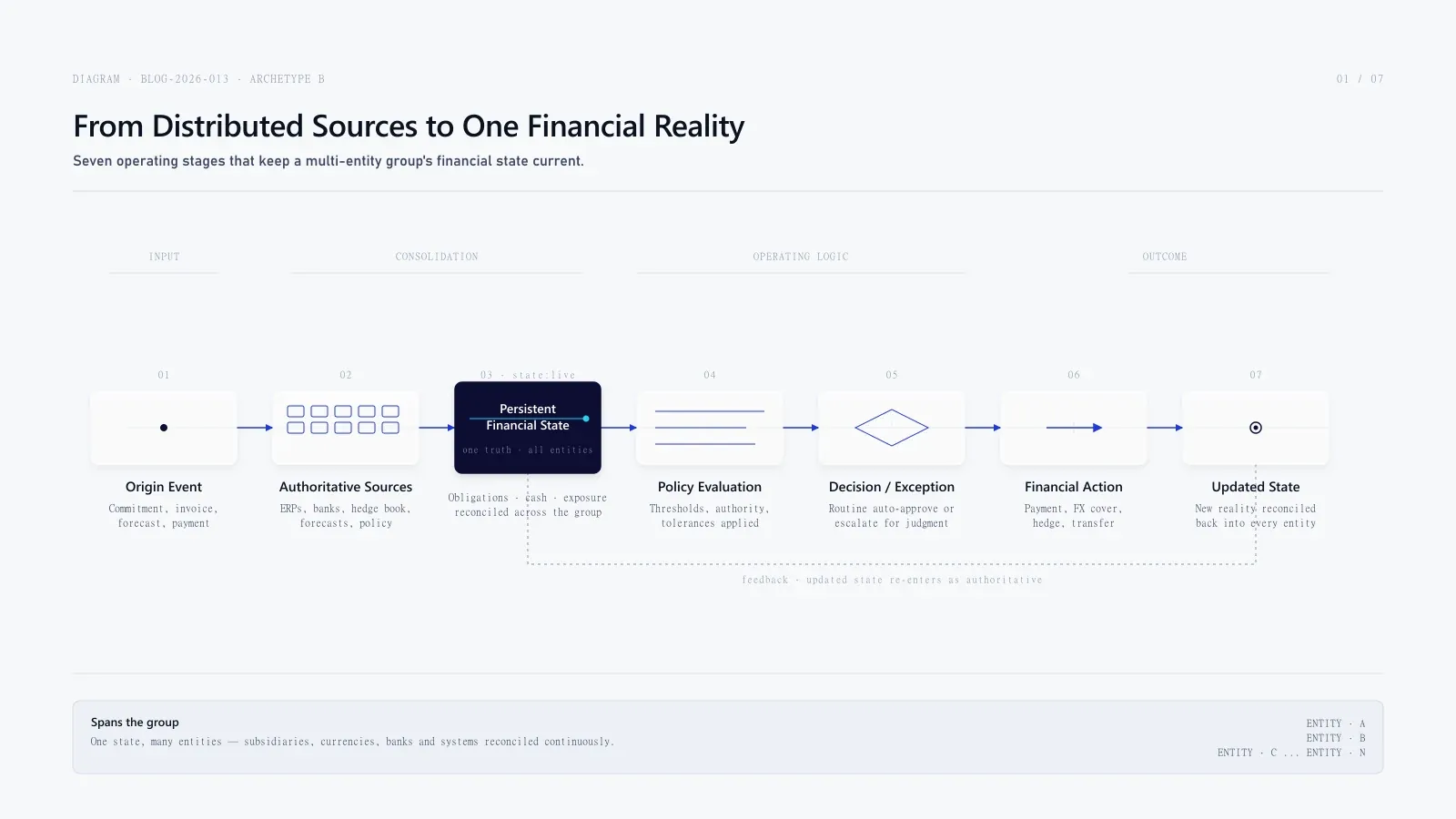
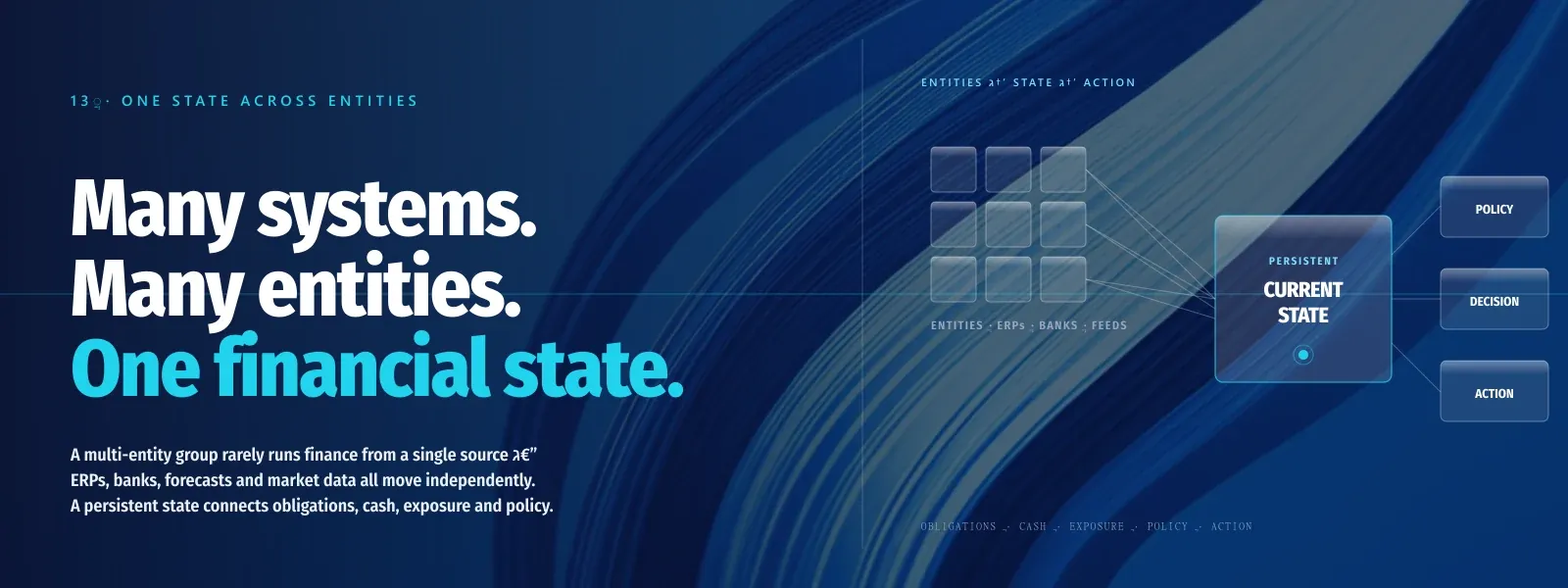
A multi-entity business rarely runs finance from a single source. One entity may use one ERP, another may use a different system, bank balances may sit across several institutions, forecasts may come from planning tools, and existing protection or financing may be tracked somewhere else.
Each source can be valid. The problem begins when financial work depends on the relationships between them.
A supplier commitment in one entity may create a future currency need. That need may interact with cash held elsewhere in the group, an existing hedge booked centrally, a policy set at group level, and an approval process owned locally. No individual record explains the whole financial position.
The operating challenge is therefore not to force everything into one database. It is to maintain one financial state that remains current as the underlying sources change.
A consolidated report is not the same as a current financial state
Consolidation usually answers a reporting question: what did the group look like at a particular point in time?
Operating finance requires a different question: what is true now, what changed, what does the change mean, and what financial work should follow?
A report can show cash, obligations, exposures and protection. A financial state must also preserve how those objects relate to each other. It should know which obligation created a currency need, which hedge protects that need, whether the timing still matches, which policy applies, what is awaiting approval and what has already been completed.
That difference is what allows software to move from visibility into operation.
The state should begin with real financial events, not with system boundaries
One of the easiest ways to design a weak group-wide view is to start by asking which systems need to be connected.
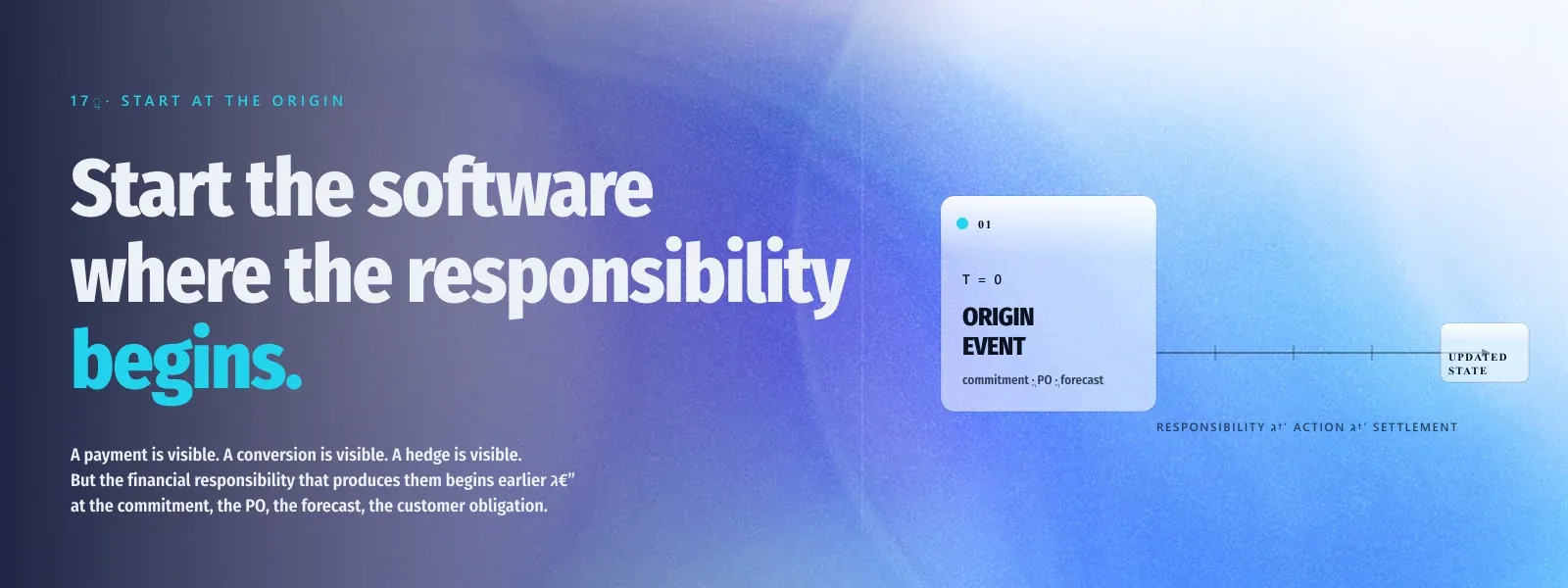
The stronger starting point is the financial event itself.
When does an obligation become real? When does a purchase commitment create a future payment need? When does a forecast become financially meaningful enough to affect liquidity or protection? When is a customer receipt expected strongly enough to influence a decision?
Once the origin event is clear, the required sources become easier to identify. The goal is not broad integration. It is the minimum durable truth required to follow that financial process across its lifecycle.
Different facts can have different sources of truth
A multi-entity group does not need one system to become authoritative for everything.
The ERP may be authoritative for invoices. A planning system may be authoritative for forecast demand. Banks may be authoritative for balances and settlement status. A treasury record may be authoritative for hedge positions. Group policy may live in a separate controlled source.
Trying to collapse all of this into one master system can create a large technology program before any operating value appears.
A financial operating layer can take a different approach: respect the authority of each source, connect only the facts required for the workflow, normalize their meaning, and maintain the relationships between them in one persistent financial state.
The state has to survive change
The real test is not whether the group can produce a correct picture once. It is whether that picture stays alive.
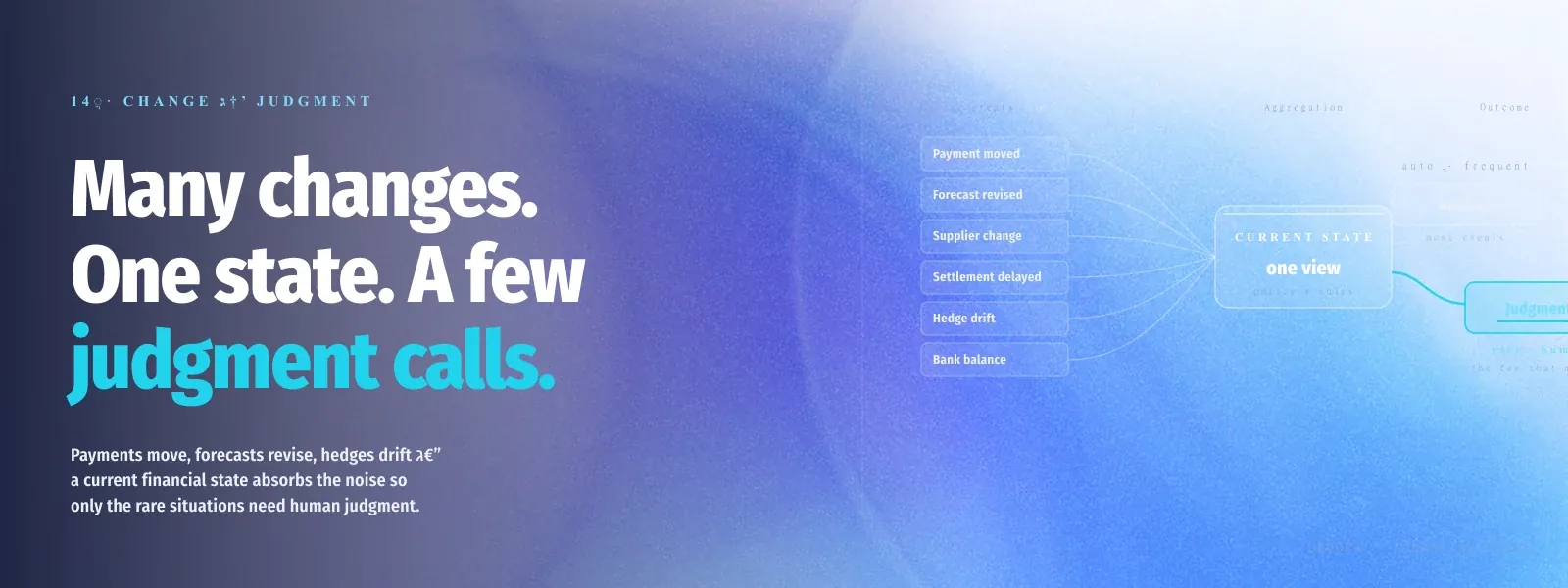
If a supplier payment date moves, the related currency need should move with it. If a forecast changes, the exposure should be re-evaluated. If a payment settles, the open obligation should update. If protection is added or resized, the coverage state should change. If a bank balance changes materially, the liquidity picture should reflect it.
When every change requires analysts to rebuild the picture in spreadsheets, the company has a reporting process. It does not yet have a persistent operating state.
A durable financial state updates from recurring source paths and preserves the relationships required to understand what changed and what should happen next.
Group context determines the meaning of local activity
The same transaction can mean something different depending on the group context around it.
A local entity may have an upcoming foreign-currency payment and insufficient cash in that currency. At group level, however, another entity may have a natural offset, the treasury team may already hold protection, or policy may require central rather than local execution.
That is why a group-wide operating view cannot be built by simply stacking local dashboards together.
The system needs to understand entity, counterparty, currency, due date, liquidity, exposure, protection, authority and policy as related parts of the same financial reality.
Policy turns the state into work
Once the financial state is current, policy can become active operating logic.
A change in the state can be evaluated against approved rules. Routine activity can continue within policy. Exceptions can be surfaced for judgment. A decision can be prepared with the relevant context. An approved action can then lead to payment, conversion, protection, financing or another financial step.
This is where a group-level view becomes commercially useful. The objective is not simply to see more. It is to turn a current financial reality into better decisions and better execution without removing the authority of the finance team.
You do not need to connect the whole group on day one
The practical path is usually narrow scope, deep lifecycle.
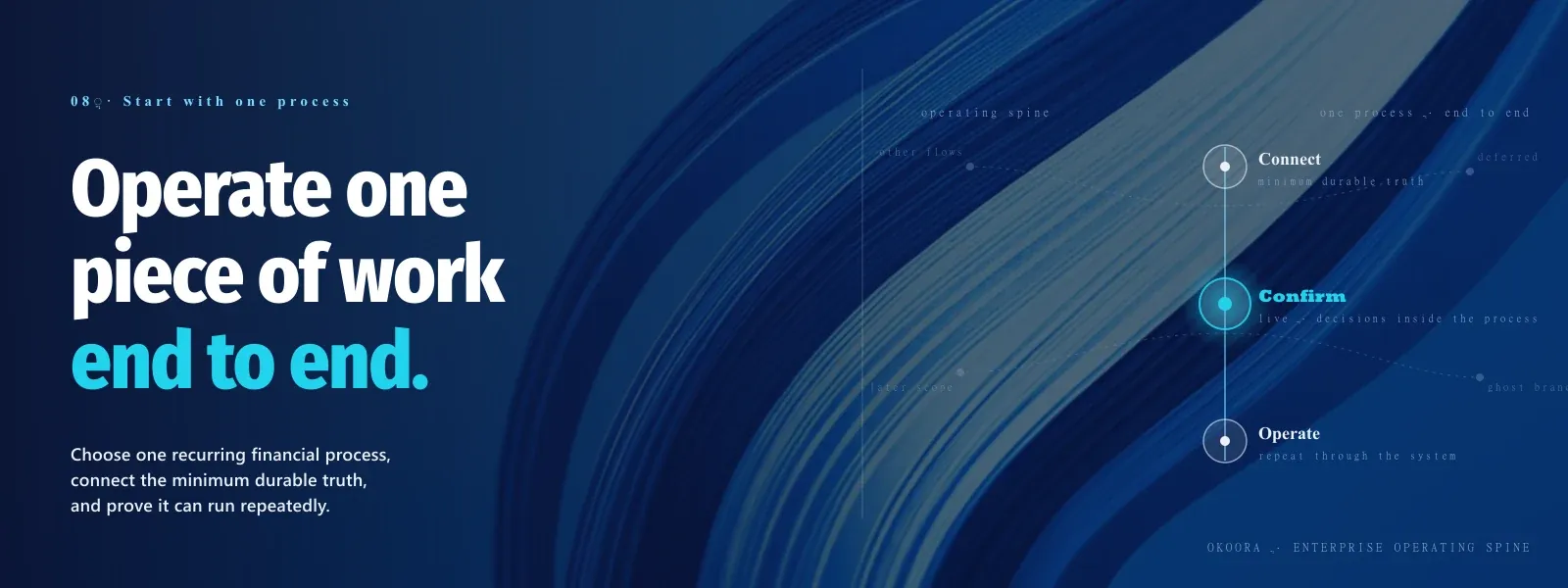
Choose one recurring financial process, one bounded population of activity, or one entity and currency combination where the operating value is clear. Identify the earliest meaningful event. Map the authoritative sources. Establish the minimum recurring data paths. Define the financial objects and relationships. Then prove that a real source change updates the state without manual reconstruction.
Only after that should the scope expand.
This approach avoids a broad integration program while still creating an operating foundation that can grow across entities, workflows and financial actions over time.
One financial reality does not require one financial system
The important shift is conceptual.
A multi-entity group does not need every company to abandon its ERP, every bank to be replaced, or every local process to become identical before finance can operate from one coherent picture.
What it needs is a layer that understands the financial meaning across those systems, keeps the relevant state current, applies the right policy and connects that state to the decisions and actions that follow.
That is the difference between consolidating financial data and operating financial reality.
Where Okoora fits
Okoora operates across accounts, payments, FX, exposure and money flows by connecting financial context, policy, execution and control.
For a multi-entity group, that means the operating layer can sit above existing ERPs, banks and financial sources, maintain the financial state required for a defined workflow, and connect that state to the decisions and actions that follow.
The objective is not to replace the systems that already hold important facts. It is to make those facts operate together as one financial reality.
Next step: See how Okoora can operate a real recurring financial process across your existing systems, entities and financial workflows.
See how Okoora operates financial activity across systems, entities and financial workflows.
Related reading: Why Financial Software Should Start With the Event That Creates Financial Responsibility.