 OkooraEditorial Team
One provider can be strong without being right for every transaction
A business can have an excellent bank, payment provider or liquidity partner.
That does not mean the same provider will always be the strongest choice for every payment, currency conversion or hedge.
Different providers have different strengths.
One bank may have attractive liquidity in a particular currency pair.
Another may provide stronger credit capacity.
A payment provider may have better local reach in one market.
A different route may fit a particular supplier payment more naturally.
Execution optionality begins with a simple idea:
Keep the providers that already create value, but do not make every future transaction depend on one provider by default.
Optionality means having real alternatives before you need them
Execution optionality is not a long list of logos.
It is the ability to choose among practical, approved alternatives when a financial action needs to be executed.
For that choice to be real, the alternatives have to be usable.
The provider relationship may need to exist already.
Legal and operational setup may need to be complete.
Credit or collateral terms may need to be agreed.
Payment routes may need to be connected.
Settlement instructions may need to be approved.
If the business waits until a large payment, volatile market event or urgent hedge appears, it may discover that the alternative provider is not operationally available.
Optionality is most valuable when it is built before the decision becomes urgent.
In FX, more providers can reveal more of the executable market
The FX market is decentralised and fragmented.
Customers can trade directly with dealers, through multi-dealer platforms, or through liquidity aggregators that consolidate access to several providers.
That structure exists because one provider does not necessarily show the full set of executable alternatives available in the market.
Different providers can have different liquidity, inventory, client flow and appetite for the same transaction.
For a business, access to several approved banks or liquidity providers can improve price discovery.
The value is not that another provider will always be cheaper.
The value is knowing what the available market looks like before the company commits to one execution path.
In payments, more providers can create more route choice
Cross-border payments have a similar problem in a different form.
One provider may use a correspondent-bank route.
Another may reach the beneficiary through local clearing.
A third may combine payment infrastructure with FX.
The right route can depend on destination, currency, amount, speed, beneficiary requirements and company policy.
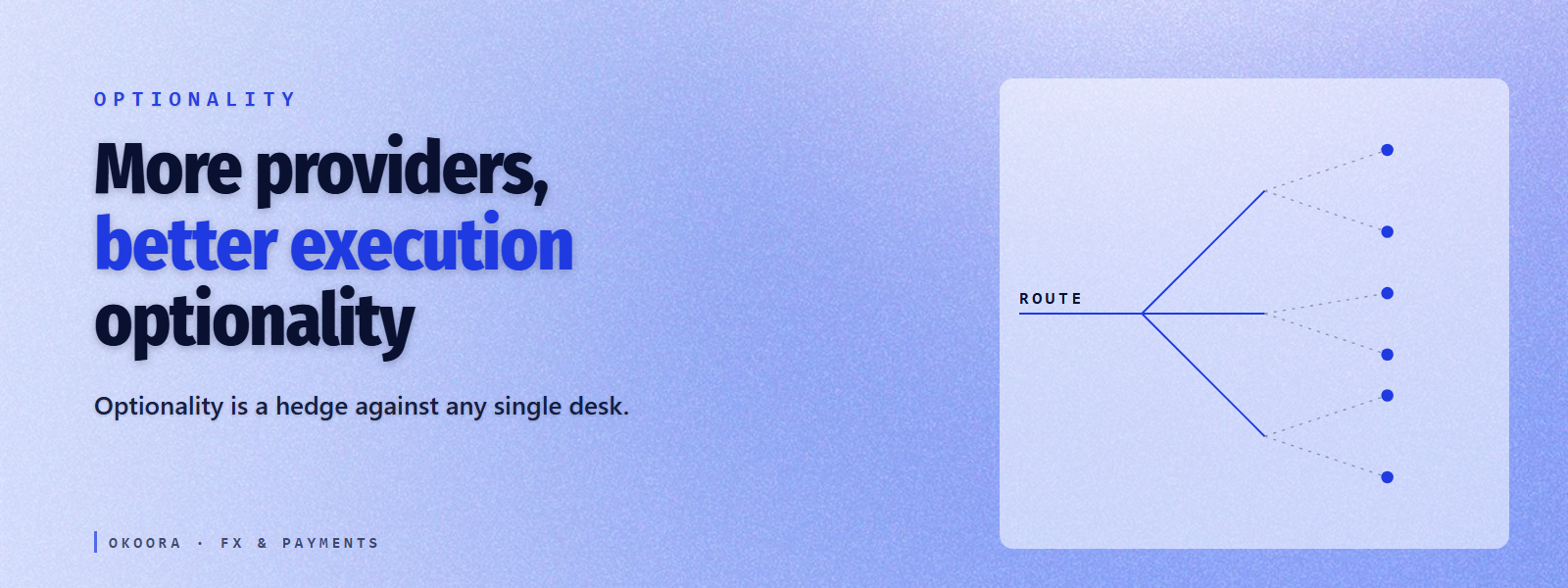
If the company has only one payment path, it has no routing decision.
If it has several approved and operational paths, it can compare them.
That is payment optionality.
The provider set creates the possible routes.
The business still needs a decision layer to determine which route fits the transaction.
Hedging also benefits from provider optionality
Hedge pricing can vary across banks and liquidity providers.
The same forward, swap or option can fit differently into each provider's liquidity, funding, inventory and balance-sheet position.
One provider may also have stronger credit terms for the customer.
Another may price a particular tenor or structure more competitively.
For a material hedge, having more than one approved provider creates the ability to market-test the same requirement.
The objective is not to turn every hedge into a bidding contest.
It is to avoid treating one quote as the only market available to the decision.
More providers can improve resilience too
Provider optionality is not only about price.
It can also create resilience.
A payment route may become unavailable.
A provider may have an outage.
A corridor may temporarily perform differently.
A liquidity source may become less competitive during volatile markets.
A credit line may be constrained.
When the business already has another approved path, it has more room to respond.
This does not eliminate operational risk.
Multi-provider models can introduce additional complexity and require stronger controls.
But they can reduce dependence on one provider's availability, pricing or infrastructure for every transaction.
The trade-off is complexity
More providers do not automatically create a better operating model.
Every relationship can introduce:
Contracts.
Onboarding.
Compliance work.
Credit management.
Technical integration.
Settlement instructions.
Data formats.
Operational support.
Provider monitoring.
A business that adds providers without a clear operating model can end up with more optionality on paper and more fragmentation in practice.
This is why aggregation and orchestration matter.
The complexity should be managed underneath the workflow rather than pushed onto the finance team.
The user should not have to navigate every provider separately
A weak multi-provider setup creates more portals, more spreadsheets and more manual comparison.
That defeats the purpose.
A stronger model centralises the decision.
The finance team should be able to begin with the financial action:
Pay this supplier.
Convert this currency.
Protect this exposure.
Then the system should surface the relevant approved alternatives.
The user should not need to remember which provider is strong in which currency, which rail reaches which market or which provider can handle which payment method.
Provider optionality is most valuable when the infrastructure absorbs the complexity.
Policy turns optionality into control
Once more alternatives exist, the company needs clear rules for when each one can be used.
That can include:
Approved providers.
Counterparty limits.
Currency rules.
Country restrictions.
Payment thresholds.
Required quote comparisons.
Credit limits.
Maximum pricing tolerances.
Approval thresholds.
Settlement requirements.
Exception handling.
Without policy, more options can produce inconsistent decisions.
With policy, the system can narrow the available provider set automatically and escalate only the decisions that require human judgment.
More providers can strengthen an existing bank relationship rather than weaken it
A company does not need to choose between loyalty to its bank and access to a broader market.
The two can coexist.
The bank may remain strategically important for financing, credit, cash management and operational continuity.
It may also continue to win a large share of FX, payment or hedge execution.
The difference is that the customer has alternatives around the relationship.
That can improve transparency and decision quality.
It can also show when the bank is genuinely delivering strong economics.
Optionality does not mean abandoning relationships.
It means making the transaction decision independently from the existence of the relationship.
The right number of providers is not 'as many as possible'
There is no reason to maximize provider count.
The useful provider set is large enough to create meaningful choice and small enough to remain governable.
The right number depends on:
Currencies.
Countries.
Transaction types.
Hedge instruments.
Volume.
Credit requirements.
Operational capacity.
The company should ask whether each additional provider creates a real alternative.
If it does not improve reach, liquidity, pricing, resilience, credit capacity or route availability, the relationship may simply add complexity.
Optionality is about relevant alternatives, not maximum connections.
A practical test for execution optionality
A business has meaningful execution optionality when it can answer yes to questions like:
Do we have more than one approved execution path for material financial actions?
Can the same transaction be compared across relevant providers?
Can we keep our strategic bank while using another provider when it makes sense?
Can the system decide which providers are eligible under policy?
Can a payment move through a different route without rebuilding the workflow?
Can a material FX trade be tested across more than one liquidity source?
Can a hedge be priced by more than one approved counterparty?
Can the execution venue change while the financial process stays intact?
Does the final execution result return into the same financial state?
If those conditions are met, the company has more than multiple providers.
It has operational optionality.
Where Okoora fits
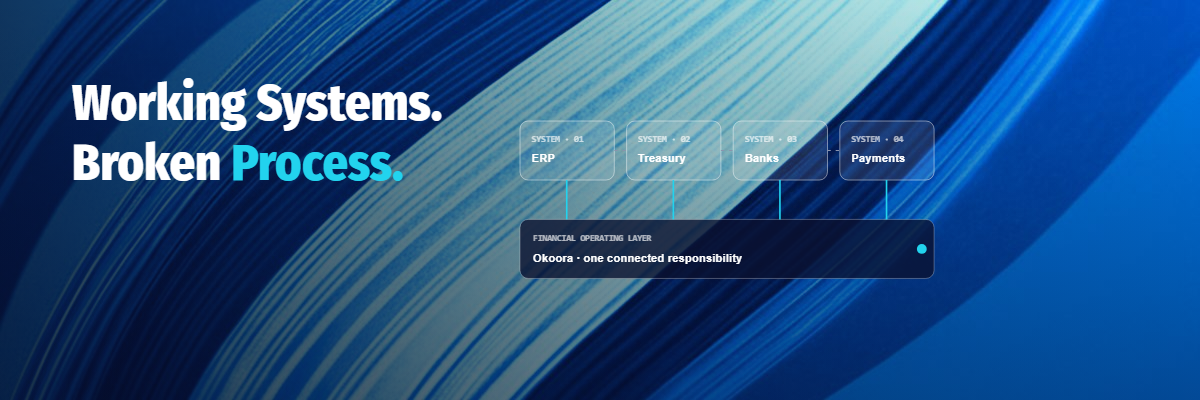
Okoora connects banks, brokers, liquidity providers, payment rails and execution infrastructure into one financial operating layer.
That allows businesses to keep the providers that already work while adding more approved alternatives around each transaction.
A supplier payment can be evaluated across available routes.
An FX conversion can be tested across multiple liquidity sources through the FX Marketplace.
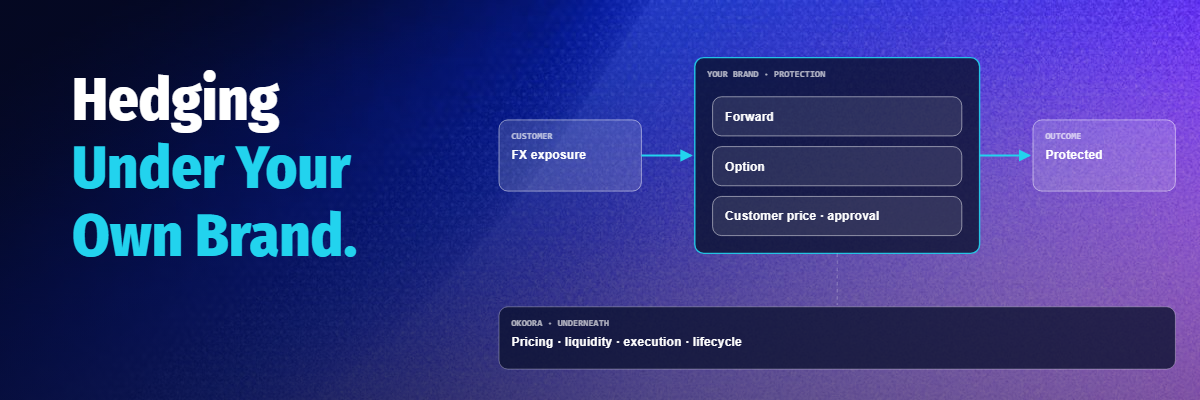
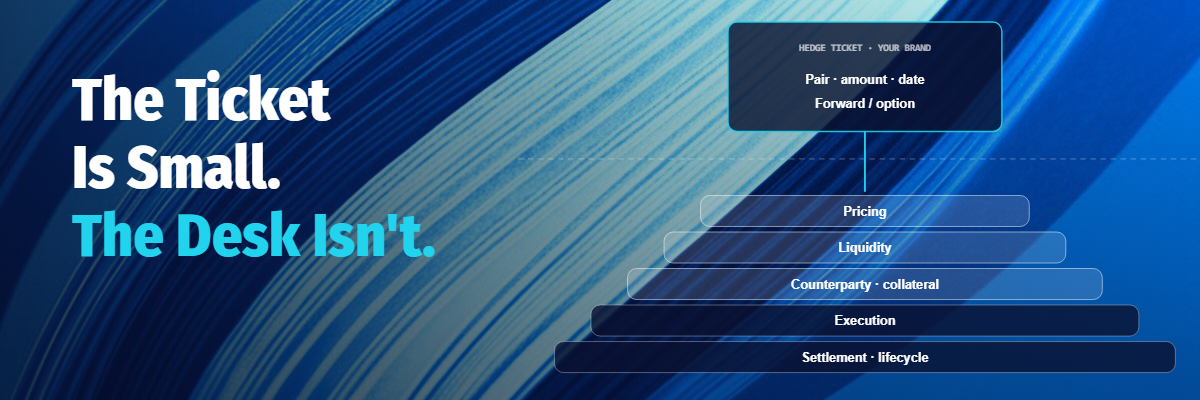
A hedge can be priced by several approved providers.
The customer keeps policy and approval control.
The execution provider can change without breaking the wider financial workflow.
That is the deeper value of optionality.
It is not having more providers for the sake of having more providers.
It is having enough connected, approved alternatives to make a better execution decision when the financial action matters.
Next step: See how Okoora lets businesses keep the financial providers that work while adding broader market access, routing and execution optionality around each financial action.
Related reading: How Provider Aggregation Changes Payment and FX Execution.