 Benjamin AvrahamCEO
Finance changes faster than most operating processes
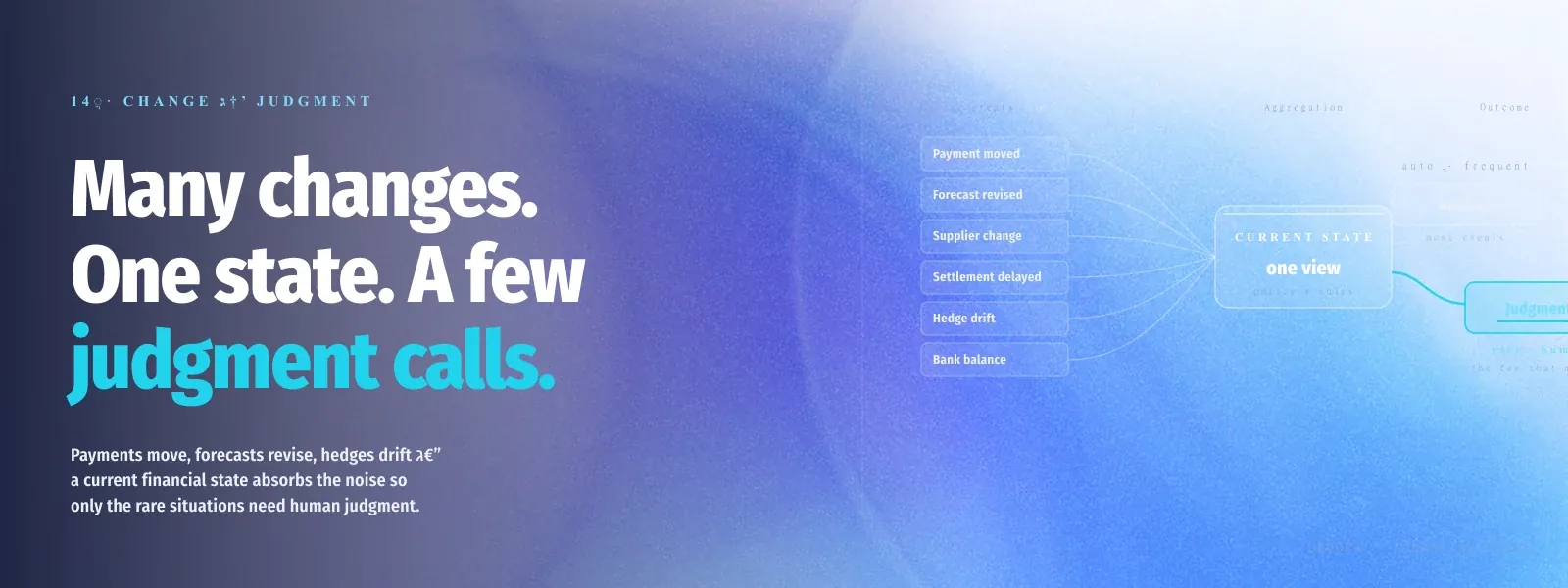
A finance team can begin the day with a clear plan and still end it with a different financial reality. A customer payment moves. A supplier commitment changes. A forecast is revised. A settlement is delayed. A hedge no longer matches the timing of the underlying need. A bank balance changes. A new approval becomes necessary.
None of these events is unusual. The difficulty is that they do not arrive as one clean financial decision. They arrive as changes across systems, files, accounts, forecasts, market data and operating teams.
The work is not simply to notice the changes. It is to determine which changes matter financially, how they affect the current state, whether policy still holds, and which situations actually require human judgment.
More alerts do not create better financial control
A common response to more data is more notification. Every system can flag something. Every dashboard can highlight a variance. Every workflow can send an alert.
That can increase visibility while making the operating problem worse.
Finance leaders do not need every change presented with equal weight. They need the system to absorb routine change, preserve context, evaluate significance and bring forward the small set of decisions that deserve attention.
The goal is not fewer facts. It is better compression of financial reality.
The first requirement is a current financial state
A system cannot decide whether a change matters if it only sees isolated records.
It needs to maintain a financial state that connects the relevant objects over time: obligations, expected receipts, cash, currency needs, exposure, existing protection, payment status, policy, approval authority and completed actions.
That state creates continuity. When a source changes, the system does not start from zero. It updates what is already known and re-evaluates the relationships affected by the change.
This is the difference between reading a new row and understanding that a financial situation has changed.
The second requirement is financial significance
Not every change deserves the same response.
A small timing movement may be operationally irrelevant. The same movement can become important if it changes liquidity, leaves an exposure unprotected, pushes an activity outside policy, affects a material customer obligation or creates a new approval requirement.
Significance therefore cannot be determined from the size of a data change alone. It depends on financial context.
A useful operating system evaluates change against questions such as:
Does this change create or remove a real financial obligation?
Does it alter cash, liquidity or currency needs?
Does it change exposure or the relationship between exposure and protection?
Does timing now fall outside the intended financial position?
Does the activity remain within policy and authority?
Does a decision, approval or financial action become necessary?
This is where domain logic becomes more important than simple anomaly detection. A change is important because of what it means financially, not because it looks unusual in a dataset.
Policy should absorb routine work before it reaches the finance team
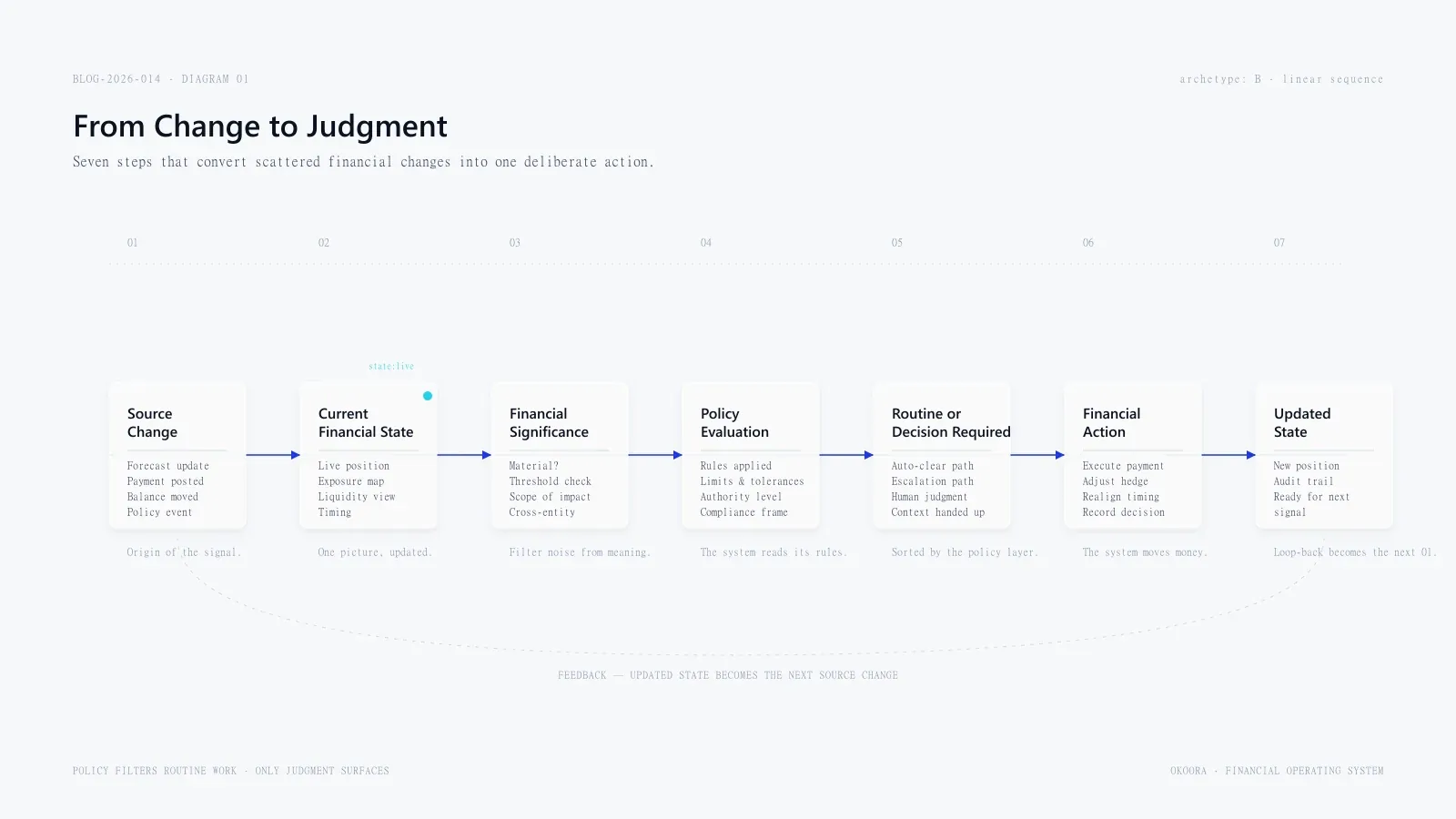
Once the financial state is current and the significance of a change is understood, policy can determine what happens next.
Routine activity may remain inside approved boundaries and continue without escalation. A change that moves the situation outside policy can become an exception. A material decision can be prepared with the relevant context, alternatives and required authority already attached.
This creates a useful separation between work the system can operate consistently and work that genuinely requires judgment.
Human attention then becomes a scarce resource applied where it adds value, rather than the mechanism required to keep every financial process moving.
A decision should arrive with the financial context already assembled
Surfacing an exception is only half the job.
If the finance team still has to open several systems, rebuild the position in a spreadsheet, find the related hedge, verify the policy, check the timing and determine who can approve the action, the system has identified work but has not operated it.
A stronger operating model prepares the decision package.
The person reviewing it should be able to understand what changed, what the current financial state is, why the situation matters, which policy applies, what action is possible, what approval is required and what happens after the decision.
That is how software reduces decision time without removing financial authority from the people responsible for it.
The same logic applies beyond treasury
This operating pattern is not limited to exposure or hedging.
A payment obligation can change because a supplier date moves. A liquidity decision can change because a receipt is delayed. A conversion need can change because an underlying commitment changes. A control exception can appear because a transaction crosses an approval threshold. A customer financial flow can create a new execution requirement.
The underlying model is the same:
Financial reality changes.
The current state updates.
The system determines what the change means.
Policy separates routine work from exceptions.
Only the relevant decisions reach the finance team.
Approved actions update the financial state again.
That loop is what turns financial software from a place where people inspect information into a system that operates financial work continuously.
Good compression should be explainable
Reducing operational noise does not mean hiding activity.
Finance teams still need lineage, source visibility and the ability to understand why the system treated one change as routine and another as material. Every decision should be traceable back to the facts, relationships, rules and policy that produced it.
That matters for control, trust and governance. The system should reduce cognitive load without becoming a black box.
Start with one recurring process
The practical way to build this capability is not to connect every source and classify every financial event across the company on day one.
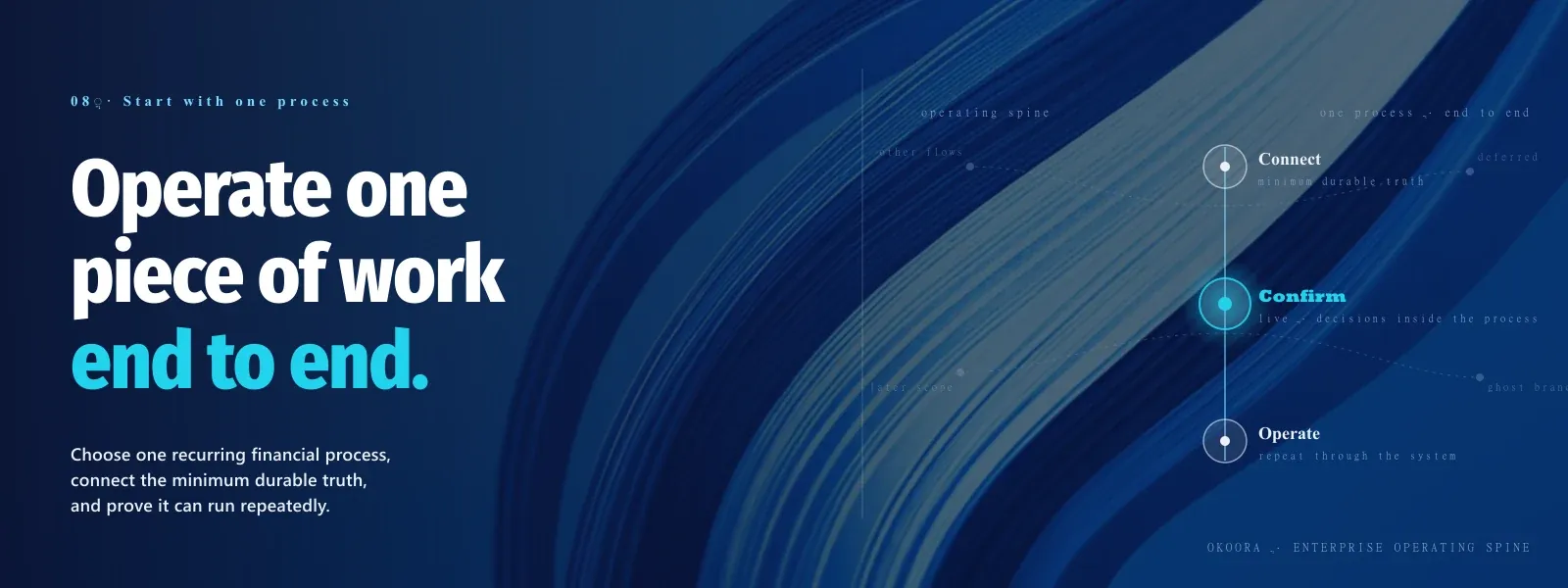
Start with one recurring financial process where changes create real work. Identify the earliest meaningful event. Map the authoritative sources. Define the minimum financial state that must remain current. Determine which changes are financially significant. Encode the relevant policy and authority. Then prove that a real source change updates the state and produces the right operating response.
Once that loop works reliably, the same pattern can expand to more activity, currencies, entities, decisions and financial actions.
The objective is not more information. It is better use of attention
Finance teams already have information. The harder problem is converting continuous change into a manageable operating workload.
The strongest financial systems will not win by showing the most data or generating the most alerts. They will win by maintaining financial reality, understanding what changed, applying policy and directing human judgment to the decisions where it matters.
That is a different standard for financial software: not simply visibility, but disciplined compression from activity to decision to action.
Where Okoora fits
Okoora operates across accounts, payments, FX, exposure and money flows by connecting financial context, policy, execution and control.
That allows changing financial activity to be evaluated as part of a current financial state, with routine work handled consistently and the decisions that require judgment brought forward with the relevant context.
The objective is not to remove the finance team from the process. It is to make sure their attention is spent on the financial decisions that actually require it.
Next step: See how Okoora can operate a recurring financial process and turn changing activity into the decisions and actions that matter.
See how Okoora turns changing financial activity into the decisions and actions that matter.
Related reading: Why Approval Should Be an Exception, Not a Step in Every Expense, Why Financial Visibility Only Matters When It Leads to Decisions and Action.