 Benjamin AvrahamCEO
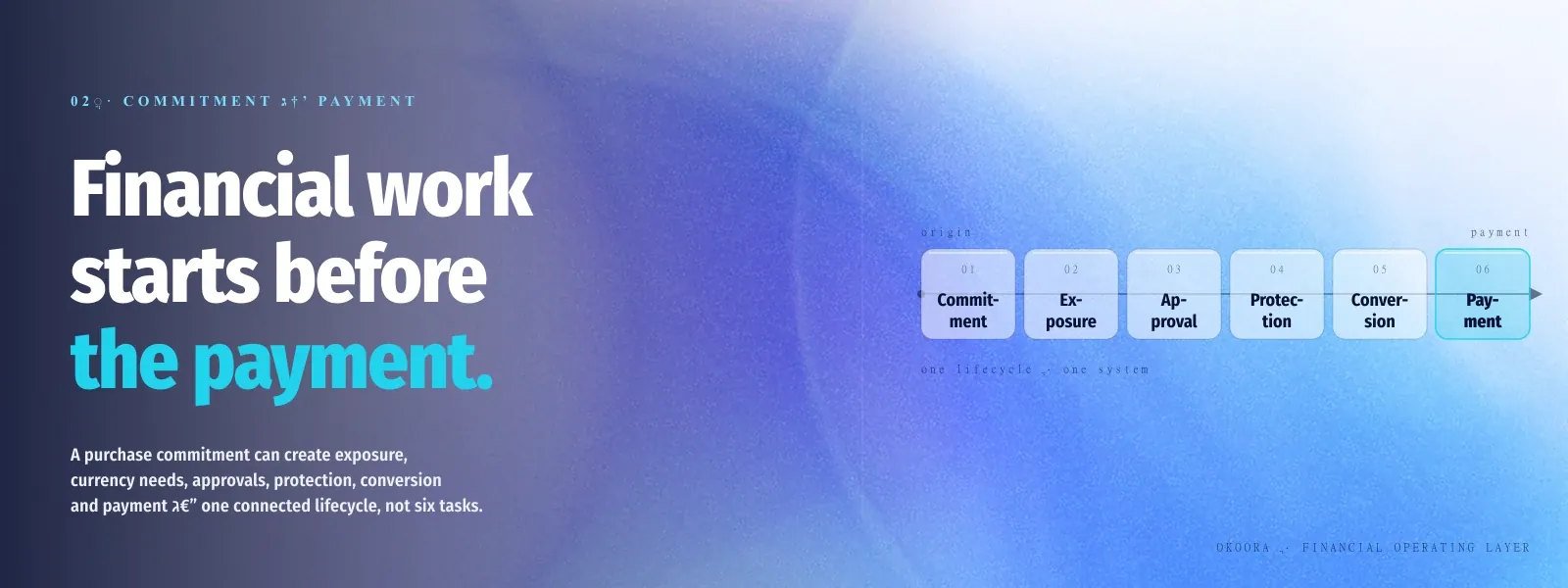
Financial work starts before the payment
A supplier payment may look like a single financial action. In reality, the work usually began much earlier.
A purchase order was approved. A commercial commitment became real. A delivery date was agreed. A currency need appeared. An exposure formed. A payment date entered the calendar. The company then had to decide what to protect, what to convert, when to fund the payment, who should approve it, and how to close the loop once the money moved.
Each step is familiar. The opportunity is to operate them as one financial lifecycle rather than as separate tasks that happen to touch the same transaction.
That shift matters because the financial meaning of a business event changes as the business moves. The amount can change. The timing can move. The currency requirement can be revised. Existing protection may no longer match. Cash may sit in a different entity or account. A routine payment can become an exception. The work is connected even when the systems around it are not.
One business event can create a chain of financial responsibility
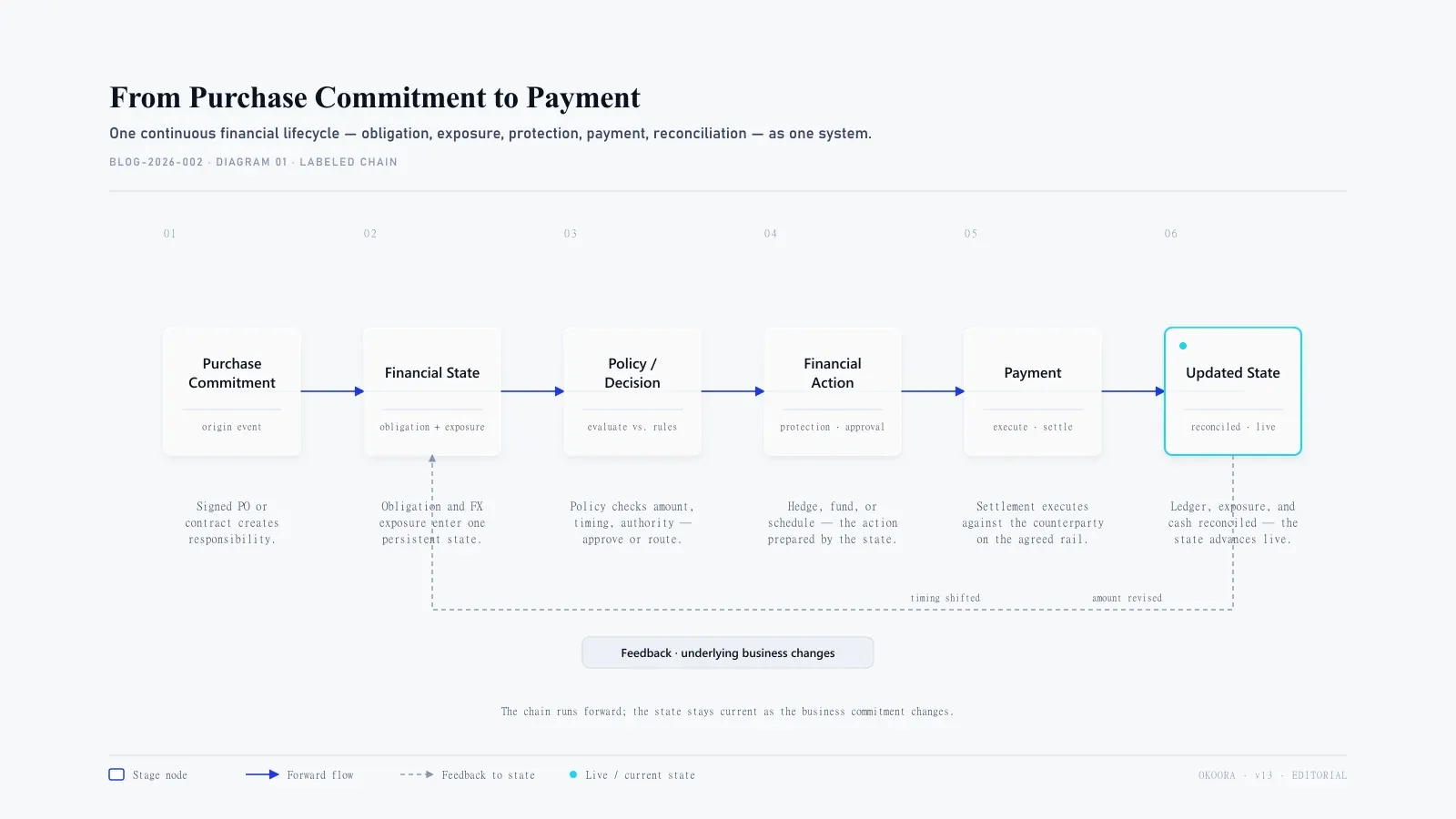
Consider a simple example. A company commits to buy goods from a foreign supplier. At that moment, finance may not yet have an invoice or a bank instruction. But the commercial event can already create something financially significant: a future obligation, a currency requirement, a liquidity need, an exposure, or a control requirement.
The exact origin event differs by business. It might be a purchase commitment, an order, a contract, an invoice, a forecast or another recurring event. What matters is identifying the earliest point at which the financial responsibility becomes real enough to operate.
From there, the lifecycle can be understood as a connected sequence:
The value comes from keeping the context intact as the work moves from one stage to the next.
The financial picture is more than the data in one system
A purchase commitment may live in an ERP. Bank balances may live with several banks. Existing hedges may be recorded elsewhere. Approval authority may sit in policy documents or workflow rules. Market data comes from another source. The final payment may travel through yet another system.
A useful financial operating layer does not require all of those systems to disappear. It needs to understand which source is authoritative for each financial fact, connect the minimum information required for the workflow, and translate that information into one persistent financial state.
That state should answer practical questions continuously: What is open? What is due? Which entity owns the obligation? In which currency? What is already protected? What still requires a decision? What has been converted? What has been paid? What changed since the last decision?
This is the difference between collecting data and operating financial reality. Rows in a file describe inputs. A financial state preserves the meaning and relationships required to act.
A connected lifecycle has five operating jobs
1. Recognize the origin event
The process begins when the financial responsibility forms, not only when payment is due. The system should know what business event created the obligation and what financial work starts because of it.
2. Maintain the financial meaning
The obligation is connected to the entity, supplier, amount, currency, due date, cash position, existing protection and other facts that determine what the event means financially.
3. Apply policy and prepare the decision
The next step is not always execution. The system should determine what can progress routinely, what requires approval, what sits outside policy, and what deserves human judgment.
4. Operate the financial action
The required action can be a payment, a conversion, a protection decision, an external execution instruction, or a combination. The action remains connected to the same underlying business event.
5. Update the state when reality changes
Once something changes or executes, the financial state updates. The lifecycle does not restart from a spreadsheet or a new reconciliation exercise. The next decision begins from the current state.
Why persistent state changes the quality of financial decisions
Financial decisions are often correct at the moment they are made. The harder problem is that the underlying business keeps moving afterwards.
A purchase can be reduced. A shipment can be delayed. A due date can move. A forecast can change. A hedge that matched the original exposure can become too large, too small or mistimed. A bank balance can change before a payment date. A previously routine transaction can cross a policy threshold.
When financial state is maintained continuously, those changes do not have to wait for the next manual review to become visible. The system can re-evaluate what the business now requires against what has already been done.
That creates a different operating model. Finance does not need to reconstruct the entire picture before every decision. The current picture already exists. The team can focus its judgment on the decisions and exceptions that actually require it.
The existing ERP and banks can remain part of the system
Operating the lifecycle as one system does not mean replacing every system that already works.
The ERP can remain the source of commercial and accounting facts. Banks can remain execution and account providers. Existing approval structures can remain. Specialist systems can continue to perform the jobs they already perform well.
The operating layer sits above that environment. It connects the relevant truth, maintains the financial state, applies policy, coordinates the next action, and keeps the lifecycle coherent from the originating event through completion.
For IT, this reduces the need to begin with a broad transformation program. The practical question is narrower: what is the minimum durable connection required to operate the first real financial workflow reliably?
Start narrow, operate deep
The strongest way to begin is usually not to connect every entity, every source and every financial process at once.
Choose one recurring population or workflow. Identify where it begins. Map the authoritative sources. Connect only the data required to keep that workflow current. Define what the system must know, what it should operate, what the customer should decide or approve, what becomes an exception, and what counts as completion.
The scope can be small while the lifecycle is deep. One supplier population. One entity. One currency. One type of obligation. What matters is that the workflow reaches real financial action and remains current across repeated cycles.
Once that operating spine works, the same model can expand across more entities, currencies, actions and financial responsibilities.
What changes for the finance team
For the CFO, the financial picture becomes connected to the work that follows from it, not just a reporting view.
For Treasury, exposure, liquidity, conversion, protection and payment decisions can stay connected to the business events that created them.
For Controllers and finance operations, approvals, execution status and reconciliation can remain part of the same operating context.
For IT, the architecture can evolve around durable connections to existing systems rather than a forced rip-and-replace program.
And for the business as a whole, financial activity can move through a governed operating lifecycle: the system knows what happened, understands what it means, prepares or takes the next permitted action, and updates the financial state afterwards.
From financial tools to financial operations
The important shift is not another dashboard, another workflow screen or another isolated automation.
It is the ability to operate financial work as a connected lifecycle. The business event, financial meaning, policy, decision, action and updated state remain linked as the underlying reality changes.
Okoora is built for that model. Its AI-native intelligence operates across accounts, payments, FX, exposure and money flows, connecting financial activity to action by policy while working above the systems and providers a company already uses.
A purchase commitment can therefore remain connected to the financial work it creates all the way through payment and completion. The payment is not the process. It is one stage in a financial lifecycle that can operate as one system.
NEXT STEP See how Okoora operates financial work across analysis, payments, currencies and protection.
See how Okoora operates financial work across analysis, payments, currencies and protection.