 OkooraEditorial Team
Entering a new country should not mean rebuilding the financial product from scratch
Geographic expansion creates real local requirements. Payment rails differ. Account structures differ. Currency support changes. Settlement models vary. Regulated providers and onboarding requirements can change. What worked in one market may not be the right infrastructure in another.
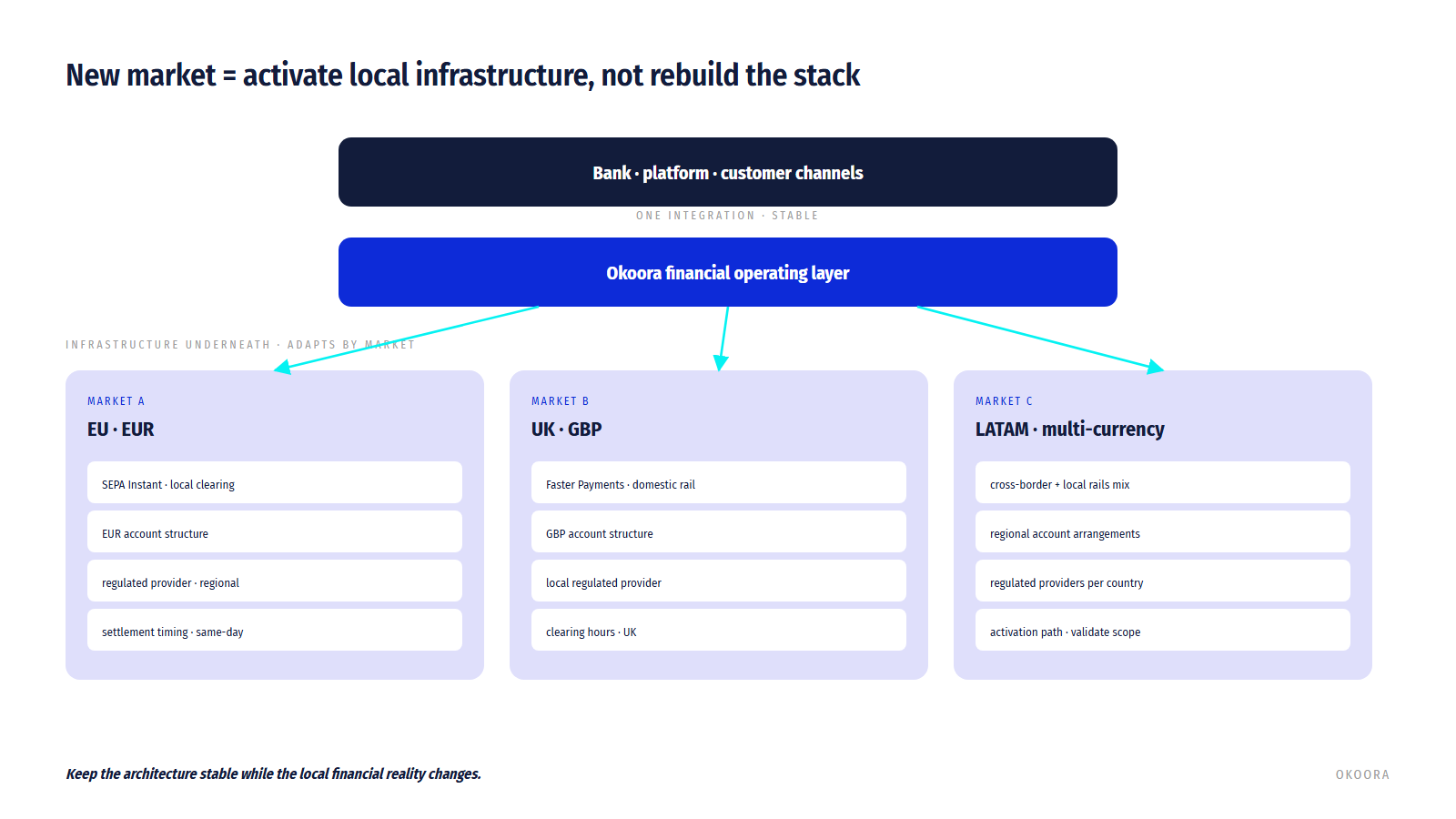
The mistake is assuming that local variation requires a completely separate financial architecture. A bank or platform can preserve one operating and integration layer while allowing the infrastructure underneath to adapt by market.
Local financial infrastructure is genuinely local
Cross-border and domestic payment systems remain fragmented across jurisdictions. Different markets use different clearing arrangements, operating hours, data requirements and provider structures. The global policy direction is toward more interoperability, but the practical reality is still that financial institutions must deal with local infrastructure.
That local complexity should be acknowledged rather than hidden. The architectural question is where the complexity lives.
The customer experience should not have to mirror the local infrastructure
A bank may want customers in several markets to experience the same brand, similar product logic and consistent operating rules. The payment rail underneath does not need to be identical for the customer experience to remain coherent.
One market may use one local clearing path. Another may require a different account model or provider. A third may rely more heavily on cross-border infrastructure. If those differences sit beneath a shared operating layer, the bank can preserve the product experience while adapting the financial plumbing.
One integration can become the stable layer
The integration between the bank and the financial operating layer can remain stable even when local infrastructure changes underneath. The bank continues to send and receive the information needed for FX, payments, accounts, settlement, reconciliation, pricing and status. The operating layer manages the market-specific provider and rail configuration.
This reduces the need to create a new integration architecture every time the bank enters a new country.
Local capability and local legal structure are different questions
A market may support local receiving, local outgoing payments or local currency holding without every product using the same domestic account or regulated structure. The exact account, IBAN, settlement or provider arrangement can vary by jurisdiction and deployment.
This distinction matters because banks should design around the functional customer capability they need while validating the regulated and provider structure required to deliver it in each market.
Policy can remain consistent while execution changes
The bank's product and commercial policy should not be rewritten simply because the underlying route changes. Customer eligibility, pricing logic, transaction controls, approval rules and product behavior can remain governed by the bank's operating model.
The market-specific layer determines which providers, rails and account structures can execute those rules locally. That creates a clean separation between global product logic and local financial infrastructure.
Expansion becomes activation, not re-platforming
With a shared foundation, geographic growth can become a process of adding market-specific capability underneath the existing architecture. The bank validates local accounts, payment rails, FX support, settlement and regulated providers, then activates the agreed scope.
This is materially different from launching a separate stack. The core operating context, integration patterns, policy and customer model can be reused while the local dependencies are validated.
This matters for product expansion too
The same architectural principle applies beyond geography. A bank can start with FX and payments, then add accounts, collections, hedging, liquidity or deeper SME financial capabilities on the same foundation. The more of the operating context that is reusable, the easier it becomes to expand without repeatedly rebuilding the product and integration layer.
Where Okoora fits
Okoora provides one embedded financial operating layer while the underlying accounts, payment rails, FX infrastructure, settlement structures and financial providers can vary by market. The bank keeps the customer relationship, channels and commercial policy. Okoora adapts the financial infrastructure underneath according to the agreed deployment.
The objective is not to make every country identical. It is to keep the architecture stable while the local financial reality changes.
Next step: See how Okoora can keep one embedded operating layer above market-specific accounts, payment rails, FX, settlement and financial providers.
Related reading: How to Choose Between Banks, Payment Providers and Local Rails for Cross-Border Payments, Why Banks Should Build Financial Products on One Infrastructure Layer, Not One Integration at a Time.