 Benjamin AvrahamCEO
The product idea is usually simpler than the infrastructure behind it
A financial institution, fintech or platform can spot a useful product opportunity very quickly. A business customer needs to pay a supplier abroad. A marketplace wants to hold balances in several currencies. A software platform wants to offer FX conversion inside its workflow. A travel business wants to protect a price between booking and settlement.
The customer proposition can be easy to explain. The difficulty begins underneath. A single financial experience may depend on accounts, wallets, ledgers, pricing, liquidity, execution, payment rails, settlement, reconciliation, controls, approvals, reporting and operational support.
That creates a strategic choice. Build the underlying financial stack piece by piece, send the customer to external providers, or use infrastructure that already operates the required financial capabilities as one system.
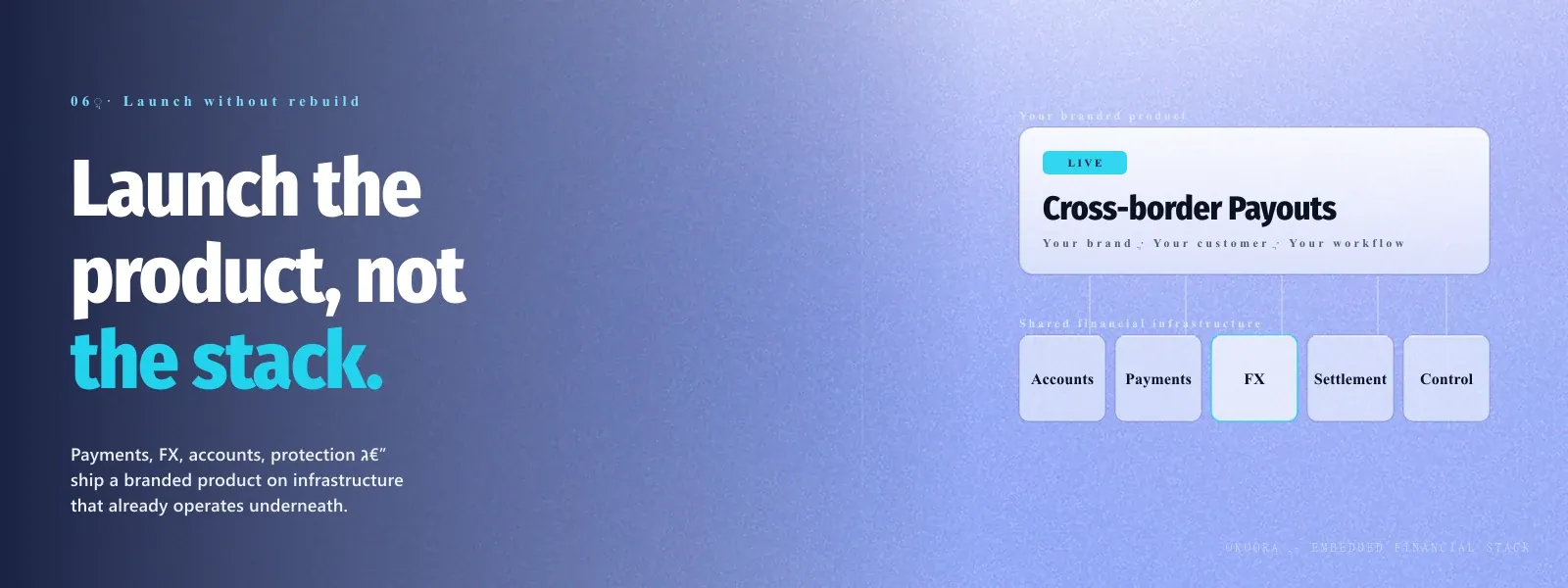
For many institutions, the strongest model is the third one: own the product, customer and economics while using a financial infrastructure layer underneath.
Start with the customer job, not the infrastructure diagram
The first question should not be, “Which APIs do we need?” It should be, “What financial job should the customer be able to complete inside our product?”
For a business payments product, the job may be simple: choose a beneficiary, enter an amount and currency, receive a quote, authorize the transaction and know when the payment is complete. For an embedded hedging product, the job may be to lock the economics of a future transaction at the moment the customer commits to it. For a multi-currency product, the job may be to receive, hold, convert and move value without leaving the platform.
Once the job is clear, the required infrastructure becomes easier to define. The customer flow determines which financial capabilities must sit underneath it, which decisions remain with the institution, and which components need to operate in real time or on a recurring basis.
One simple customer action may trigger an entire financial system
Consider an international supplier payment inside an existing business product. The customer may experience only a few steps: select the recipient, enter the amount, accept the quote and confirm.
Underneath, the system may need to validate the beneficiary, determine the settlement route, price the currency conversion, authorize the funding method, execute FX, move funds, reconcile the transaction, update status, handle exceptions and preserve the audit trail.
The quality of the product depends on those components behaving like one system. If each capability is isolated, the institution inherits the work of coordinating them. The customer may see a simple interface while the operator manages a growing web of separate vendors, data models, failure states and reconciliations.
The infrastructure decision therefore affects more than time to market. It affects product reliability, operational ownership, customer experience and how easily the product can expand later.
The institution should own five things
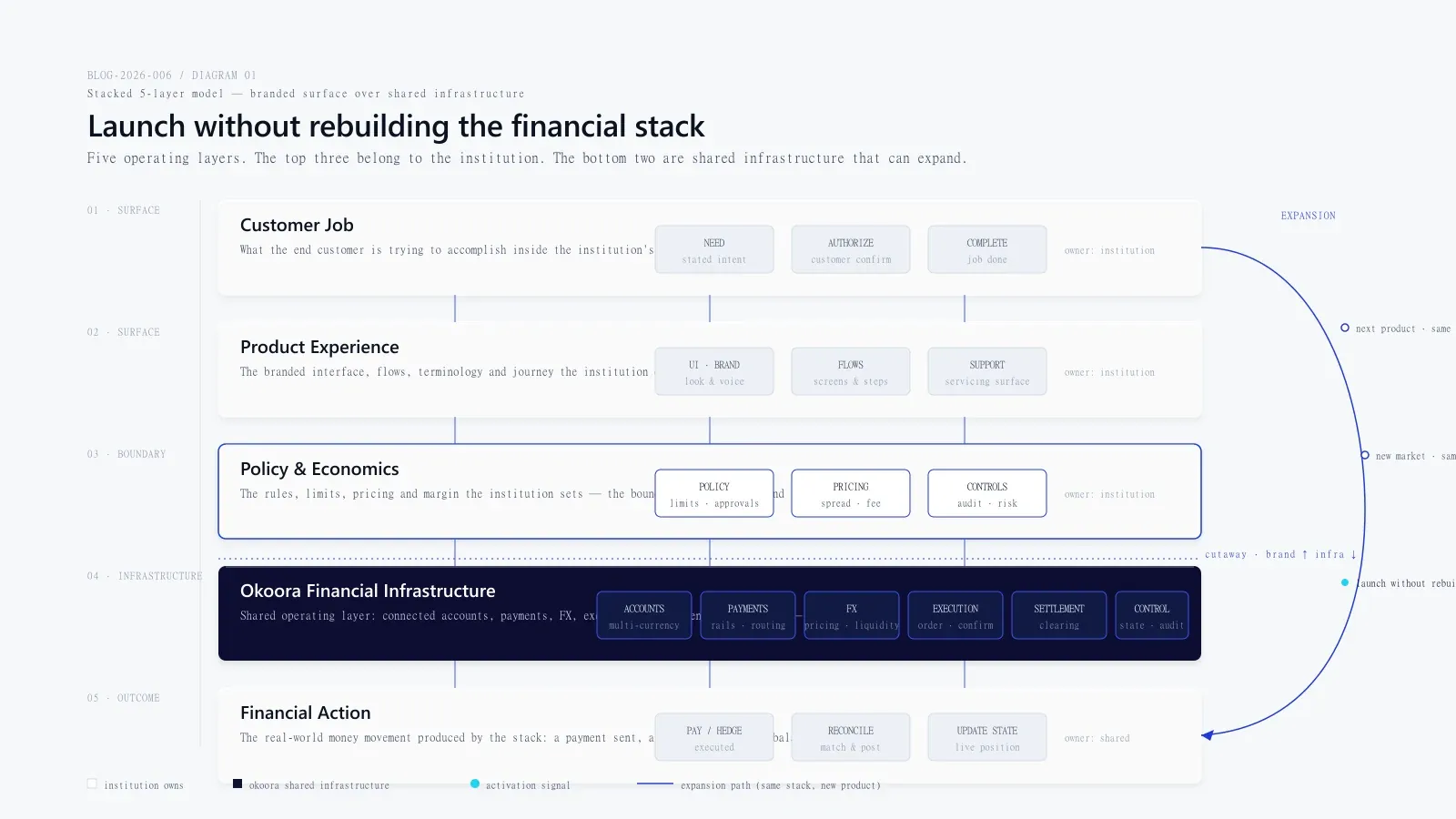
Using external infrastructure does not mean outsourcing the product. The institution should remain in control of the parts that define the commercial relationship.
First, the customer. The financial capability should live inside the relationship the institution already owns.
Second, the experience. The customer should interact with the institution’s product and brand, not be pushed into a fragmented journey.
Third, the policy. The institution defines what customers can do, which actions require approval, what limits apply and where exceptions stop the flow.
Fourth, the economics. Pricing, fees, margin structure and the value shared with the customer should belong to the commercial design of the product.
Fifth, the product roadmap. The institution should be able to expand from the first use case into adjacent financial capabilities without redesigning the operating model every time.
The infrastructure layer should operate the financial depth
What sits underneath should be designed around financial operation, not around exposing as many APIs as possible.
Depending on the use case, the infrastructure may need to operate accounts or wallets, payment initiation and settlement, FX pricing and execution, liquidity, protection instruments, transaction status, reconciliation, controls and data connectivity.
The critical requirement is that these capabilities remain connected. Pricing should connect to execution. Execution should connect to settlement. Settlement should update state. Controls should apply across the workflow. Exceptions should be visible without reconstructing the transaction manually.
Okoora is built for this layer. It operates financial activity across accounts, payments, FX, exposure and money flows, connecting intelligence, infrastructure, execution and control underneath the customer-facing product.
Do not start by rebuilding everything
A common mistake is to turn a new product idea into a broad infrastructure program before the first customer flow is proven.
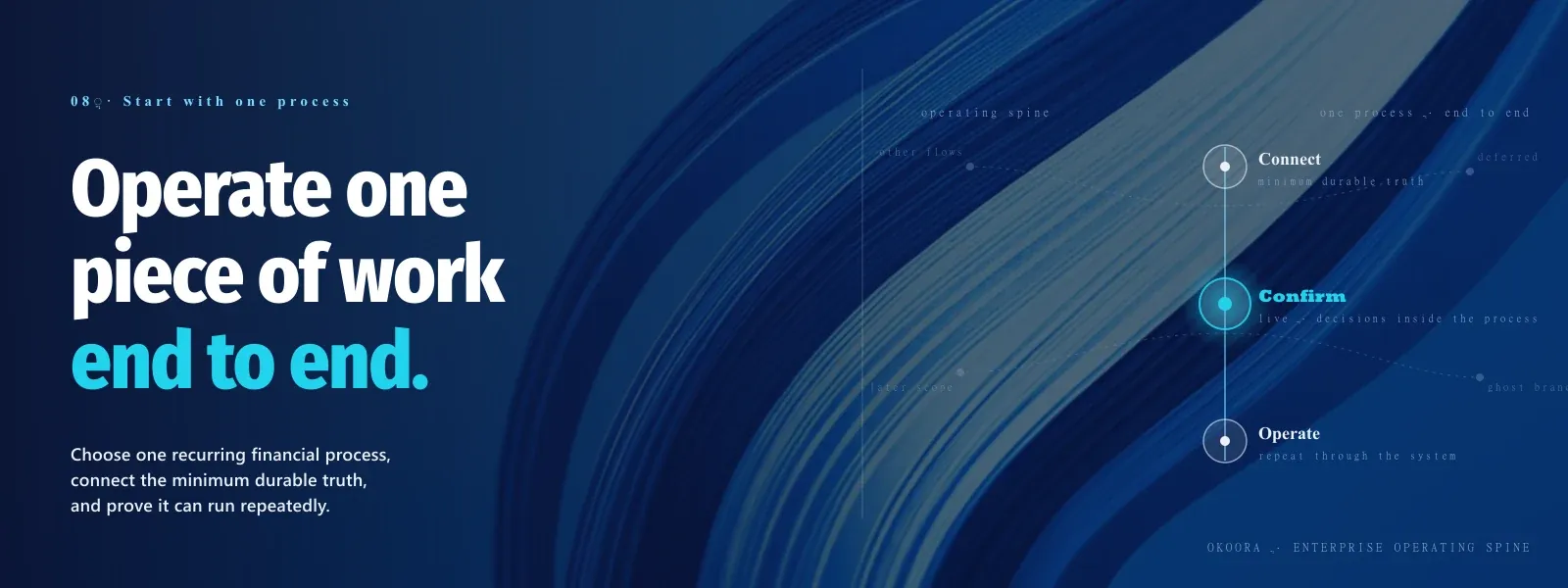
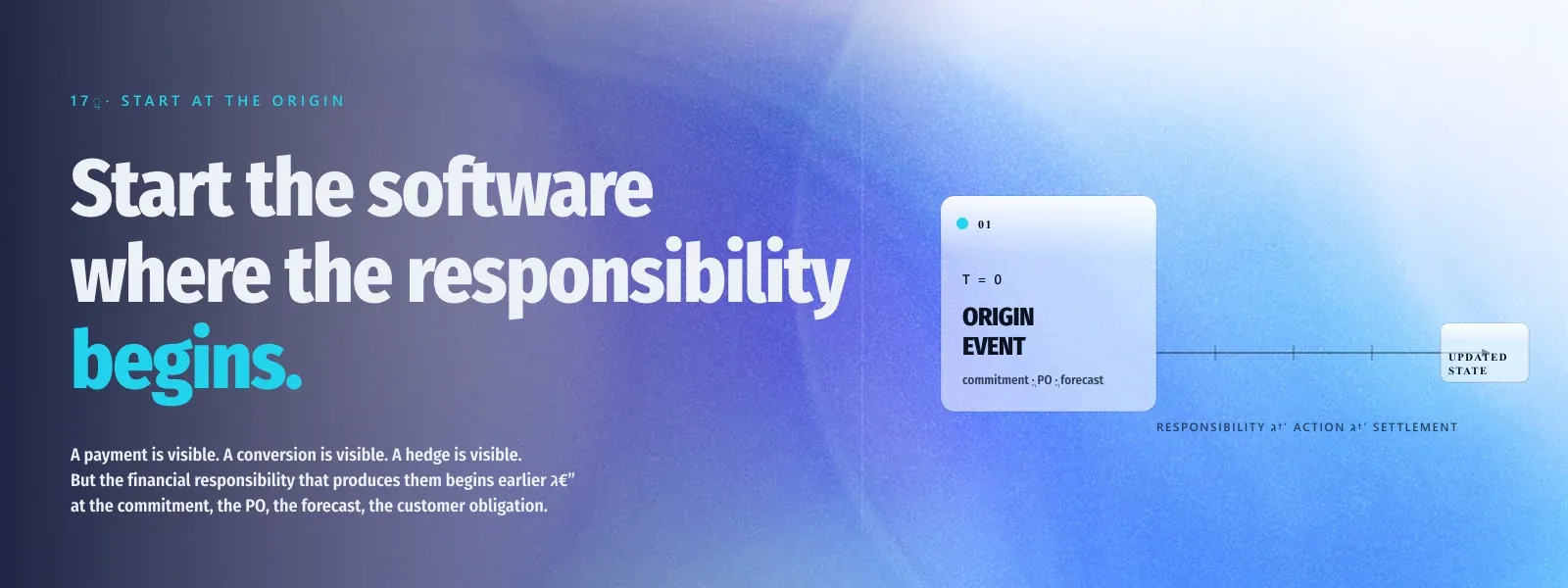
A better starting point is one bounded financial job with meaningful commercial value. Define the customer event that starts it, the action that should be completed, the data required to operate it, the policy boundary, the financial capabilities underneath and the completion state.
Then connect only what the first product requires. A new international payment product may not need every account capability on day one. An embedded hedging product may first need selected currencies, pricing, execution and settlement rather than a full treasury stack. A payout product may begin with one transaction population before expanding into broader balance and payment use.
This creates a faster and more disciplined build path: narrow product scope, deep operational completeness.
Choose infrastructure by operating responsibility, not by feature count
Feature checklists can make infrastructure providers look similar. The harder questions are operational.
Who is responsible for pricing when the market moves? What happens when a payment fails after authorization? How are cancellations, refunds or amendments handled? Which party owns liquidity and settlement? How are limits and approvals enforced? What data remains authoritative? How does reconciliation work? What happens when a transaction needs manual review?
For products involving FX or hedging, the questions go deeper. Does the provider support the required currencies and corridors? Can it provide the necessary instruments? Does the flow require streaming prices, RFQ or API quotes? Are exposures hedged transaction by transaction, aggregated, or both? What settlement cycles, prefunding or credit structures are required?
These questions reveal whether a provider is simply exposing a capability or can actually operate the financial process behind the product.
A good architecture keeps the product brand in front and the financial complexity underneath
The customer should not need to understand the infrastructure map.
They should see a product that belongs naturally inside the institution they already use. The platform, bank, insurer, card issuer or software company remains the visible provider. The underlying financial layer stays behind the experience and operates the complexity required to make the action work.
This is especially important when the institution is using the new capability to deepen an existing customer relationship. Sending the customer to another provider gives away part of the experience, the data and potentially the economics. Embedding the capability keeps those elements inside the product.
Build the first product so it can become a system
The first use case matters, but the larger advantage comes from what can follow.
A business payment product can later add multi-currency balances, local collection, smarter FX pricing or protection. A payout experience can expand into payments and currency activity. An embedded hedging product can add currencies, corridors, settlement options or additional execution sources.
That expansion is much easier when the first capability already sits on a financial infrastructure layer that shares state, controls, connectivity and execution across products.
The result is not a collection of disconnected features. It is a growing financial product surface operating on one underlying system.
The practical decision
When evaluating a new financial product, the central build-versus-buy question is not whether your team can technically create each component.
It is whether rebuilding the full financial stack is the best use of time, capital and operational attention when the commercial advantage may sit somewhere else: customer ownership, distribution, product design, policy, data and the economics of the relationship.
If those are the assets you want to own, the infrastructure underneath should help you move faster without giving up control of the product.
Own the customer. Own the experience. Own the policy and economics. Let the financial infrastructure operate the depth underneath.
NEXT STEP See how Okoora helps you launch financial capabilities under your brand without rebuilding the full financial stack.
Related reading: How Financial Institutions Can Turn Existing Customer Activity Into New Revenue, How to Find the First Financial Activity Worth Turning Into an Embedded Product, How Existing Customer Payouts Can Become New Financial Products.