 OkooraEditorial Team
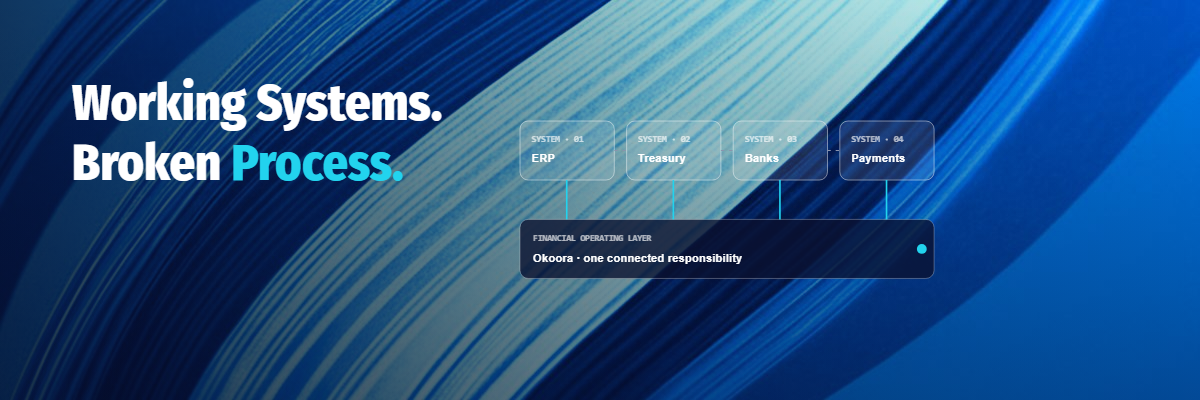
The systems can be fine. The process can still be broken.
A company can have a capable ERP, strong banking relationships, a treasury process, a payment system and experienced finance people. Every component can work. Yet the end-to-end financial job can still depend on people moving information from one place to another, rebuilding context and deciding what the next step should be.
This is one of the most common forms of fragmentation in enterprise finance. The problem is not that a system is missing. The problem is that responsibility disappears at the boundaries between systems.
ERP knows the business event, but not always the whole financial decision
The ERP may know that an order exists, an invoice was posted or a liability is due. That is essential information. But the next financial action can depend on facts that live elsewhere: current cash, currency balances, existing hedges, bank limits, funding alternatives, live market prices, payment routes and company policy.
The ERP is therefore part of the truth, but not the entire operating context. Finance still needs to assemble the financial meaning around the business event.
The bank knows its relationship, not the whole company context
A bank can provide pricing, liquidity, credit and payment infrastructure. It can be an excellent partner. But the bank typically sees the transaction presented to it, not every internal commitment, policy rule, competing provider, future cash requirement or business change inside the company.
That means the bank can execute its part perfectly while the company still needs a layer that decides whether this is the right action, at the right time, through the right provider, under the right policy.
The payment system knows how to move money, not why the money should move
A payment system can validate beneficiaries, generate instructions, apply approvals and track status. But the payment obligation usually began earlier. It began with an order, invoice, contract, payroll requirement or another business event.
If the financial context is lost between the source event and the payment instruction, Finance may have to reconstruct why the payment exists, which currency should fund it, whether conversion is required, whether the selected bank is appropriate and what evidence closes the process afterward.
Manual handoffs become the hidden operating layer
When systems do not carry context across boundaries, people fill the gap. Someone exports a file. Someone updates a spreadsheet. Someone emails Treasury. Someone requests a bank quote. Someone re-enters payment information. Someone checks whether the supplier was paid. Someone stores the evidence.
These actions are often invisible when companies evaluate their technology stack because no single step looks dramatic. Together, they form a large human operating layer that sits between otherwise capable systems.
Fragmentation creates repeated decisions
The cost is not only manual effort. Context has to be rebuilt again and again. Treasury asks what the payment is for. AP asks which bank should be used. The controller asks whether the transaction is complete. The same facts move through meetings, messages and spreadsheets because the responsibility does not remain connected from the original event to the final record.
A durable financial process should not require the organization to rediscover the same context at every stage.
The missing layer is persistent financial responsibility
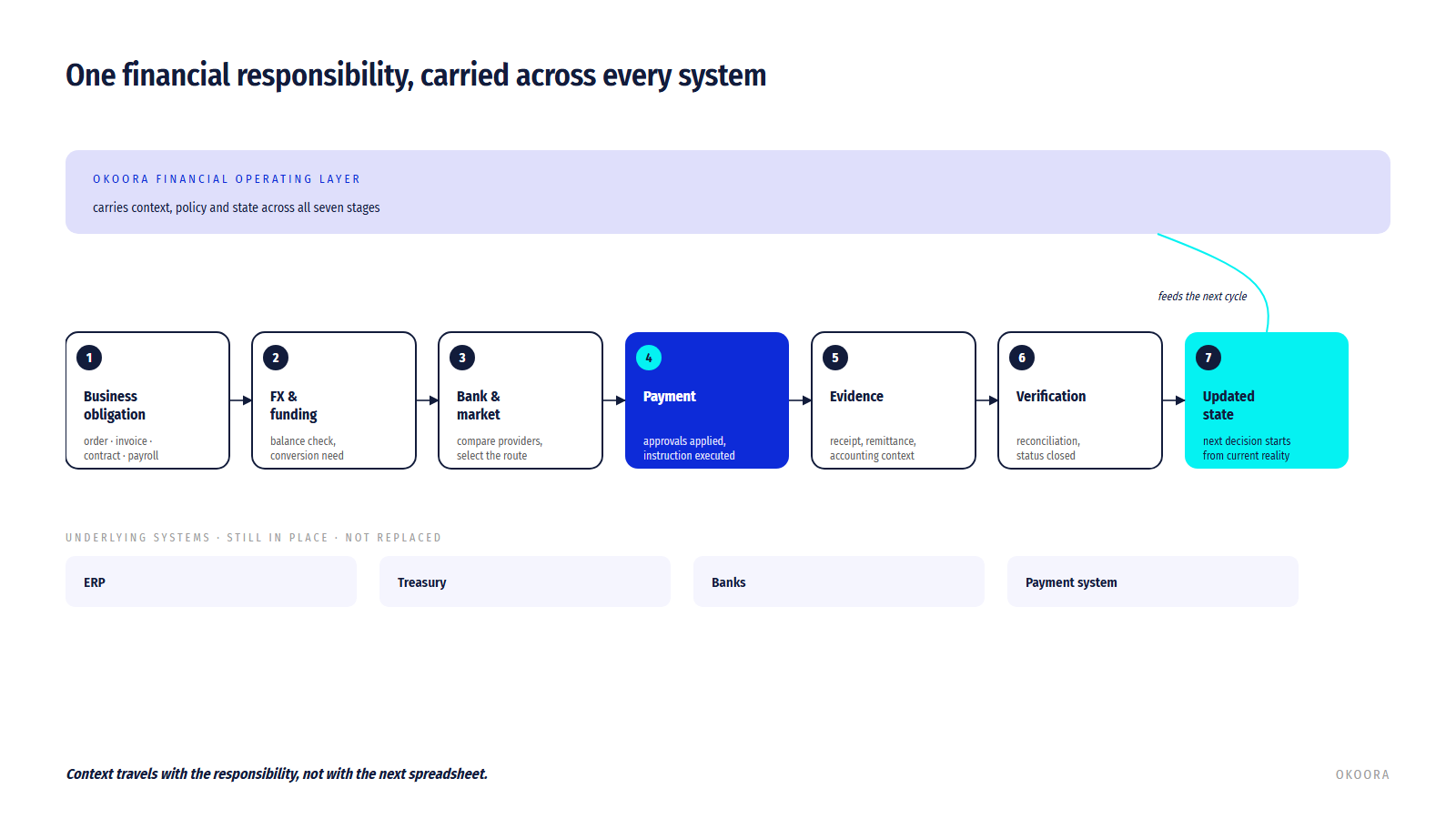
The financial job should carry its own context as it moves. The obligation, amount, currency, timing, funding requirement, market alternatives, policy, approval, payment, evidence and verification should remain connected to the same underlying responsibility.
That does not require replacing the ERP, bank or payment system. It requires an operating layer that sits above and between them, preserving the state and advancing the work as each external system performs its part.
This is why integration alone is not enough
Connecting systems technically is important, but an API connection does not automatically create an operating model. Data can move between systems while responsibility remains fragmented.
The higher-value question is what the combined data means and what action should happen next. Has the obligation changed? Is there enough currency available? Does policy allow the route? Does the transaction require approval? Has execution completed? Did the result return into the current financial state?
The operating layer needs to convert connected data into connected financial work.
A closed loop changes the economics of the process
An end-to-end flow can begin with the business obligation and continue through financial preparation, market or provider choice, approval, execution, evidence and verification. The result then returns to the financial state so the next decision starts from updated reality.
That closed loop reduces manual reconstruction and creates a stronger basis for automation. It also gives management a clearer view of where work is complete, where it is blocked and which exceptions require attention.
Where Okoora fits
Okoora is designed to sit above existing enterprise systems and financial providers as a financial operating layer. The ERP can remain. The banks can remain. The payment system can remain. Okoora carries the financial context and recurring responsibility across them.
The objective is not to replace what already works. It is to stop making people rebuild the financial process between systems that work individually.
Next step: See how Okoora can carry financial context and responsibility across ERP, treasury, banks, payments, evidence and the updated financial state.
Related reading: How to Build One Financial Operating Layer Above Multiple ERPs and Banks, From Purchase Commitment to Payment: Operating the Financial Lifecycle as One System.