 OkooraEditorial Team
A bank is both a financial provider and a financial enterprise
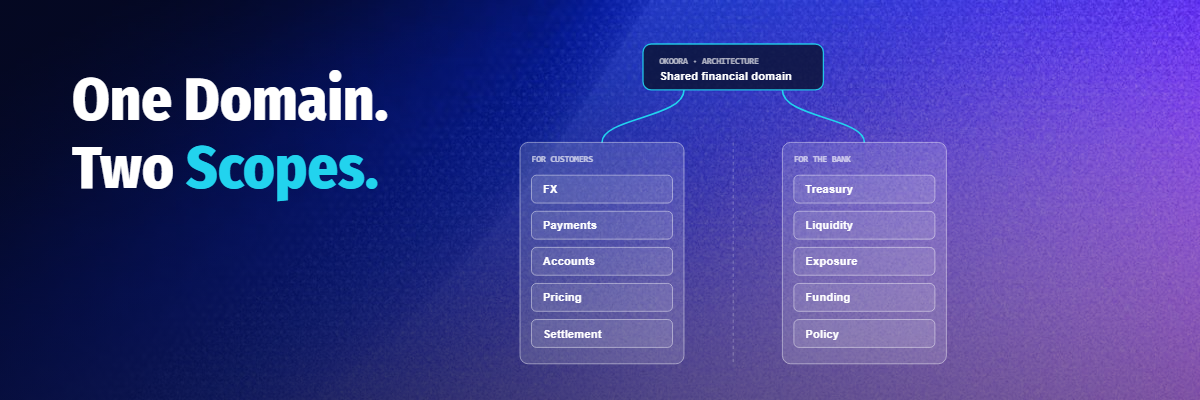
A bank has two very different financial responsibilities. It provides financial products to customers, and it also operates its own treasury, liquidity, funding, exposure, policy, controls and financial state.
These are usually treated as separate technology worlds. Customer-facing FX, payments and accounts sit in one architecture. Treasury tools, market access, liquidity and internal controls sit in another. Yet much of the financial domain underneath them is shared.
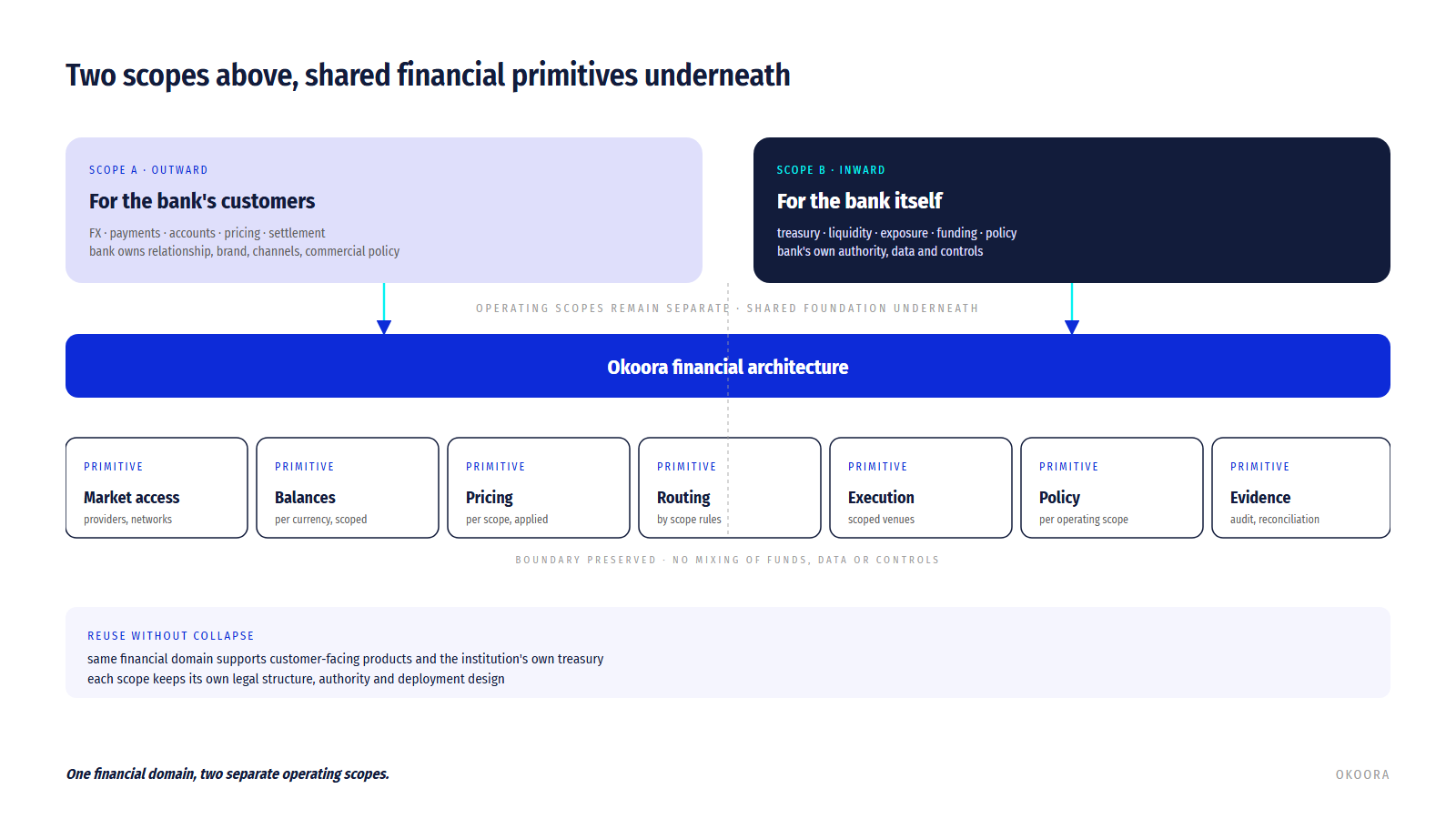
The customer side needs infrastructure and economics
For customers, the bank may need FX pricing and execution, local and cross-border payments, accounts, collections, settlement, reconciliation and customer-level pricing. The bank owns the relationship, brand, channels and commercial policy. The infrastructure underneath needs to make those products operable and economically attractive.
The goal is to give customers useful financial capability while preserving the bank's control of the proposition.
The bank's own side needs financial operating depth
Inside the institution, Treasury faces another set of responsibilities: liquidity position, funding requirements, currency exposure, market access, execution quality, policy, limits, reconciliation and oversight. These are not customer products. They are the bank's own financial operations.
The important insight is that both scopes rely on similar financial primitives: balances, currencies, liquidity, pricing, market alternatives, execution, settlement, policy, control and evidence.
A shared financial domain can support both without collapsing them
Using the same financial architecture does not mean mixing customer funds, internal treasury positions or regulated responsibilities. The operating scopes remain distinct. Customer-facing products have their own legal, regulatory and product structure. Internal Treasury has its own authority, data and controls.
The architectural opportunity is to reuse the financial domain, connectivity and operating logic where appropriate while preserving the boundaries required by each scope.
Market access can be valuable on both sides
Customer products may need access to banks, liquidity providers, payment rails and execution venues. Treasury may need the same types of market connectivity for its own FX, funding or execution decisions.
A common network and orchestration layer can reduce duplication while still applying different policies, pricing logic and permissions to each operating scope.
Financial intelligence also transfers
The bank may use financial intelligence outward to price a customer transaction, select a payment route or determine which product is relevant. Internally, similar intelligence can help Treasury evaluate exposure, liquidity, funding or execution alternatives.
The questions differ, but the domain logic is related. What is the current financial state? Which market alternatives are available? Which policy applies? What action is permitted? What changed after execution?
This can improve product expansion
A bank that already has an infrastructure relationship for customer-facing FX and payments may be able to extend the same foundation into deeper SME capability. Separately, it may choose to use the same financial domain for its own internal treasury workflows.
The advantage is not that every new scope is automatically included. Each needs its own solution design, controls and commercial structure. The advantage is that the institution does not need to build an entirely unrelated financial foundation for every new responsibility.
It also creates a stronger architecture conversation
When a bank evaluates an infrastructure provider only for one immediate customer product, it can miss the larger strategic value. The more useful question is whether the architecture can support additional customer capabilities, additional markets and deeper internal financial work over time.
That does not mean choosing a platform based on hypothetical future promises. It means evaluating whether the underlying financial domain is broad, connected and extensible enough to support more responsibility when the bank decides to activate it.
Where Okoora fits
Okoora provides a financial intelligence, operating and infrastructure layer that can support both customer-facing financial capabilities and the institution's own financial operations as distinct scopes.
For customers, Okoora can operate infrastructure behind FX, payments, accounts, routing, pricing, settlement and reconciliation. For the institution itself, the same financial domain can support treasury, liquidity, exposure, funding, policy, market and execution decisioning.
The bank retains the customer relationship and its internal authority. Each scope is designed and governed separately. The shared value sits in the financial foundation underneath.
Next step: See how Okoora can support customer-facing financial products and the institution's own treasury operations on the same underlying financial architecture.
Related reading: Why Financial Infrastructure Should Help Banks Make More Money From Existing Customers, How Banks Can Expand Into New Markets Without Rebuilding the Financial Stack, Why Banks Should Build Financial Products on One Infrastructure Layer, Not One Integration at a Time.